
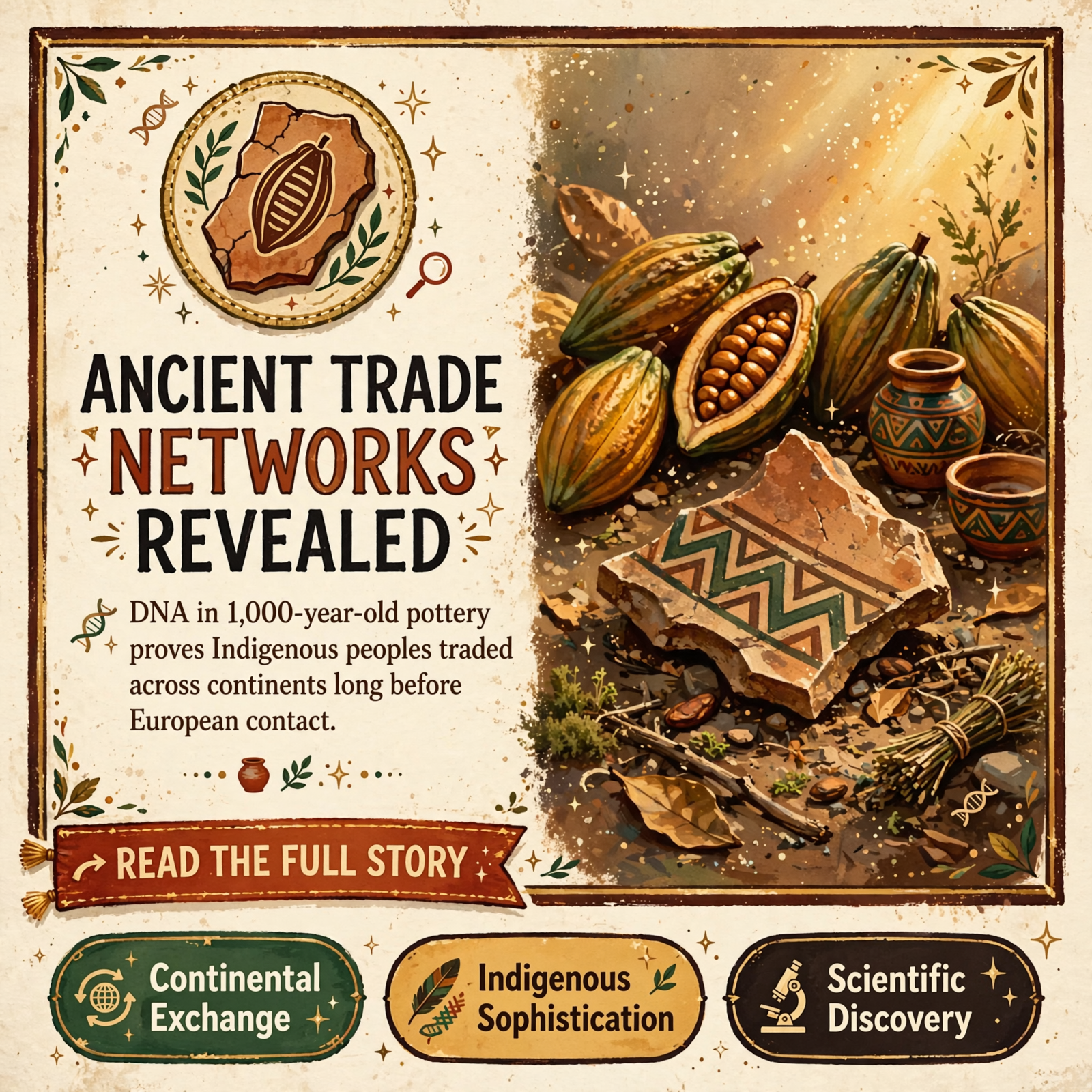
🏺 Ancient Cacao DNA Found in 1,000-Year-Old Georgia Pottery Reveals Mississippian Trade Networks
A groundbreaking archaeogenomic discovery at the Etowah Indian Mounds in northern Georgia has revealed that Indigenous Mississippian peoples were trading with distant Mesoamerican societies nearly a thousand years ago-long before European contact. The finding reshapes how regional historians and community members understand the sophistication and reach of pre-Columbian Native American networks.
🔬 The Discovery: Ancient DNA Confirms Cacao in the Southeast
Researchers analyzing 1,000-year-old pottery fragments from the Etowah Indian Mounds have confirmed the presence of cacao DNA (Theobroma cacao) trapped within the clay matrix. This represents a significant leap beyond earlier chemical analysis, which could only detect caffeine and theobromine markers-compounds that could have come from either cacao or yaupon holly, a native Southeastern plant used to make a ceremonial beverage known as the “Black Drink.” Genomic sequencing provided definitive proof: the pottery contained actual cacao. 🍫
📍 Why This Matters to the Region
Cacao trees cannot survive in the temperate climate of northern Georgia. The presence of cacao at Etowah-located in Putnam County, Georgia, on the Cumberland Plateau edge-demonstrates that Mississippian societies maintained expansive, long-distance trade routes reaching deep into Mesoamerica or Central America. For residents of the Sequatchie Valley and nearby plateau communities, this discovery underscores a profound truth: the region’s Indigenous ancestors were not isolated but were part of sophisticated continental networks of exchange, knowledge, and culture.
🎭 Sacred Rituals and Elite Exchange
The cacao-bearing pottery sherds were excavated from ritual feasting pits associated with the construction of Etowah’s first ceremonial earthen mound. This context suggests that cacao was not a common trade good but an elite, sacred beverage reserved for large-scale communal gatherings and ceremonial occasions. The discovery reveals how Mississippian leaders used rare, distant goods to reinforce social bonds, mark important events, and demonstrate their connection to broader networks of power and prestige. ✨
🌍 What This Reveals About Pre-Columbian America
For centuries, European contact has been framed as the moment when the Americas “opened up” to the wider world. This discovery challenges that narrative. Cacao was domesticated in South and Central America over 5,000 years ago, but its presence in Georgia 1,000 years ago proves that Indigenous peoples had already established trade routes spanning thousands of miles-routes that moved luxury goods, ideas, and cultural practices across vast distances. The Mississippian civilization was not waiting for Europeans; it was already deeply connected to continental systems of exchange.
💡 Why Local History Matters
For residents of the Sequatchie Valley, Marion County, Bledsoe County, and surrounding communities, this discovery is a reminder that the region’s Indigenous heritage runs deeper and wider than many realize. The Etowah Mounds, located in neighboring Georgia, represent a cultural landscape that extends across state lines and connects to the broader history of the Southeast. Understanding these ancient networks helps residents appreciate the sophistication, resilience, and continental reach of the peoples who lived here before European arrival.
🏛️ Community Connections and Learning Opportunities
This discovery opens doors for local schools, historical societies, and community organizations to deepen their understanding of Mississippian culture and pre-Columbian trade. Museums, educational programs, and heritage organizations throughout the region may find new ways to interpret local Indigenous history through the lens of continental networks. For those interested in regional archaeology, Native American history, or the deep roots of Southeastern culture, this research provides a tangible example of how scientific methods-in this case, ancient DNA analysis-can reveal hidden chapters of local and regional history.
❓ Questions Worth Considering
- How might this discovery change the way local schools teach about pre-Columbian Native American societies in the Southeast?
- What other trade goods or cultural exchanges might have moved along these ancient networks that we have yet to discover?
- How can regional museums and heritage organizations use this finding to help visitors understand the sophistication of Mississippian civilization?
- What does this reveal about the resilience and adaptability of Indigenous peoples in the face of environmental and social challenges?
🔮 Long-Term Implications for Regional Understanding
This archaeogenomic breakthrough has the potential to reshape how the Southeast is understood-not as a peripheral region waiting for European contact, but as a dynamic hub of continental trade, cultural exchange, and political sophistication. As more ancient DNA research is conducted on pottery and artifacts from sites throughout the Sequatchie Valley and Cumberland Plateau region, residents may discover additional evidence of these far-reaching networks. Over time, this body of research could fundamentally alter regional identity, educational curricula, and tourism narratives, helping communities recognize their Indigenous heritage as part of a larger, more complex American story.
🧵 Community Threads: Understanding the Deeper Connections
The Scholar-Community Connection: This discovery illustrates how academic research and local heritage are intertwined. Scientists working on ancient DNA analysis depend on archaeological sites and artifacts preserved by communities and institutions. In turn, residents benefit from new knowledge about their region’s past. Supporting local museums, historical societies, and educational programs strengthens this two-way relationship.
The Trade Route Legacy: The ancient cacao trade route that connected Georgia to Mesoamerica mirrors modern patterns of regional commerce and cultural exchange. Understanding that the Sequatchie Valley and Cumberland Plateau region has always been part of larger networks-whether in the Mississippian era or today-helps residents see their communities not as isolated but as natural crossroads of connection and commerce.
The Ceremonial Tradition Thread: The discovery that cacao was used in sacred feasting rituals connects to broader questions about how communities mark important moments and reinforce social bonds. While the specific rituals have changed, the human impulse to gather, celebrate, and use rare or special items to mark significance remains constant in valley communities today.
📚 What Residents Should Know
The Etowah Indian Mounds are located in Putnam County, Georgia, approximately 60 miles south of the Sequatchie Valley. The site is open to the public and includes a museum and interpretive trails. For residents interested in learning more about this discovery, the research has been published in peer-reviewed archaeological and genomic journals. Local schools and community organizations may consider inviting speakers or organizing field trips to the site to deepen understanding of Mississippian culture and pre-Columbian trade networks.
🔍 What Happens Next
As archaeogenomic research continues, scientists will likely analyze additional pottery and artifacts from Etowah and other Mississippian sites throughout the Southeast. Each new discovery may reveal additional evidence of trade goods, cultural practices, and long-distance connections. Regional museums and heritage organizations may develop new exhibits or educational programs highlighting these findings. For residents, this means ongoing opportunities to learn, engage, and deepen their understanding of the region’s Indigenous past.

0 Comments