
🚦🤖 AI Routing: Choosing Which Kid Gets the Job Before Somebody Breaks Something

Or: Why You Probably Shouldn’t Send the Same Whippersnapper to Mow the Yard, Do the Taxes, and Rebuild the Transmission
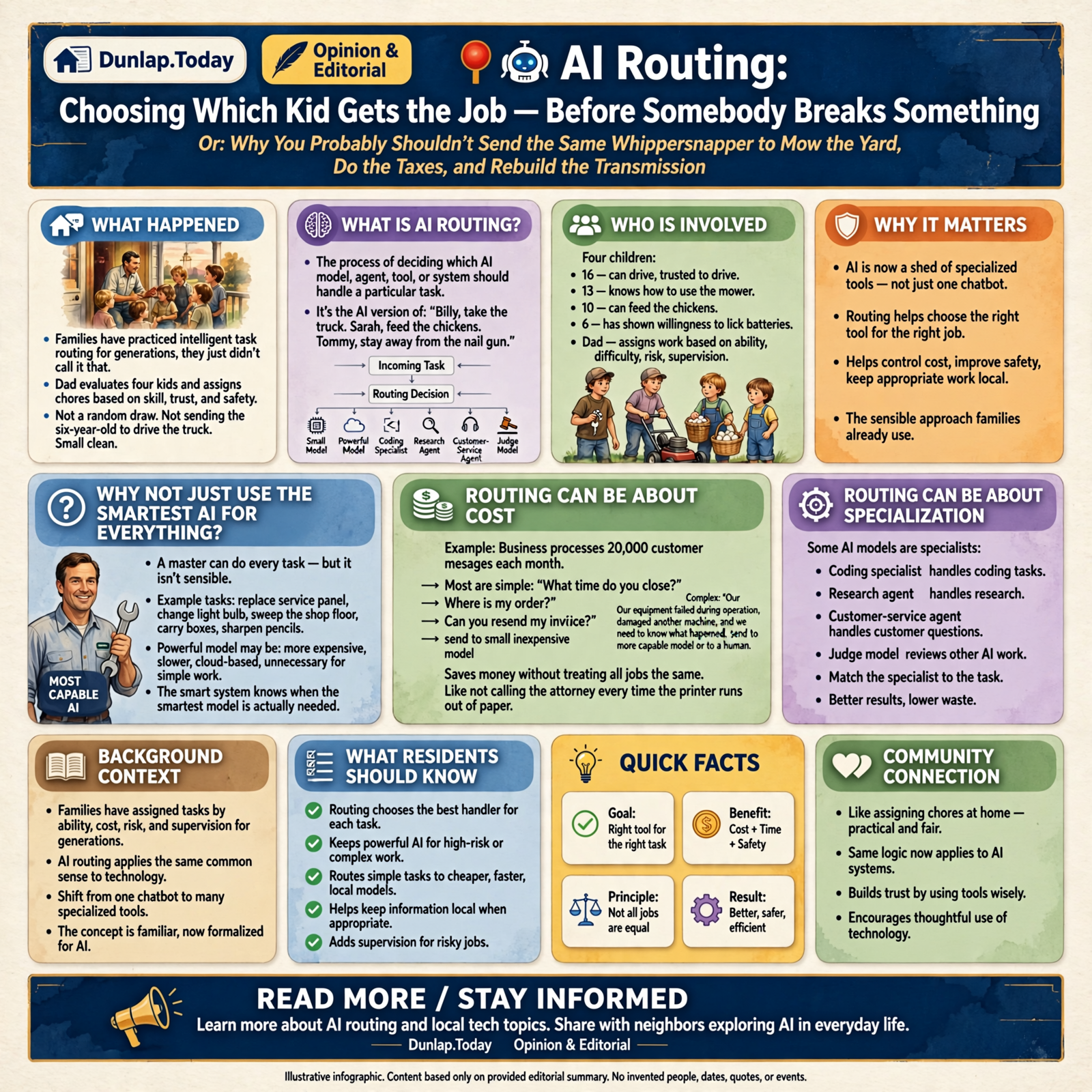
Families have been practicing intelligent task routing for generations.
They simply did not call it that.
Suppose you have four children standing around the house.
One is sixteen and can drive.
One is thirteen and knows how to use the mower.
One is ten and can feed the chickens.
One is six and has recently demonstrated an unusual willingness to lick batteries.
Dad announces:
“We’ve got chores.”
He does not place all four names in a hat.
He does not send the six-year-old to town in the pickup because fairness demands equal opportunity.
He considers:
- who can do the job,
- who can be trusted with the equipment,
- how difficult the job is,
- how expensive a mistake would be,
- and whether somebody needs supervision.
Then he assigns the work.
Computer scientists have apparently discovered this idea.
They call it AI routing.
And as artificial intelligence becomes less like one chatbot and more like a whole shed full of specialized tools, routing may become one of the most important ideas ordinary people need to understand.
🚦 What Is AI Routing?

AI routing is the process of deciding which AI model, agent, tool, or system should handle a particular task.
That definition sounds simple because the idea is simple.
Suppose you have access to:
- a small local AI model,
- a powerful cloud model,
- a coding specialist,
- a research agent,
- a customer-service agent,
- and a judge model that reviews other AI work.
When a new task arrives, somebody—or some software—needs to decide:
“Who gets this one?”
That decision is routing.
It is the artificial-intelligence version of standing in the barn doorway and saying:
“Billy, take the truck. Sarah, feed the chickens. Tommy, stay away from the nail gun.”
🧠 Why Not Just Use the Smartest AI for Everything?

This is the obvious question.
If one AI model is the most capable, why not send every job to it?
Sometimes that makes sense.
Often it does not.
Imagine hiring a master electrician to:
- replace a service panel,
- change a light bulb,
- sweep the shop floor,
- carry boxes,
- and sharpen pencils.
The electrician can probably perform every task.
That does not mean this is a sensible use of the electrician.
The same principle applies to AI.
A very powerful model may be:
- more expensive,
- slower,
- located in the cloud,
- unnecessary for simple work,
- or inappropriate for information that should remain local.
The smartest system is not necessarily the one that uses the smartest model every time.
It may be the one that knows when the smartest model is actually needed.
💵 Routing Can Be About Cost

Suppose you run a business that processes 20,000 customer messages each month.
Most are simple.
Examples:
“What time do you close?”
“Where is my order?”
“Can you resend my invoice?”
A small inexpensive model may handle these perfectly well.
But once in a while a message arrives saying:
“Our equipment failed during operation, damaged another machine, and we need to know what happened.”
That is not the same chore.
A routing system could send:
- ordinary questions to a cheaper model,
- complex problems to a more capable model,
- and high-risk situations to a human.
This saves money without pretending all jobs are equally easy.
It is the same reason you do not call the attorney every time the printer runs out of paper.
🎯 Routing Can Be About Specialization

Some AI models and agents are better suited to particular kinds of work.
One may be especially strong at:
- computer programming,
- mathematics,
- writing,
- images,
- speech,
- document analysis,
- or classification.
Routing allows the system to recognize the type of problem and choose accordingly.
If the question is:
“Why won’t this computer program compile?”
send it to the coding specialist.
If the question is:
“What is happening in these 2,000 invoices?”
send it to the data-analysis system.
If the question is:
“Turn this into a photograph of a rooster driving a forklift,”
we have apparently reached the image department.
A good shop uses different tools because different tools are good at different jobs.
🔐 Routing Can Be About Privacy

Our earlier articles discussed local and cloud AI.
This is where that distinction becomes practical.
Suppose a task contains:
- private financial information,
- customer records,
- employee information,
- confidential designs,
- or sensitive internal documents.
A business might establish a rule:
“This type of information stays local.”
The router sees the task and sends it to a local model.
Another task asks:
“Research current public information about a new technology.”
That may be routed to a cloud system with strong research capabilities.
The router is not merely choosing the smartest AI.
It is enforcing where different kinds of work are allowed to happen.
That is more like a foreman than a search box.
⚡ Routing Can Be About Speed

Sometimes you do not need the best possible answer.
You need a good enough answer immediately.
Suppose a factory system is classifying incoming records every second.
Sending every item to a large, slow model may create a traffic jam.
A small fast model may handle most items.
Only uncertain cases get escalated.
This creates a useful pattern:
easy work stays on the fast lane.
hard work takes the exit ramp.
That is routing.
The family equivalent is:
“If the gate is simply unlatched, close it. If the whole fence is down, come get me.”
📊 Routing Can Be About Confidence

Sometimes an AI system can estimate whether a task appears easy or difficult.
Imagine a small model examining a document.
It says:
“This is clearly an invoice.”
The system accepts the result.
Then another document arrives.
The model says:
“This might be an invoice, but it could also be a purchase order.”
Now the router may escalate it to:
- a stronger AI model,
- a specialized document model,
- or a human.
This is a useful principle:
do not spend expensive intelligence on easy certainty.
Spend it where uncertainty begins.
🧑⚖️ Judge Models Can Help With Routing

In the previous article, we discussed AI judge models—systems that evaluate the work of other AI systems.
A judge can become part of a routing process.
For example:
- A small model handles the task.
- A judge checks the result.
- If the result passes, the job ends.
- If the result is weak, the router sends the task to a stronger model.
- If uncertainty remains high, a human receives it.
Now the judge is not merely grading homework.
It is helping decide:
“Does this need somebody more experienced?”
That is exactly what good supervisors do.
🪜 Escalation Is Just Routing With a Ladder

Businesses have used escalation for years.
A receptionist handles simple matters.
A supervisor handles harder ones.
A manager handles unusual problems.
The owner gets the call everybody hoped would never be necessary.
AI systems can work similarly.
Perhaps:
- Level 1 is a small local model.
- Level 2 is a larger local model.
- Level 3 is a powerful cloud model.
- Level 4 is a human specialist.
Each level costs more.
Each level is reserved for problems that justify it.
This is often called an escalation path.
Grandpa called it:
“Try it yourself first. If you can’t get it, come get me.”
🏠 Local-First Routing Can Be a Practical Strategy

Some organizations may choose a local-first approach.
The system begins with local AI whenever possible.
Why?
- privacy,
- low operating cost,
- low latency,
- offline capability,
- or greater control.
If the local model succeeds, the job ends.
If it struggles, the router escalates the problem.
This resembles repairing equipment in your own shop.
You start with what you have.
If the transmission requires machinery you do not own, then you call town.
You do not haul the tractor sixty miles away because a headlight bulb burned out.
☁️ Cloud-First Routing Can Make Sense Too

Other organizations may prefer cloud-first routing.
Perhaps they value:
- minimal maintenance,
- access to the newest models,
- strong general-purpose capability,
- or simplicity.
Routine requests go directly to a cloud provider.
Only special privacy-sensitive or offline tasks remain local.
Again, there is no religion here.
The right design depends on the work.
Cloud-first and local-first are strategies.
They are not personality types.
🛠️ Tool Routing Is Related but Different

Sometimes the question is not:
“Which AI model should answer?”
It is:
“Which tool should the AI use?”
Suppose you ask:
“How much did we sell last month?”
The AI might need to call the accounting system.
You ask:
“What is the weather tomorrow?”
It needs a weather source.
You ask:
“Find Invoice 1427.”
It needs document or accounting search.
This is tool routing.
The AI chooses the correct tool.
Our earlier MCP article dealt with standardized ways AI can connect to tools.
Routing answers the next question:
“Which one should I use right now?”
👥 Agent Routing Matters in Multi-Agent Systems

We recently put six AI whippersnappers on the same chore.
That article introduced multi-agent systems.
Once several agents exist, routing determines which one receives each task.
A new customer message arrives.
The router may decide:
“Sales question.”
Send it to sales.
Another arrives.
“Invoice problem.”
Send it to accounting.
Another says:
“Our machine caught fire.”
Perhaps the correct route is:
“Human. Now.”
The existence of AI does not mean every task must remain inside AI.
Humans are valid routing destinations too.
🙋 Sometimes the Correct Model Is a Person

This deserves emphasis.
When people discuss AI routing, they sometimes imagine the router choosing only among machines.
That is unnecessarily narrow.
A good system can route to:
- small AI,
- large AI,
- specialized AI,
- a software tool,
- a human reviewer,
- or a human decision-maker.
Suppose a customer asks:
“What time do you close?”
AI.
Suppose the customer says:
“Your delivery damaged our building and our attorney will contact you.”
Perhaps the routing system should stop being clever.
Some chores belong upstairs.
🚨 Risk Should Affect Routing

Not every mistake costs the same amount.
If AI misclassifies a newsletter as an advertisement, perhaps nothing terrible happens.
If AI misclassifies a major safety complaint as junk mail, that is different.
Routing can consider the consequences of being wrong.
A system might ask:
“How dangerous would a mistake be here?”
Low-risk tasks may use cheaper automation.
Higher-risk tasks may require:
- stronger models,
- more verification,
- additional evidence,
- or human review.
This is ordinary risk management.
You may let a teenager choose where to stack firewood.
You probably do not let him decide whether the foundation beam is structurally sound after watching one video.
💰 Routing Needs a Budget

Routing systems can optimize cost.
They can also accidentally create cost.
Imagine this workflow:
Small model tries.
Judge checks.
Medium model retries.
Second judge checks.
Large model retries.
Research agent gathers information.
Supervisor summarizes.
Human finally reads it.
Your $0.02 task has grown a mustache and applied for a mortgage.
Routing should have:
- per-task limits,
- daily limits,
- maximum escalation levels,
- and stopping rules.
Efficiency requires knowing not only where to send the job, but when to stop sending it anywhere.
🔄 Routing Can Create Fallbacks

Another useful routing pattern is the fallback.
Suppose your preferred AI service is unavailable.
The router may send the job to an alternate.
Or the local model may continue basic operations while the cloud service is down.
Or perhaps a smaller model handles emergency requests temporarily.
This adds resilience.
People have practiced fallback routing for ages.
If the truck does not start:
take the car.
If the car does not start:
call Earl.
If Earl does not answer:
apparently we are staying home.
A system becomes more reliable when it knows what Plan B is before Plan A fails.
📡 Routing Can Also Depend on Availability

A model may be excellent but temporarily unavailable.
A local computer may be overloaded.
A cloud service may be down.
A provider may have reached a rate limit.
The Internet connection may be unstable.
The router can consider current availability.
This is not very different from calling around town.
Your favorite mechanic says:
“I can get to it next Thursday.”
You need the truck tomorrow.
Suddenly the second-best mechanic becomes extremely attractive.
📊 Good Routing Requires Measuring Performance

You cannot route intelligently forever based on assumptions.
You need evidence.
Perhaps you assume the expensive model is better.
Then testing shows the smaller model performs equally well on 93 percent of your routine tasks.
That matters.
Perhaps you assume the local model is cheap.
Then you discover employee troubleshooting time makes it more expensive than expected.
That matters too.
A useful routing system should eventually learn from measurements such as:
- accuracy,
- success rate,
- response time,
- cost per task,
- failure rate,
- human-review rate,
- and user satisfaction.
Without measurement, routing becomes:
“I reckon Billy’s probably good at that.”
That may work.
It is not much of an operating system.
🧪 Routing Rules Should Be Tested

A routing system can make mistakes too.
Perhaps it sends:
- easy tasks to expensive models,
- sensitive tasks to inappropriate services,
- hard tasks to models that repeatedly fail,
- or unusual cases into endless escalation loops.
So routing requires testing.
Create known examples.
Send them through the router.
See where they go.
Ask:
“Would we have assigned this chore the same way?”
It is basically checking the family chore chart before discovering that the six-year-old was assigned chainsaw maintenance.
📝 Rules-Based Routing Is the Simple Version
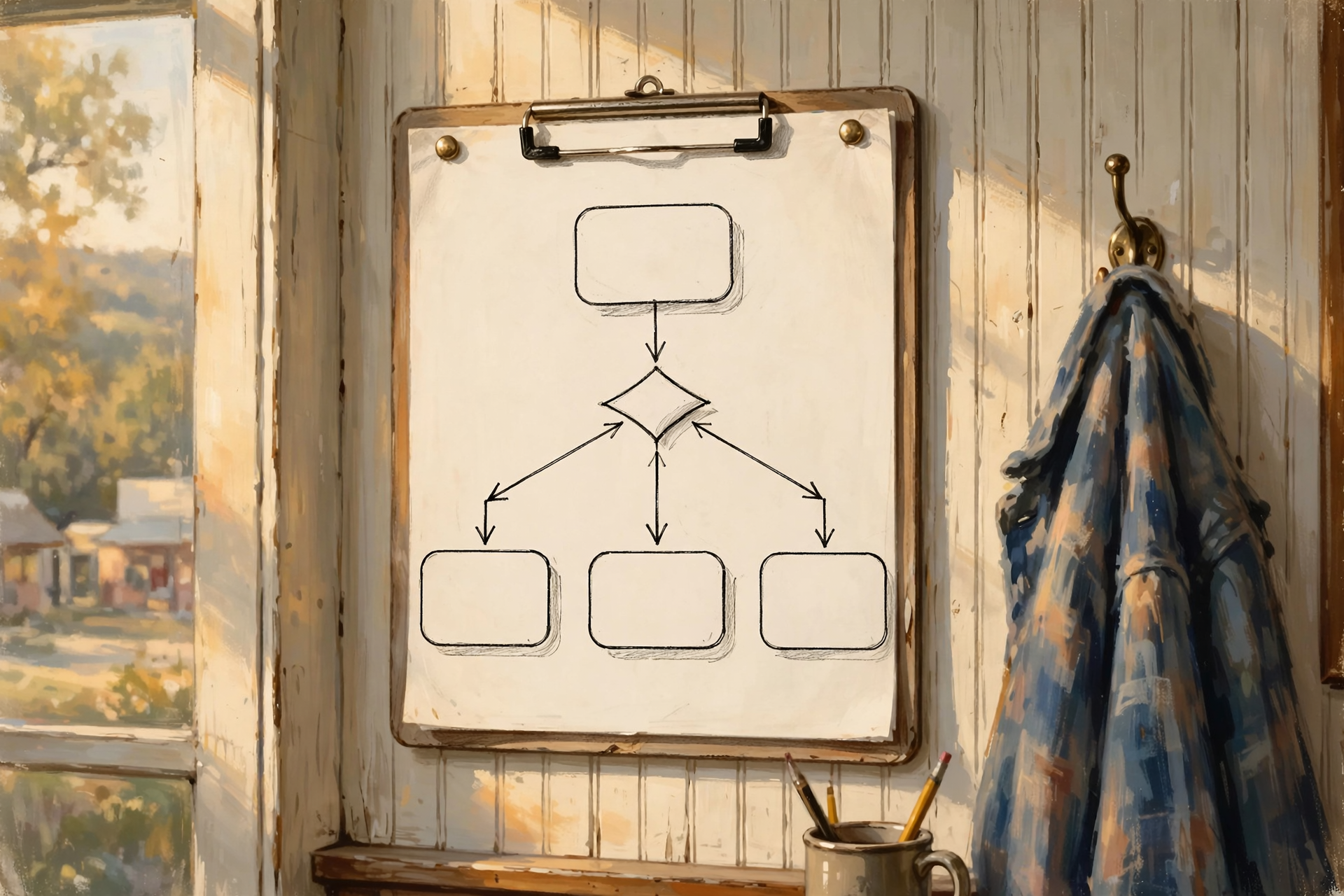
The easiest router uses explicit rules.
For example:
If the task contains confidential customer data, keep it local.
If it involves code, send it to the coding model.
If estimated cost exceeds a threshold, require approval.
If safety language appears, route to a human.
This is straightforward.
It is understandable.
And in many businesses, understandable is a feature.
You can look at the rule and know why the job went where it went.
🧠 AI Can Also Help Make the Routing Decision

For more complicated tasks, an AI model itself may classify the request.
The router might ask:
“What kind of problem is this?”
“How difficult does it appear?”
“Does it contain sensitive information?”
“Which specialist is best suited?”
This creates intelligent routing.
But now the routing decision can be wrong.
Which means the router may need:
- guardrails,
- tests,
- confidence thresholds,
- and fallback rules.
We have apparently hired a teenager to decide which other teenager gets the tractor keys.
Supervision remains fashionable.
🪜 Routers Can Combine Rules and AI Judgment

This is often a sensible approach.
Hard rules handle things that should not be negotiable.
For example:
“Payroll data never leaves this environment.”
AI judgment handles softer questions.
For example:
“Does this question appear complicated enough to need the stronger model?”
Now the system combines:
- hard boundaries,
- flexible judgment,
- cost controls,
- and escalation.
This resembles human management.
Some rules are fixed.
Some decisions require judgment.
Good systems know the difference.
🏪 Routing Could Be Extremely Useful for Small Businesses

Small businesses rarely want the most complicated AI architecture imaginable.
They want useful work at a sensible cost.
Routing can help accomplish that.
Imagine a small business with:
- a local AI model,
- a cloud AI account,
- a private company knowledge base,
- a coding assistant,
- and human staff.
A routing layer could decide:
Routine document classification? Local.
Private company search? Local RAG.
Current public research? Cloud research model.
Complex coding problem? Coding specialist.
High-value customer complaint? Human review.
Simple email draft? Cheap general model.
That is not artificial intelligence for its own sake.
That is workload management.
👨🌾 Rural Operations Have Their Own Routing Logic

A rural business may have different constraints than a large urban office.
Perhaps:
- Internet service is less reliable,
- some locations are remote,
- certain systems are old,
- staff are small,
- and a few experienced people carry enormous institutional knowledge.
A sensible router might prefer local capabilities when connectivity is questionable.
Then use cloud capabilities when available and useful.
It might preserve basic operation during an outage.
It might route unusual decisions to the one person who actually understands the equipment.
This is one reason AI architecture should follow the real environment rather than whatever looks fashionable on a diagram.
🧾 Routing Decisions Should Be Logged

Suppose an important task goes to the wrong model and produces a poor result.
You need to know:
“Why was it routed there?”
A useful audit trail might record:
- what type of task arrived,
- which route was chosen,
- which rule triggered,
- which model handled it,
- what the task cost,
- whether it succeeded,
- and whether it later escalated.
Without those records, improving the router becomes guesswork.
You know somebody took the tractor.
You just do not know which child had the keys.
🔍 Routing Can Reveal Whether You Are Overbuying Intelligence

This is one of the more interesting benefits.
Once you measure which models handle which jobs successfully, you may discover that many tasks do not require premium AI at all.
Perhaps:
- 70 percent of jobs are simple,
- 20 percent need a stronger model,
- 8 percent need specialized tools,
- and 2 percent genuinely require human judgment.
Those numbers will vary widely by business.
The principle is what matters.
You may discover you have been sending every grocery run in a tractor-trailer.
Routing makes inefficiency visible.
⚠️ Bad Routing Can Quietly Ruin Good AI

You can own excellent models and still build a poor system.
If the router consistently sends the wrong jobs to the wrong places, the user experiences poor results.
Perhaps:
- the cheap model gets problems beyond its ability,
- the expensive model gets overloaded with trivial tasks,
- private data goes somewhere it should not,
- human-review cases remain automated too long,
- or everything escalates until the system becomes slow and expensive.
The individual AI models may all be working perfectly.
The dispatcher is the problem.
A fire department with excellent trucks and terrible dispatching still has a problem.
🧠 The Router Itself Can Become an Important Piece of Intelligence

This leads to a subtle point.
As AI systems mature, the most valuable intelligence may not always be the model answering the final question.
It may be the system deciding:
- what kind of problem this is,
- what evidence is needed,
- which model should handle it,
- which tools should be used,
- how much should be spent,
- and when a human should become involved.
That is management intelligence.
And management intelligence can matter just as much as raw brainpower.
A farm full of skilled workers still needs somebody to know which field everybody is supposed to be in.
👨💼 The Future May Look More Like Dispatch Than Chat

Many people currently experience AI as a conversation.
You ask one system a question.
It answers.
But behind future applications, something more complicated may happen.
You ask:
“What should I know about the business this morning?”
Behind the scenes:
- the router sends accounting questions to financial tools,
- customer issues to the service agent,
- inventory concerns to operations,
- public developments to a research model,
- and the final synthesis to a stronger reasoning model.
You receive one answer.
You never see the dispatching.
That may be where practical AI is headed.
The user asks for an outcome.
The system figures out which whippersnappers need to get out of bed.
👴 Older Folks Already Understand Routing Better Than They Think

Forget the words:
model router.
orchestration.
confidence threshold.
fallback provider.
escalation policy.
The underlying questions are:
Who can do this?
Who should do this?
Who can do it cheaply?
Who can do it safely?
Who is available?
And when do I need to call somebody more experienced?
Anybody who has managed a family, shop, farm, church event, volunteer group, or small business already understands the logic.
The computers are merely catching up.
🐓 Wisdom From the Front Porch

The artificial-intelligence world has spent enormous energy asking:
“Which model is best?”
That may eventually prove to be the wrong question.
The better question may be:
“Which model is best for this job, under these conditions, at this price, with this level of risk?”
That is routing.
And once you understand that idea, much of the future of AI becomes easier to picture.
There may not be one artificial intelligence running your business.
There may be many.
Small ones.
Large ones.
Local ones.
Cloud ones.
Specialists.
Reviewers.
Agents.
Tools.
And occasionally a human who knows better than all of them.
The trick is not building the biggest collection of whippersnappers.
The trick is making sure the right one gets the chore.
Because Billy may be brilliant with computers.
Sarah may understand the books.
Tommy may be the only one who knows why the tractor makes that noise.
And the six-year-old…
Well.
He can feed the chickens.
Probably.
So when somebody starts talking about:
“dynamic model routing across heterogeneous inference endpoints,”
you can translate that into plain English:
“We’re deciding which kid gets the job.”
And if the system cannot explain why it handed that kid the chainsaw…
the routing needs work.
— Dunlap.Today
📚 Plain-English AI Glossary

🚦 AI Routing: Deciding which AI model, agent, tool, or human should handle a particular task.
🧠 Model Router: Software or logic that selects among available AI models according to rules, task characteristics, performance, cost, or other factors.
🎯 Specialized Model: An AI model particularly suited to a narrower type of task, such as coding, classification, speech, images, or reasoning.
🪜 Escalation: Sending a task to a more capable or authoritative system when the first level cannot handle it reliably.
🔄 Fallback: An alternate system used when the preferred model, service, or tool is unavailable or fails.
📊 Confidence Threshold: A level used to decide whether a result is sufficiently reliable or should be escalated for additional review.
🛠️ Tool Routing: Choosing which software tool or external system should be used to perform a task.
👥 Agent Routing: Assigning a task to the appropriate AI agent in a multi-agent system.
🏠 Local-First: A routing strategy that attempts to perform suitable tasks using locally controlled AI before escalating elsewhere.
☁️ Cloud-First: A routing strategy that primarily uses cloud AI while reserving local systems for specific requirements such as privacy, offline operation, or specialized work.
🧾 Routing Log: A record showing where a task was sent and why a particular route was chosen.
❓ Frequently Asked Questions

What is AI routing?
AI routing is the process of selecting which AI model, agent, tool, or human should handle a particular request or task.
Why not use the best AI model for every task?
The most capable model may also be slower, more expensive, unnecessary for simple work, or inappropriate for sensitive information. Routing helps match capability to actual need.
Can routing reduce AI costs?
Yes. Routine work can be sent to smaller or less expensive models while more costly models are reserved for problems that require their additional capability.
Can routing protect private information?
It can help by enforcing rules that keep certain classes of data on local or otherwise approved systems rather than sending every task to the same provider.
Can AI decide which AI to use?
Yes. A model can help classify tasks or estimate their difficulty, but important routing boundaries may still be better enforced through explicit rules and permissions.
What is escalation?
Escalation means moving a task to a stronger model, specialized system, supervisor, or human when the first attempt is not sufficient.
What is a fallback model?
A fallback is an alternate model or provider used when the preferred option is unavailable, overloaded, fails, or cannot complete the task.
Can humans be part of AI routing?
Yes. A human can be an intentional destination for tasks involving high risk, unusual circumstances, low confidence, or judgment that should not be delegated completely to automation.
Is routing the same thing as multi-agent AI?
No. Multi-agent AI uses several agents. Routing is the decision process that can determine which agent receives which job. Routing can also choose among standalone models, tools, providers, or humans.
How do businesses know whether routing is working?
They can measure cost, accuracy, response time, failure rates, escalation rates, human-review rates, and outcomes for each route and then adjust the rules based on evidence.
✅ The Front-Porch AI Routing Checklist

Before letting software decide which whippersnapper gets the chore, ask:
- ✅ What kinds of tasks do we actually receive?
- ✅ Which tasks are simple enough for a smaller model?
- ✅ Which tasks require specialized AI?
- ✅ Which information should remain local?
- ✅ Which tasks require current Internet information?
- ✅ What is the cost of each available route?
- ✅ What response time does each task require?
- ✅ How serious would a mistake be?
- ✅ When should a task escalate?
- ✅ When should a human receive it immediately?
- ✅ What happens if the preferred model is unavailable?
- ✅ Are there hard rules preventing sensitive data from taking the wrong route?
- ✅ Are routing decisions logged?
- ✅ Are model performance and costs measured over time?
- ✅ Are easy jobs being sent to unnecessarily expensive AI?
- ✅ Are difficult jobs repeatedly failing on models that are too weak?
- ✅ Is there a stopping rule preventing endless escalation?
- ✅ Can someone explain why a particular route was chosen?
The practical rule is simple:
Do not ask whether one whippersnapper is smartest at everything.
Ask whether he is the right whippersnapper for this particular chore.




0 Comments