
📚 AI Made Document Review Cheaper, So There’s More of It

Or: Reviewers Get Busier, a Court Won’t Cut Fees Over AI, Your Work AI Chats Can Now Be Collected, a Silent ESI Protocol Causes a Fight, and Word Metadata Wins a Patent Case: The Week’s eDiscovery AI News in Plain English
By Thomas Seest, Dunlap.Today · Wednesday, November 4, 2026
When the new four-lane highway came through, folks figured there’d be less traffic on it than on the old two-lane road. Instead, more people started driving, because the trip got easier.
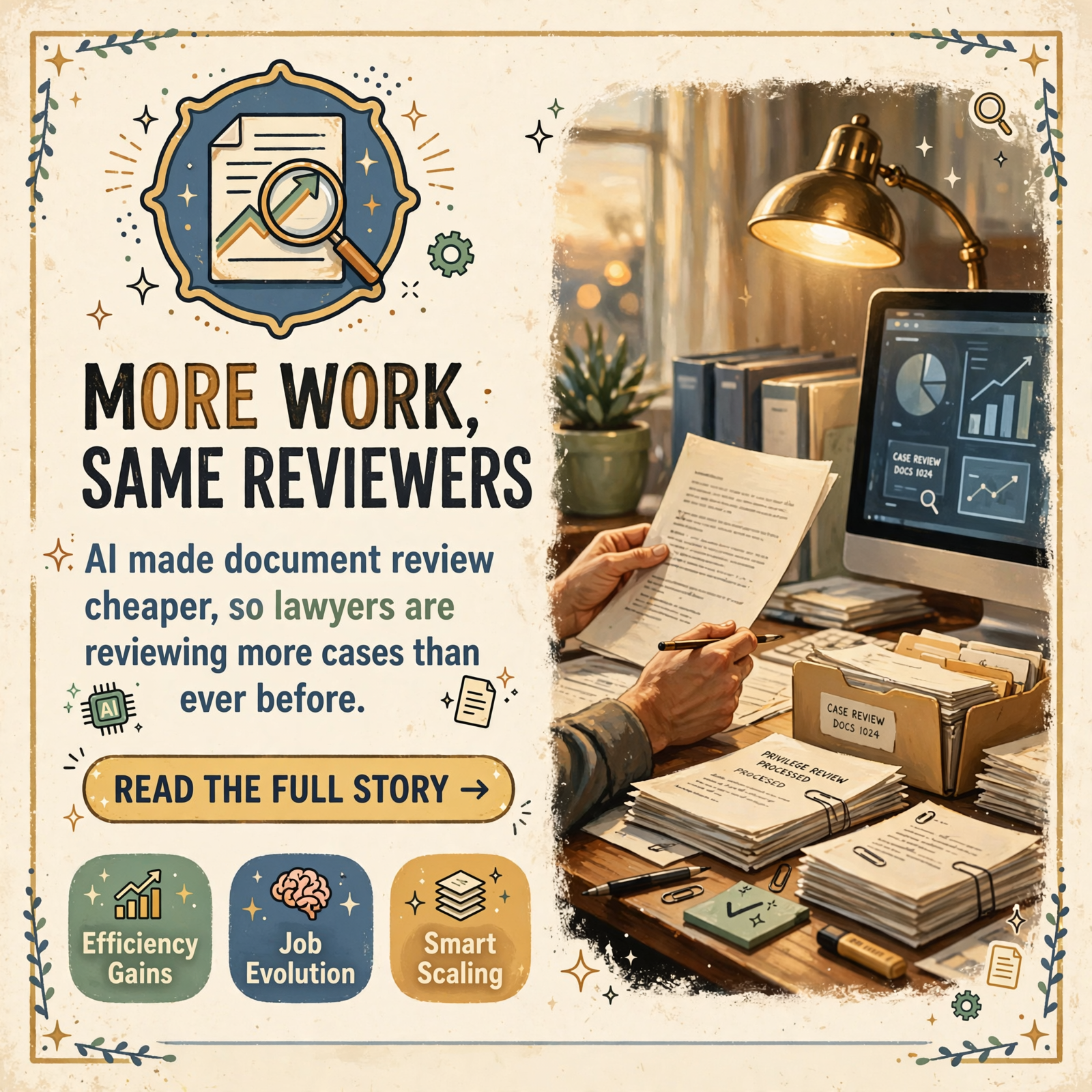
AI is doing the same thing to document review, the part of a lawsuit where people read through emails and files to find what matters. Everybody said AI would put the reviewers out of work. Instead, because review got cheaper, a lot more cases are getting reviewed.
Here’s this week’s roundup: why reviewers are busier than ever, a court that won’t cut fees just because AI helped, work AI chats you can now collect for a lawsuit, a fight over personal email, a patent case won with Word metadata, and a few quick hits worth keeping.
⏱️ What this means for you in 30 seconds
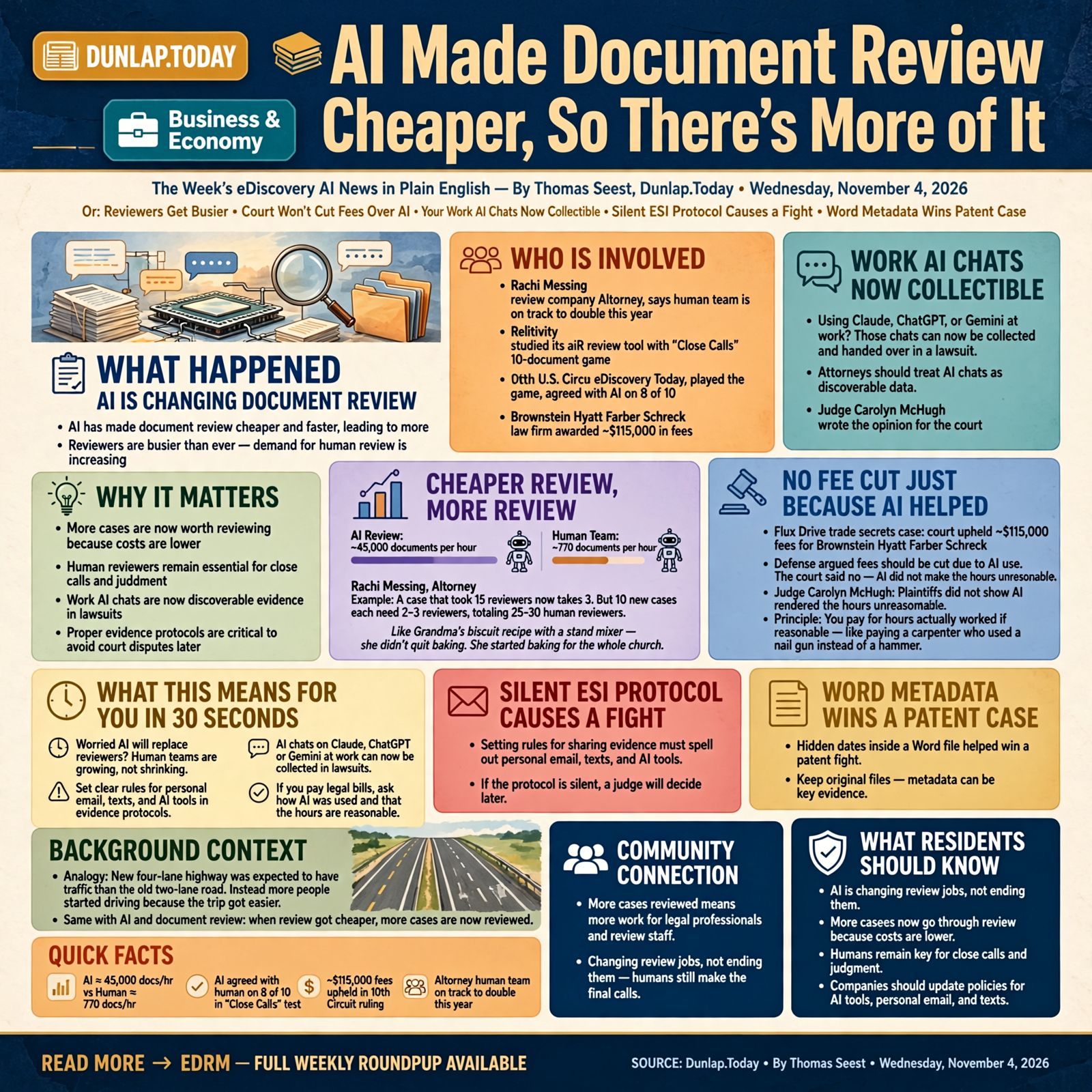
- Worried AI will replace document reviewers? One review company says its human team is on track to double this year.
- Paying a lawyer who uses AI? A federal appeals court says AI use alone isn’t a reason to cut a fee. What matters is whether the hours were reasonable.
- Using Claude, ChatGPT or Gemini at work? Those chats can now be collected and handed over in a lawsuit.
- Setting up rules for sharing evidence? Spell out personal email, texts and AI tools. Silence just means a judge decides later.
- Keeping old files? Keep the originals. The hidden dates inside a Word file helped win a patent fight.
📈 Cheaper Review, More Review

Rachi Messing of the review company Altorney writes that the human side of his business is on track to double this year, even as its AI review engine keeps growing. His explanation: when review costs less, more cases are worth reviewing. In his made-up example, a case that once took 15 reviewers might now take 3, but ten new cases that each need 2 or 3 reviewers add up to 25 or 30 people.
Relativity, meanwhile, turned a big study of its aiR review tool into a 10-document game called “Close Calls.” Doug Austin of eDiscovery Today played it and agreed with the AI on 8 of the 10. In the study, the AI ran at about 45,000 documents an hour, against about 770 for the human team. Some researchers have challenged that study, and it’s worth knowing that too.
It’s like Grandma’s biscuit recipe getting easier with a stand mixer. She didn’t quit baking. She started baking for the whole church.
What it means for you: AI is changing review jobs, not ending them. People still make the close calls, and there are more cases to make them on.
💵 No Fee Cut Just Because AI Helped

In a trade secrets case brought by Flux Drive, the 10th U.S. Circuit Court of Appeals upheld about $115,000 in attorney fees for the law firm Brownstein Hyatt Farber Schreck. The losing side argued the fees should be cut because the firm used AI. Judge Carolyn McHugh, writing for all three judges, said the plaintiffs “have not shown that defense counsel’s use of AI rendered the hours that they actually expended unreasonable.”
It’s like paying a carpenter who brought a nail gun instead of a hammer. You pay for the hours he actually worked, as long as they were reasonable.
What it means for you: If you pay legal bills, ask how AI was used and what the human checking cost. If you send bills, write down the real work.
💬 Your Work AI Chats Can Now Be Collected

Reveal’s Onna tool, which gathers data for lawsuits, can now collect conversations from Claude Enterprise. It already handled ChatGPT and Gemini. An Above the Law column warns that many employees don’t realize their prompts can be handed over in a lawsuit, and a careless one can turn into a “smoking gun.” Across the pond, a UK tribunal accepted a witness statement that a man said AI helped polish, even though he’d deleted his AI history. A law firm writing about the case still advises keeping your drafts.
It’s like the party line telephone. You might think you’re just talking to Cousin Billy, but somebody else may be listening, and now somebody may be writing it down.
What it means for you: Treat a work AI chat like a work email. Don’t type anything you wouldn’t want read aloud in a courtroom.
📧 The Rulebook Didn’t Mention Personal Email

In Flybar v. Express Trade Capital, a New York federal case, both sides had signed an agreement about how to share electronic records, but it said nothing about personal email accounts. When they fought over it, the judge had to decide whether there was reason to think the personal accounts were used for work. The judge called it “a close one” and sided with the defendants. In a separate case, a court threw out West Virginia’s attorney general’s subpoenas for ten years of files from two environmental groups on free-speech grounds, saying he “brought dynamite to the lake.”
It’s like a handshake deal on a fence line that never said who fixes the gate. Sooner or later, somebody has to settle it, and it might not go your way.
What it means for you: If you’re in a lawsuit, make sure the evidence agreement names personal email, texts and AI tools. And remember there are limits on how much the other side can demand.
🗂️ The Hidden Dates in a Word File Won a Patent Fight

In Google v. Valtrus, the Federal Circuit court of appeals agreed that the metadata in old Microsoft Word files, the hidden information showing when a file was made and changed, can back up an inventor’s story about when he came up with his idea. That evidence helped the patent survive Google’s challenge.
It’s like the date stamped on the bottom of an old photograph. Nobody notices it until the day it settles an argument.
What it means for you: Don’t “clean up” old files by copying or re-saving them. Keep the originals, because the hidden details can matter.
🧭 Quick Hits for the Desk Drawer

- New faces at DISCO. The review company hired a new chief technology officer from Thomson Reuters and says its AI revenue is up tenfold since early this year. citybiz
- Check it without downloading it. Cimplifi added a viewer so teams can check shared evidence in the browser. GlobeNewswire
- A Tennessee company on legal holds. Nashville’s Insight Optix updated Legal Hold Evolve to track holds across a whole company. eDiscovery Today
- Public records, with AI. Casepoint launched a tool to help towns, counties and schools answer public-records requests. Legal Reader
- Chat windows are the next privacy lawsuit. A new California law limits “tracking pixel” suits, and one writer expects website chat logs to be the next target. JD Supra
- Social media, the right way. Public posts can help prepare for a deposition, but lawyers shouldn’t send “friend requests” to see private ones. JD Supra
- AI tools teaming up. Harvey added Jus Mundi’s arbitration AI, Legora connected to iManage’s document system, and Thomson Reuters took CoCounsel Legal to 100+ countries’ worth of content. Harvey
- AI with walls. Intapp put its Celeste AI inside ChatGPT Enterprise, with the firm’s ethical walls applied. National Law Review
- Clients are checking too. Siemens Energy Canada’s top lawyer says AI now gets him 85–90% of the way on most tasks, up from about 60% a year ago. Lexpert
✅ Your Front-Porch eDiscovery AI Checklist

- ✅ Expect AI to change review work, not end it. People still make the close calls.
- ✅ Ask your lawyer how AI was used on your matter, and what the human checking cost.
- ✅ Treat work AI chats like work email: they can be collected and handed over.
- ✅ Keep drafts of anything AI helped you write for a case.
- ✅ Make sure evidence-sharing agreements name personal email, texts and AI tools.
- ✅ Keep original files. Don’t copy or re-save them to “tidy up.”
- ✅ If your website has a chat box, find out who records those chats.
- ✅ Check that AI tools at work follow the same permissions as your document system.
Practical rule: When the road gets easier, more folks drive it: plan for more review, more records and more checking, not less.
— Dunlap.Today
📚 Plain-English AI Glossary

- Document review: The part of a lawsuit where people (and now AI) read emails and files to find what’s relevant or private.
- eDiscovery: Finding, saving and sharing electronic records like email, texts and chats for a lawsuit.
- ESI protocol: An agreement between the sides in a lawsuit about which electronic records get shared and how.
- Metadata: Hidden information inside a file, like when it was created and who changed it.
- Legal hold: An instruction to keep records, including chats, because they might matter in a lawsuit.
- Prompt: What you type into an AI tool. At work, it can become a record like any email.
- MCP (Model Context Protocol): A standard way for AI tools to connect to other software, like a document system.
- Ethical wall: A rule inside a law firm that keeps certain people from seeing certain client files.
❓ Frequently Asked Questions

Is AI putting document reviewers out of work?
Not so far, according to at least one review company. Because AI makes review cheaper, more cases get reviewed, so the work shifts to smaller teams on more matters.
Should my legal bill be lower because my lawyer used AI?
Not automatically. A federal appeals court this week said AI use alone isn’t a reason to cut fees. The question is whether the hours actually worked were reasonable. It’s fair to ask your lawyer how AI was used.
Can my AI chats at work be used in a lawsuit?
Yes. Tools can now collect chats from Claude, ChatGPT and Gemini work accounts, the same way they collect email.
What happens if our evidence agreement doesn’t mention personal email?
A judge decides. In one New York case this week, the judge looked at whether there was reason to think the personal accounts were used for work.
🔗 Other Resources

- eDiscovery Today: “Close Calls,” an interactive look at the Redgrave study
- Large Language Law: Appeals court refuses to presume AI should reduce legal fees
- EDRM: Dynamite discovery blasted by court
- Paul Hastings via JD Supra: AI assistance in employment tribunals
- SecurityBrief: Legora to connect with iManage MCP Server
- IAPP: When does not using AI become negligence?
🌄 No Need to Worry, Just Stay in the Know

None of this means AI is taking over the courthouse. Judges are treating AI as one more tool, neither a reason to cut fees nor an excuse for sloppy work. What’s changing is that AI makes it easier to look at more records, and it creates new ones. The safest moves are the old ones: keep your originals, write things down clearly and know what you’ve typed where.
Read Dunlap.Today and sign up for our newsletter for plain-English updates.



0 Comments