
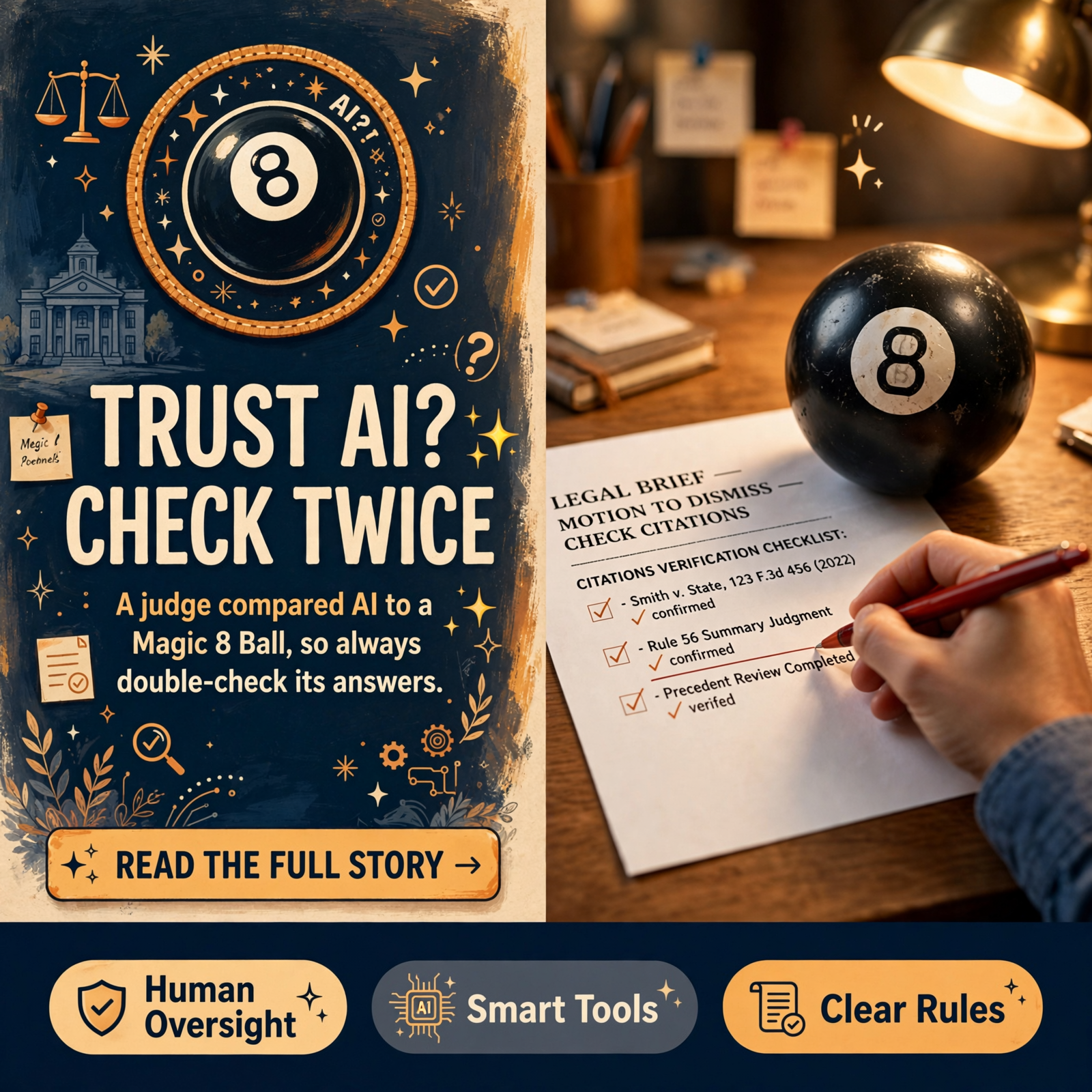
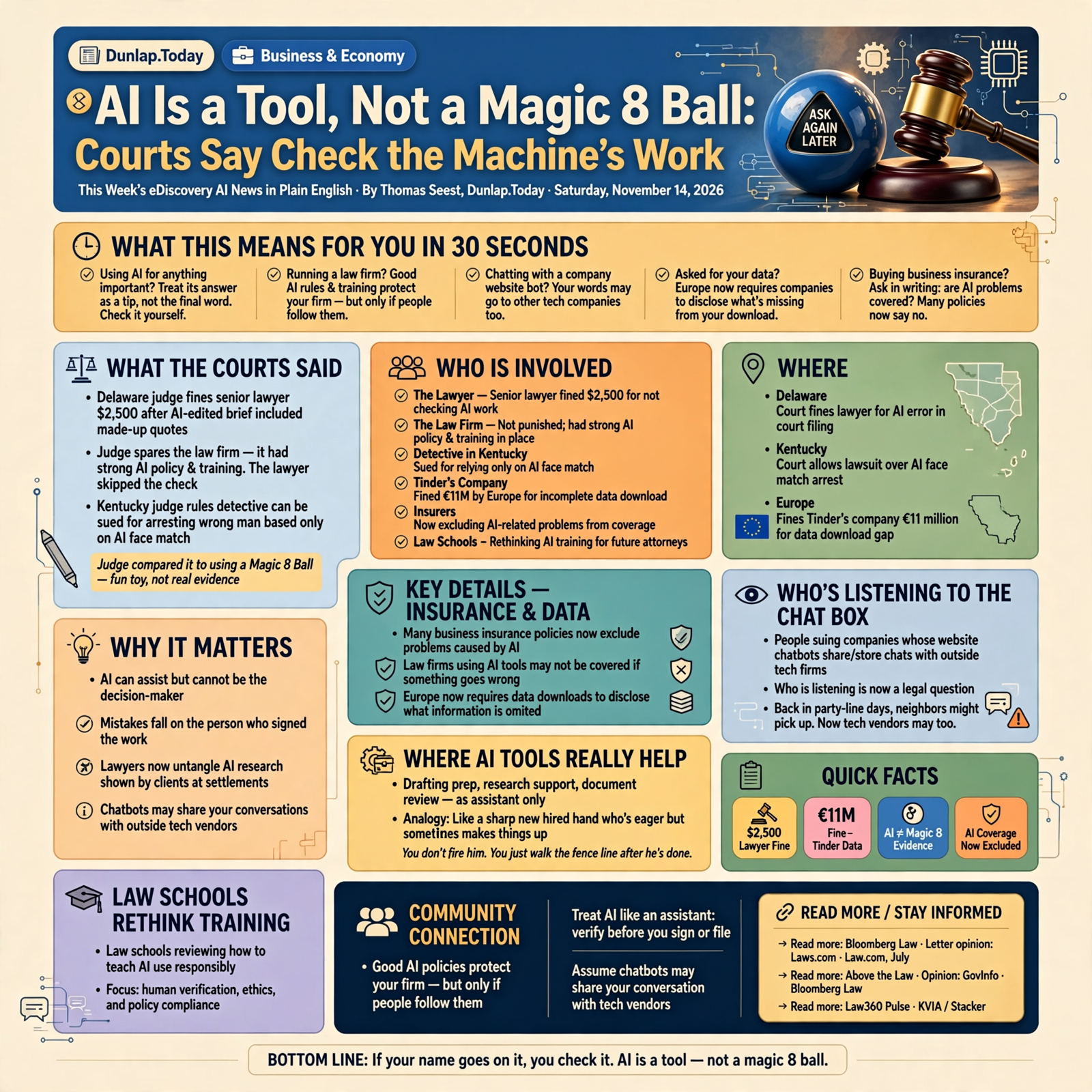
🎱 AI Is a Tool, Not a Magic 8 Ball: Courts Say Check the Machine's Work

Or: A Delaware Lawyer Gets Fined but His Firm Doesn't, a Judge Compares an AI Face Match to a Magic 8 Ball, Tinder Pays for an Incomplete Data Download, Insurers Quietly Drop AI Coverage, and Law Schools Rethink Training: This Week's eDiscovery AI News in Plain English
By Thomas Seest, Dunlap.Today · Saturday, November 14, 2026
Most of us had a Magic 8 Ball as kids. You’d ask it a big question, give it a shake, and it would tell you ‘Signs point to yes.’ Fun at a sleepover. Not something you’d use to pick a husband or buy a tractor.
This week a federal judge used that same toy to make a serious point about AI. And a Delaware judge made a similar one about a lawyer who trusted AI without checking. The machine can help you. It can’t be the one who decides.
Here’s the rundown: what the courts said, who’s listening to the chat box, putting AI rules in writing, where AI tools really help, and money, schools and law firm people.
⏱️ What this means for you in 30 seconds
- Using AI for anything important? Treat its answer as a tip, not the final word. Check it yourself.
- Running a law firm? Good AI rules and training can protect your firm, but only if people follow them.
- Chatting with a company’s website bot? Your words may go to other tech companies too.
- Asked a company for your data? Europe now says the download has to tell you what’s missing.
- Buying business insurance? Ask, in writing, whether AI problems are covered. Many policies now say no.
⚖️ What the Courts Said

A Delaware judge fined a senior lawyer $2,500 after an AI-edited brief included made-up quotes. The judge didn't punish his law firm, because it had a strong AI policy and training. The lawyer just didn't follow it.
A Kentucky judge said a detective can be sued for arresting the wrong man based only on an AI face match. The judge compared it to using a Magic 8 Ball.
Lawyers say clients now show up to settlement talks with their own AI research, and lawyers often have to untangle what the chatbot got wrong.
It's like having a sharp new hired hand who's eager but sometimes makes things up. You don't fire him. You just walk the fence line after he's done.
What it means for you: If your name goes on it, you check it. A firm with good AI rules can stay out of trouble, but the person who skips the check still pays.
👉 Read more (Bloomberg Law) · Letter opinion text (Laws.com) · Law.com, July · Read more (Above the Law) · Opinion (GovInfo) · Bloomberg Law · Read more (Law360 Pulse)
🔒 Who's Listening to the Chat Box

People are suing companies whose website chatbots quietly share or store their conversations with outside tech firms. Who's actually 'listening' is now a legal question.
Europe fined Tinder's company €11 million because its 'download your data' button didn't give people all their data and didn't say what it left out.
Many business insurance policies now exclude problems caused by AI. Law firms using AI tools may not be covered if something goes wrong.
Back in the party-line days, you knew the neighbors might pick up. Website chat boxes can work the same way. There may be more folks on the line than you think.
What it means for you: Assume a company's chatbot may share your words with its tech vendors. If you ask a company for your data, you're entitled to know what they left out. And business owners should ask their insurance agent about AI in plain words.
👉 Read more (KVIA / Stacker) · Read more (ComplexDiscovery) · Read more (Insurance Business)
📝 Putting AI Rules in Writing

Lawyers advise that when you hire an AI 'agent' that can take actions on its own, the contract should spell out what it's allowed to do, who checks it and who pays if it goes wrong.
Insurance regulators are about to adopt a checklist that asks whether the humans 'checking' AI decisions can actually overrule it, and whether they ever do.
A small Chicago law firm publicly promised to follow 14 rules for using AI, including having a person check everything the AI produces and never using client files to train AI.
A handshake works fine with your neighbor. But when you rent out the back forty to a stranger, you write down who mends the fence and who pays if the cows get out.
What it means for you: If an AI tool can take actions on its own, get it in writing what it's allowed to do and who checks it. And make sure the person checking can really say no.
👉 Read more (JD Supra (Mayer Brown)) · Read more (JD Supra (McDermott Will & Schulte)) · Read more (citybuzz)
🤖 Where AI Tools Really Help

A big-firm innovation leader says AI helps most with the big, repetitive reading jobs lawyers do, as long as a person stays in charge.
A new report from AI company Harvey looks at how 10 smaller and mid-sized law firms use AI to take on bigger cases with the same staff. All 10 are Harvey customers.
A law-firm software company won an industry award for AI that drafts lawyers' time entries and keeps a record of everything it does.
An Irish-American startup uses AI to gather family paperwork and prepare probate documents, so grieving families aren't buried in forms.
A new startup launched 'Mike,' an AI legal helper for small businesses that reviews contracts first and then connects you with real lawyers.
A good log splitter saves your back. It doesn't decide which trees to cut.
What it means for you: AI shines at big, repetitive reading and paperwork jobs. Keep a person in charge of the decisions, and keep the records it creates.
👉 Read more (Artificial Lawyer) · Read more (Harvey) · Read more (LawFuel) · Read more (Business Post) · Read more (X post)
💼 Money, Schools and Law Firm People

A study found that a popular trick for getting AI chatbots to recommend your law firm doesn't actually work.
Wall Street money is pouring into a handful of big legal tech companies, while smaller ones are getting less.
An investor said AI could soon write most deal paperwork. Lawyers replied that one missing comma once cost a company $5 million.
Trial lawyers are slower to adopt AI than other lawyers. They're not against it. They worry about judges, ethics and getting it right.
Law schools are changing how they teach because AI now does much of the document reading that new lawyers used to learn on.
Georgetown's law school now lets students use Harvey, a popular legal AI tool, so they're ready for law firm jobs.
When the co-op got its first computer, the old-timers still checked the scale tickets by hand. Turned out they caught a few mistakes.
What it means for you: AI is changing how lawyers train, charge and find clients. But the careful folks, like trial lawyers, are careful for good reason.
👉 Read more (FinancialContent) · Read more (Law.com) · Read more (X trending story) · Read more (Law.com Texas Lawyer) · Read more (GovTech) · Read more (The Hoya)
✅ Checklist for this week

- ✅ Name a person responsible for checking every citation before any filing is signed
- ✅ Keep proof of your firm’s AI policy and training. It can matter if something slips through
- ✅ Ask how any AI result in a case was double-checked before anyone relied on it
- ✅ Map where your website chatbot sends conversations, including vendors and subprocessors
- ✅ Make sure data-download tools say what they don’t include
- ✅ Ask your insurance agent, in writing, whether AI-related claims are covered
- ✅ Put logging, audit and human sign-off rights into contracts for AI agents
- ✅ Track how often reviewers overrule the AI. If it’s never, ask why
Practical rule: Let AI give you a lead. Let a person make the call.
— Dunlap.Today
📚 Plain-English AI Glossary

- Hallucination: When AI makes up something that sounds real, like a court case or quote that doesn’t exist.
- Rule 11: The court rule that says a lawyer who signs a filing promises they checked it.
- Facial recognition: Software that tries to match a face in a photo or video to other photos.
- Probable cause: Enough real evidence for police to arrest someone or get a warrant.
- Wiretapping claim: A lawsuit saying someone secretly listened to or recorded a conversation without permission.
- Data access request (DSAR): Asking a company for a copy of the personal information it keeps about you.
- AI exclusion: Wording in an insurance policy that says it won’t pay for problems caused by AI.
- AI agent: An AI program that can take actions on its own, like sending emails or filing forms, not just answer questions.
- Human in the loop: A person who reviews what the AI does and can actually stop or change it.
❓ Frequently Asked Questions

Can a lawyer get in trouble for using AI?
Using AI isn’t against the rules. Not checking its work is. A Delaware judge said AI is ‘neither forbidden nor inherently problematic,’ then fined a lawyer who didn’t verify what it wrote.
Can police arrest someone just because AI matched their face?
A Kentucky federal judge said that, if the facts are as claimed, relying on an AI match alone isn’t enough. Officers need to do real investigating, too. The case is still at an early stage.
Is my chat with a company’s website bot private?
Not always. The bot may be run by outside tech companies that store or analyze what you type. That’s what many new lawsuits are about.
If I download my data from an app, do I get all of it?
Not necessarily. In Europe, regulators just fined Tinder’s company because its download left things out without telling people. The tool doesn’t have to give you everything, but it has to be honest about what it skips.
Does my business insurance cover AI mistakes?
Maybe not. Many insurers are adding wording that leaves AI problems out. Ask your agent directly and get the answer in writing.
Other Resources

- Osorio v. Kilmer opinion (E.D. Ky., Nov. 9, 2026)
- Above the Law: AI in our courts, useful or a Magic 8 Ball?
- ComplexDiscovery: Tinder’s incomplete data export fine
- Mayer Brown: Contracting to address agentic AI governance
- Insurance Business: Why your clients probably aren’t covered for AI
Got an eDiscovery or legal AI question from the porch? Send it our way. We’ll keep translating the jargon into plain English.
Know about an upcoming event or story in the Dunlap, TN area? Submit it here.



0 Comments