

🌾 A Windy Front, Two Chilly Nights and a Dry Week Behind Them: Porch Plants In, Hay Math Done, and a Canning Class to Circle — Your Farm & Garden Report

Or: Gusts to 30 Tonight, Near 38 Saturday Night, Then Sunny and Dry Through Thursday — Your Weekend Farm and Garden Plan
By Thomas Seest, Dunlap.Today · Friday, October 16, 2026
Fridays on the farm are a lot like packing the truck before a weekend trip. You don’t need to do everything. You just need to tie down what might blow away, bring in what might get cold, and make sure there’s enough in the cooler for the week.
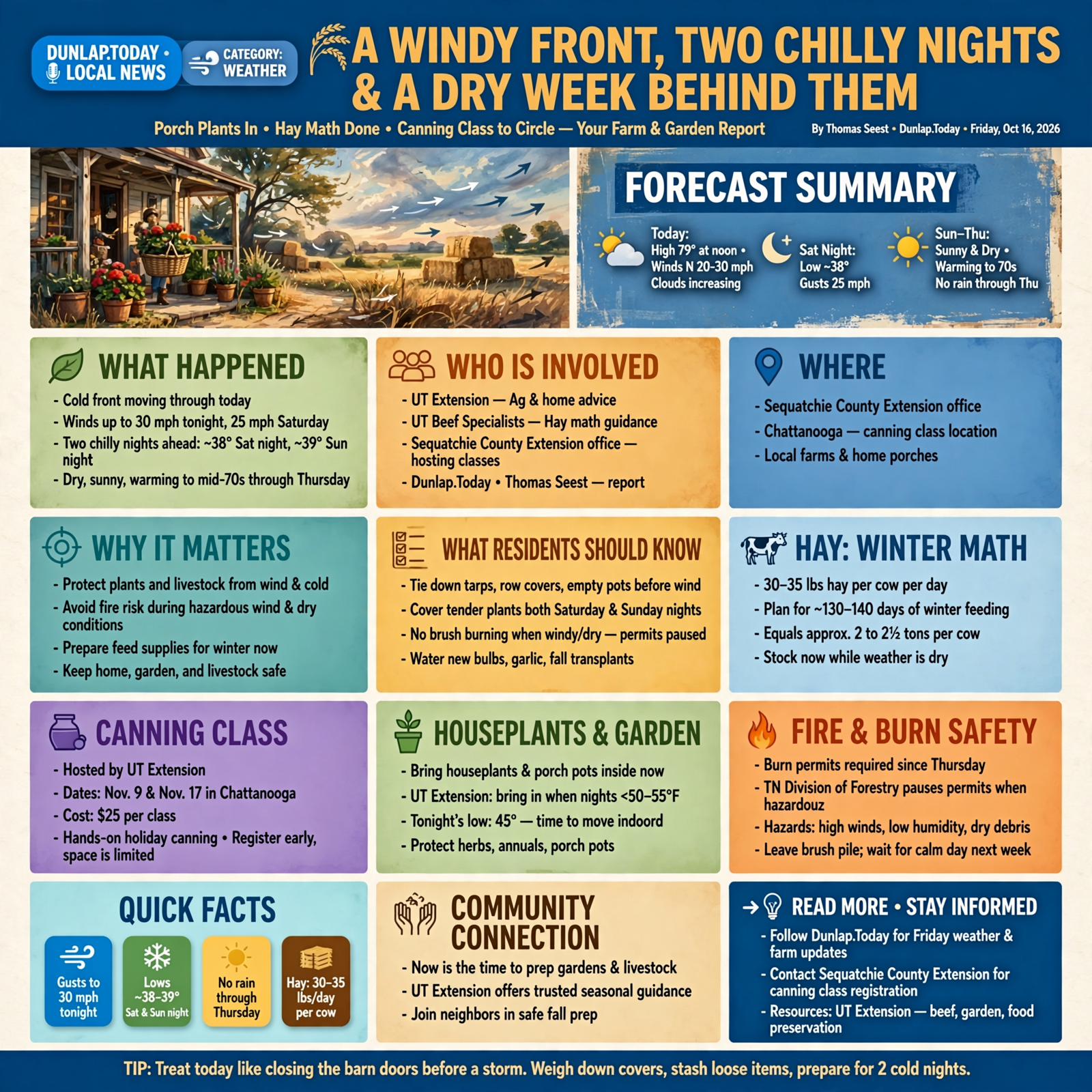
Here’s where things stand Friday morning. The front arrives today. Dunlap’s National Weather Service forecast has temperatures peaking near 79 around noon, then falling into the 60s, with north wind gusts up to 30 mph tonight and 25 mph Saturday. Then come two chilly nights: about 38 Saturday night and 39 Sunday night. After that, it’s sunny and dry, warming into the mid-70s through Thursday, with no rain in the forecast. That makes this the weekend to bring houseplants and porch pots inside, and UT Extension’s rule of thumb says we’re already past the line. For cattle folks, UT’s beef specialists offer simple winter hay math: 30 to 35 pounds per cow per day. And UT Extension, including our own Sequatchie County office, is helping host hands-on holiday canning classes in Chattanooga next month. A short checklist is at the end.
⏱️ What this means for you in 30 seconds
- Wind: Gusts up to 30 mph tonight and 25 Saturday. Tie down row covers, tarps and empty pots, and don’t burn brush on windy days.
- Cold: About 38 Saturday night and 39 Sunday night. Cover tender plants both nights.
- Dry: No rain in the forecast through Thursday. Water new bulbs, garlic and fall transplants.
- Houseplants: UT Extension says bring them in when nights dip to 50–55°F. Tonight’s low is 45.
- Hay: Plan on 30–35 lbs per cow per day for about 130–140 days. That’s roughly 2 to 2½ tons per cow.
- Canning: Nov. 9 and Nov. 17 in Chattanooga, $25 a class. Register early, because space is limited.
🌬️ The Front Blows Through Today: Tie Things Down, Then Plan for Two Cool Nights and a Dry Week
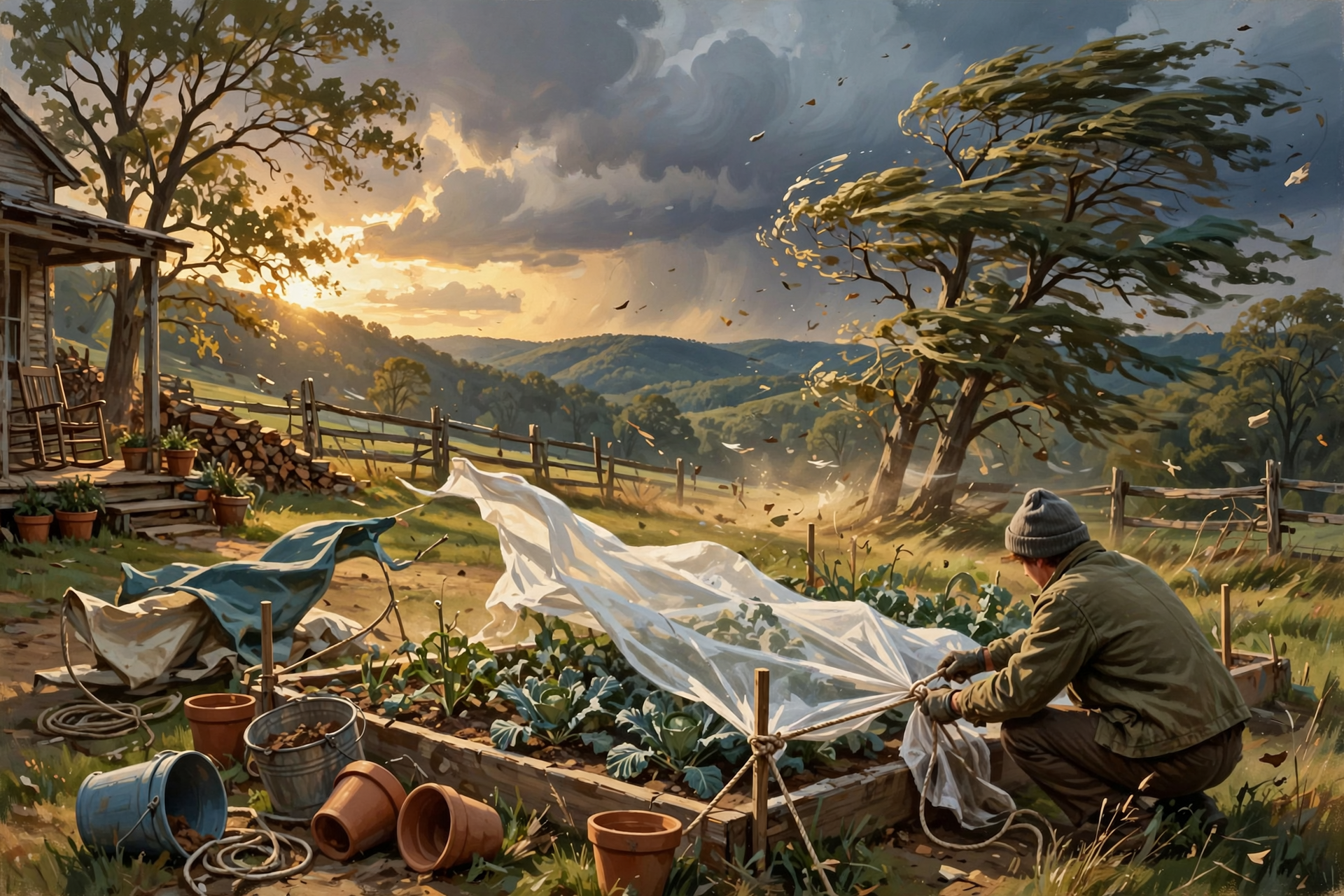
The National Weather Service’s Dunlap forecast, updated early this morning, calls for increasing clouds today, with the temperature rising to near 79 by noon, then falling to around 62 through the afternoon. Wind turns from the west to the north, with gusts up to 20 mph. Tonight is mostly cloudy with a low around 45 and north wind gusts as high as 30 mph. Saturday is mostly sunny but cool, with a high near 60 and gusts to 25 mph. Saturday night is mostly clear with a low around 38. Sunday is sunny, near 66, with calm wind and a clear Sunday night around 39. Then the warm-up starts: 69 Monday, 74 Tuesday, 76 Wednesday and 77 Thursday, all sunny or mostly clear, with no rain in the forecast through Thursday.
Burn permits have been required since Thursday. The Tennessee Division of Forestry says it pauses permit issuance when conditions are hazardous, including high winds, very low humidity or very dry debris.
What it means for you: Treat today like closing the barn doors before a storm. Before the wind picks up this evening, weigh down or stake row covers, tarps and frost cloth, and stash empty pots and buckets. Leave the brush pile for a calm day next week, and get the free permit that morning. Have your covers ready for both Saturday and Sunday nights. Sunday night is clear and calm, so cold air will settle into low spots. Then, with a dry, sunny week ahead, give anything you planted this month (garlic, daffodils, pansies, new shrubs) a good drink early in the week.
👉 Read more (NWS Dunlap forecast) · BurnSafeTN burn permits
🪴 Ferns, Peace Lilies and Porch Pots: This Is the Weekend to Bring Them In
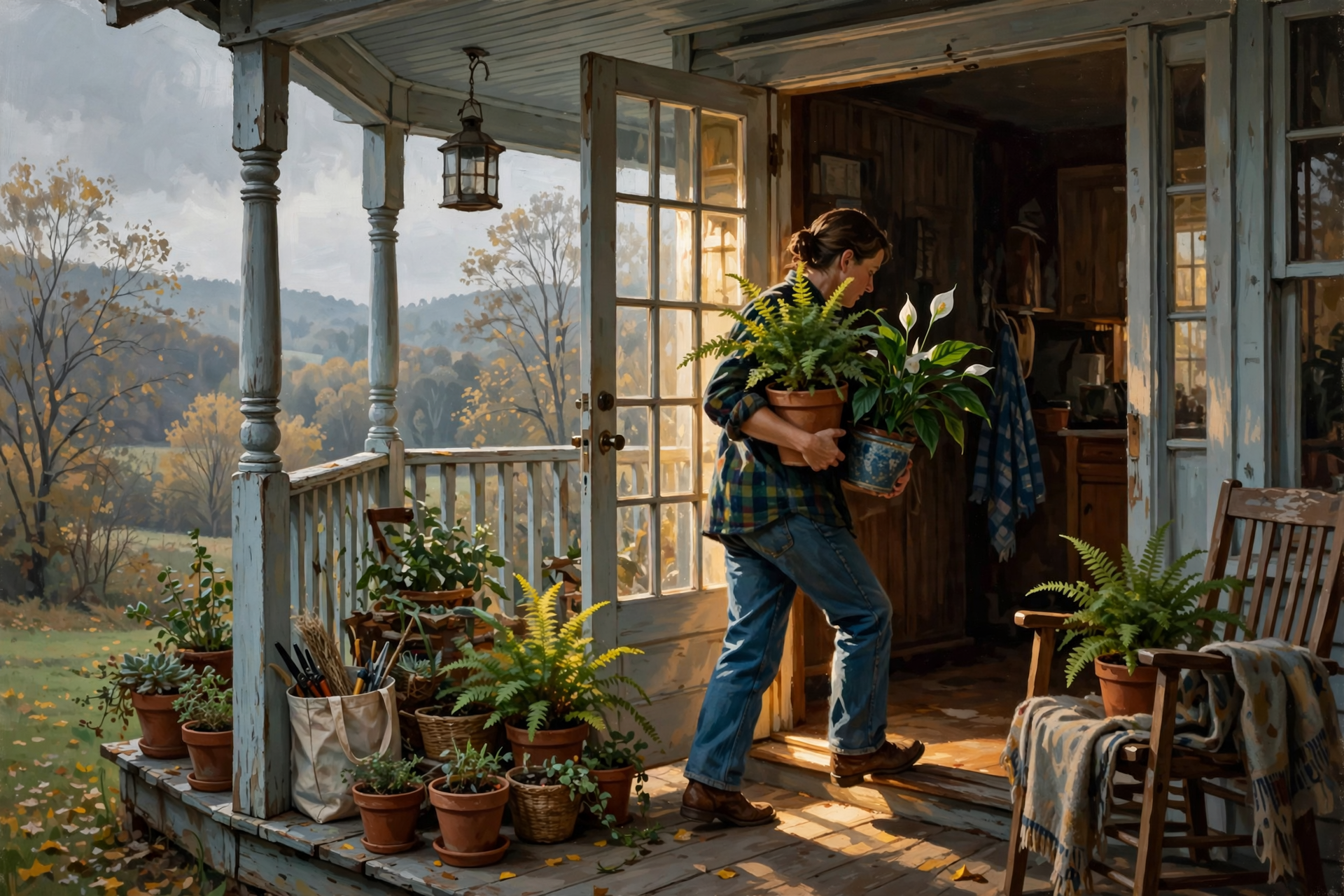
If your houseplants spent the summer on the porch, they’ve had a good run. Amy Dunlap, UT Extension’s agent for Davidson County, gave a simple rule in Tennessee Home & Farm, the Tennessee Farm Bureau magazine: bring houseplants inside when temperatures are consistently dipping to 50 to 55 degrees. For cold-sensitive outdoor landscape plants, she says to protect them when temperatures dip to about 32. Tonight’s forecast low is 45, and the next three nights run from 38 to 42, so most porch plants have already passed the line.
University of Minnesota Extension adds a few tips that work anywhere. Most tropical houseplants should come in before nights fall below 50, and most succulents before nights fall below 40. Plants can go into shock if they move suddenly from bright outdoor light to a dim room. You may see yellow leaves or a little leaf drop, and UMN says that’s common. It also says plants need less water in fall, and you can stop fertilizing until late winter.
What it means for you: Think of it like bringing the dog in on a cold night. Carry them in today or Saturday morning, before the coldest air. Look under the leaves and around the pot rim for any bugs riding along. Set them by your brightest window, away from the heat vent, and don’t worry if they drop a few leaves the first couple of weeks. The tough ones, like rosemary in the ground, mums and pansies, can stay outside. Tender plants that stay outdoors can go under a sheet Saturday and Sunday nights.
👉 Read more (Tennessee Home & Farm, with UT Extension) · UMN Extension: Bringing houseplants in from the cold
🐄 The Winter Hay Math, Done on the Back of an Envelope

Earlier this week, this report suggested counting your bales. Here’s how to turn that count into a plan. UT Beef & Forage Center nutrition specialist Dr. Katie Mason writes that a cow typically eats 2 to 2.5 percent of her body weight in dry matter each day. After you allow for waste, it’s safe to figure 30 to 35 pounds of hay per cow per day. UT plant sciences director Dr. Bruno Pedreira notes that most Tennessee operations need to feed hay for about 130 to 140 days each year, and longer when drought slows pasture growth.
Multiply those together and you get roughly 3,900 to 4,900 pounds of hay per cow, or about 2 to 2½ tons for the winter. A 20-cow herd would need roughly 39 to 49 tons. Bale weights vary a lot, so UT suggests getting an average weight for your own bales. As an example only, if your round bales weigh about 1,000 pounds, that’s around 4 to 5 bales per cow, before any storage losses.
Storage makes a big difference. Pedreira says hay stored on the ground can lose as much as 40 percent, while covered racks or a barn can cut losses to as little as 3 percent. Both UT specialists say that if you come up short, the first lever is culling: open cows, late calvers, cows that wean light calves, and extra bulls. Pedreira adds that animals sold in good condition in the fall typically bring stronger prices than thin ones sold later, when hay is scarce. Mason says to keep the rest of the herd at a body condition score of 5 to 6 so cows rebreed, and to keep feeding areas from getting muddy, since walking through mud burns energy.
What it means for you: It’s like checking the woodpile against the calendar. If you have 2 tons per cow under a roof, you can relax. If you’re short, you have time to call your Extension office, check the hay directories, send a hay sample off for testing, or decide which cows to sell while they’re still in good shape. Any of those beats scrambling in February.
👉 Read more (UT Beef & Forage: When Hay Supplies Are Limited) · UT: Stretching Forage and Hay in a Dry Fall
🫙 Put Up a Jar for Gift-Giving: Hands-On Holiday Canning Classes, Nov. 9 and 17
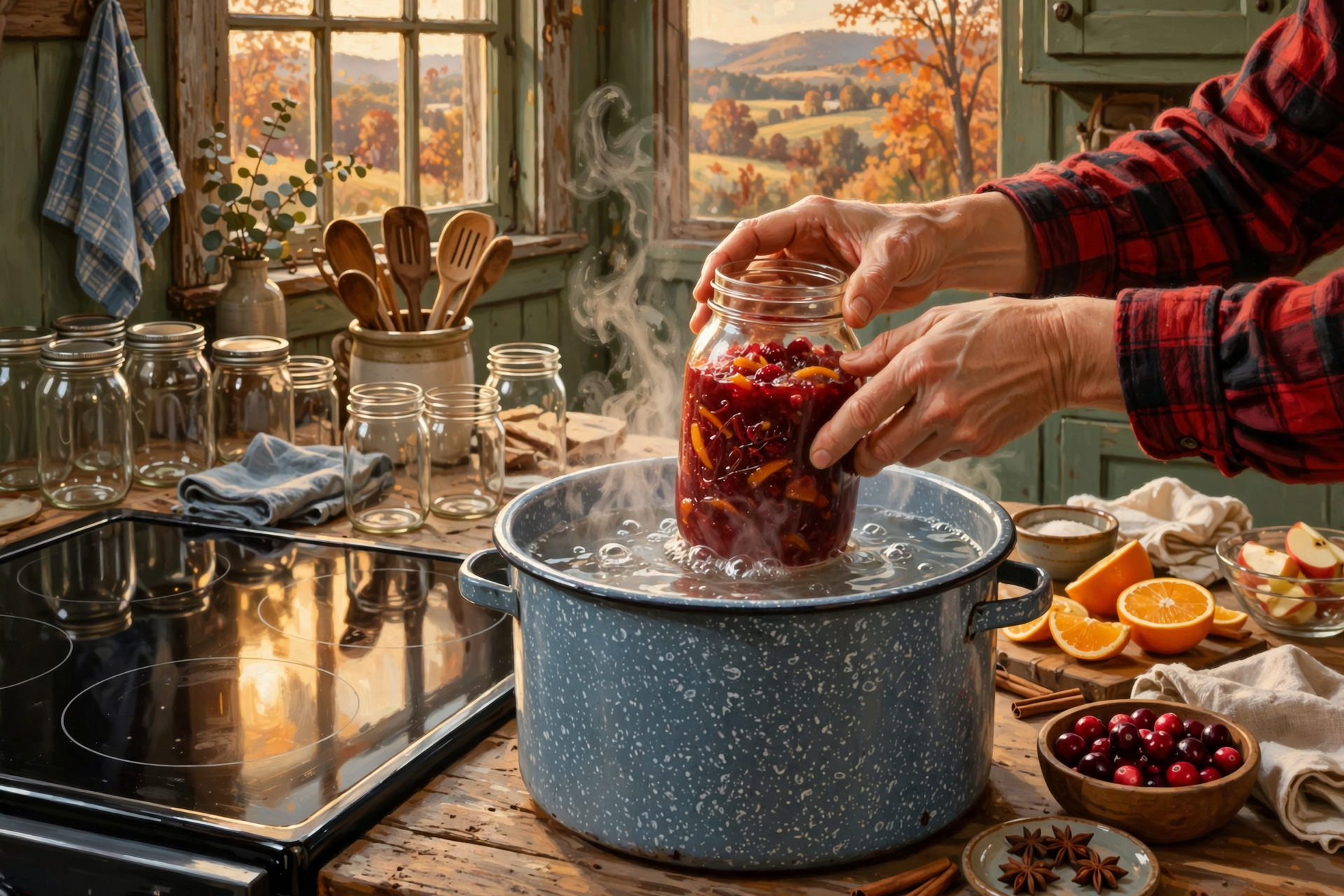
UT Extension in Hamilton and Sequatchie counties is teaming up with Georgia’s Whitfield County Extension for two hands-on “Canning for the Holidays” classes at the Hamilton County Extension office, 6183 Adamson Circle, Chattanooga:
- Monday, Nov. 9, 10:30 a.m.: Harvest Time Apple Relish
- Tuesday, Nov. 17, 1 p.m.: Cranberry Orange Chutney
Each class costs $25 (no refunds). You’ll learn the basics of water bath canning using newer equipment that UT says is good for folks with a glass cooktop. You’ll use safe, tested recipes and go home with a jar. Space is limited. No children or extra guests are allowed, so register early. Wear your hair pulled back and closed-toe shoes. Register by card at tiny.utk.edu/HolidayCanning, or mail the flyer’s form with a check made out to the University of Tennessee. Questions go to (423) 209-8560.
What it means for you: Store-bought gifts are fine, but a jar of apple relish you made yourself is a small piece of the Valley. If a glass-top stove has kept you from canning, this class answers that question. It’s about a 45-minute drive from Dunlap, so it’s a nice outing with a friend. Grab a spot soon, since classes like this fill up.
👉 Read more (UT Extension: Canning for the Holidays flyer) · UT Extension Sequatchie County
📌 Sticky Notes for the Fridge
- Tonight and Saturday: Gusts to 30 and 25 mph. Not a burning weekend.
- Saturday, Oct. 17, 9 a.m.–1 p.m.: Dunlap Farmers Market Young Entrepreneurs Day at the Jeff Johnson Pavilion in Harris Park. Dress warm, since the high is only about 60.
- Saturday night, Oct. 17, and Sunday night, Oct. 18: Lows near 38 and 39. Covers on both nights.
- Monday, Oct. 19: USDA’s next weekly Tennessee cattle summary and Crop Progress report.
- Thursday, Oct. 22: The next Drought Monitor map, plus FSA’s weekly update of drought-payment (LFP) counties. Sequatchie FSA is in Jasper at (423) 942-2244.
- Nov. 9 and Nov. 17: UT Extension holiday canning classes in Chattanooga.
- Dec. 1, 2026: Deadline for Tennessee Department of Agriculture water-quality grant proposals.
- March 1, 2027: Deadline to apply for 2026 Livestock Forage Disaster Program payments.
👉 Dunlap Farmers Market · USDA FSA: LFP · TDA Newsroom
✅ Your Farm & Garden Checklist for Windy-Then-Dry Week
- ✅ Before this evening: Weigh down or stake row covers, tarps and frost cloth. Stash empty pots and buckets.
- ✅ Today or early Saturday: Bring houseplants and porch pots inside. Check them for bugs, and set them by a bright window away from the heat vent.
- ✅ Saturday and Sunday afternoons: Cover tender plants before dark both nights. Uncover them in the morning.
- ✅ Early next week: Water garlic, bulbs and fall transplants, since no rain is in the forecast through Thursday.
- ✅ Hold the brush pile until a calm day, and get the free permit that morning.
- ✅ Hay math: Multiply cows × 30–35 lbs × 130–140 days. Then compare that with your bale count and average bale weight.
- ✅ Short on hay? Call your Extension office, test a hay sample, and decide on culls while cows are in good shape.
- ✅ Sign up for a holiday canning class at tiny.utk.edu/HolidayCanning or call (423) 209-8560.
- ✅ Saturday 9–1: Bundle up and visit the young vendors at the Dunlap Farmers Market.
Practical rule: Tie down before the wind, bring in before the cold, and count the hay before February does it for you.
— Dunlap.Today
📚 Plain-English Farm & Garden Glossary
- Cold front: The leading edge of cooler, drier air. It often brings a wind shift, gusty wind and falling temperatures.
- Gust: A short burst of wind that’s stronger than the steady wind speed.
- Dry matter: What’s left of a feed after the water is taken out. Cattle rations are figured on dry matter.
- Body condition score (BCS): A 1-to-9 scale of how thin or fleshy a cow is. UT recommends 5 to 6 for cows to rebreed well.
- Culling: Selling cows that aren’t paying their way, like open cows or late calvers, so the hay goes further.
- Open cow: A cow that isn’t pregnant.
- Water bath canning: Processing filled jars in boiling water. It’s used for high-acid foods like fruit relishes, jams and pickles.
- Acclimate: Letting a plant adjust slowly to a new spot, light or temperature.
❓ Frequently Asked Questions
Will it frost this weekend in Dunlap?
The National Weather Service forecasts lows around 38 Saturday night and 39 Sunday night. Frost can form in low, open spots even when the official low is a few degrees above freezing, so covering tender plants both nights is the safe bet.
Can I burn brush this weekend?
A free permit has been required since Oct. 15, and the Division of Forestry pauses permits when winds are high. With gusts to 30 mph tonight and 25 mph Saturday, wait for a calm day next week and get the permit that morning at BurnSafeTN.org or in the MyTN app.
When should houseplants come inside?
UT Extension’s rule of thumb is when nights consistently dip to 50 to 55 degrees. Tonight’s forecast low is 45, so now is the time.
My plants dropped leaves after I brought them in. Did I do something wrong?
Probably not. Extension specialists say some yellowing or leaf drop is common while plants adjust to lower indoor light. Give them a bright window, water them less, and hold off on fertilizer until late winter.
How much hay does one cow need for winter?
UT’s guide is 30 to 35 pounds a day, including waste, for about 130 to 140 days of feeding. That works out to roughly 2 to 2½ tons per cow. A drought or a late spring can stretch it further.
Does it matter where I store my hay?
Yes. UT says bales stored on the ground can lose as much as 40 percent, while a barn or covered rack can cut losses to as little as 3 percent.
Can I do water bath canning on a glass-top stove?
The UT Extension holiday classes teach water bath canning with newer equipment they describe as good for people with glass cooktops. Call (423) 209-8560 with specific questions.
🔗 Other Resources
- National Weather Service: Dunlap forecast
- BurnSafeTN (free burn permits)
- TDA: Fire prevention during wildfire season
- Tennessee Home & Farm: Protecting plants from the cold (with UT Extension)
- UMN Extension: Tips to rescue houseplants from the cold
- UT Beef & Forage Center: When Hay Supplies Are Limited
- UT Beef & Forage Center: Stretching Forage and Hay in a Dry Fall
- UT Extension: Canning for the Holidays (flyer and mail-in form)
- USDA FSA: Livestock Forage Disaster Program
- Dunlap Farmers Market
- UT Extension Sequatchie County (170 Church Street, Dunlap · 423-949-2611)
- Dunlap.Today
🏡 Keep Learning, Stay Calm and Come Back to the Porch
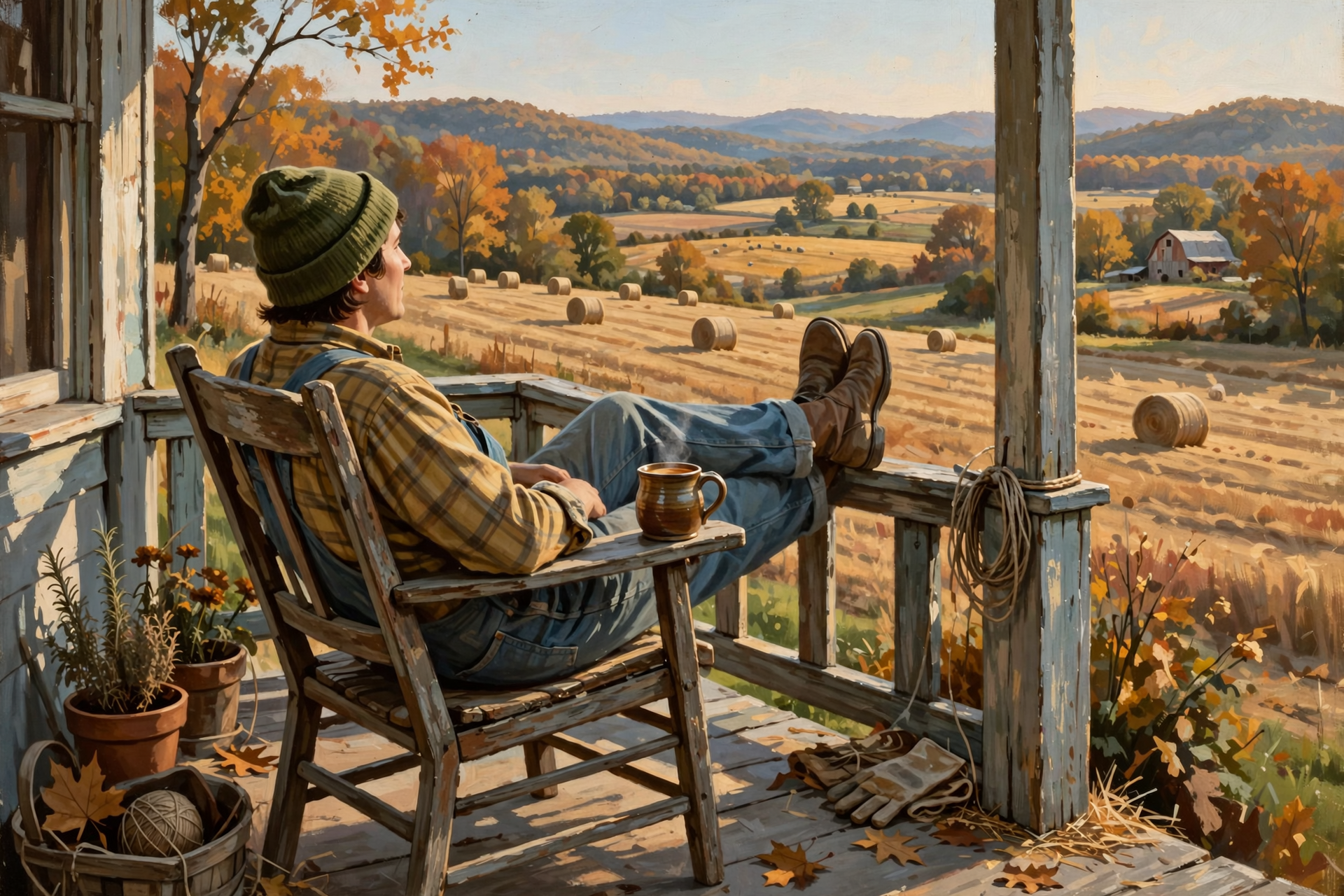
A windy evening and two chilly nights are just October doing what October does. Tie down the covers, carry the ferns inside, run the hay numbers once, and you can enjoy a sunny, dry week with your feet up on the porch rail.
When you want the next calm, practical update for Sequatchie Valley readers, pull up a chair at Dunlap.Today.
Know about an upcoming event or story in the Sequatchie Valley? Submit it here.




0 Comments