
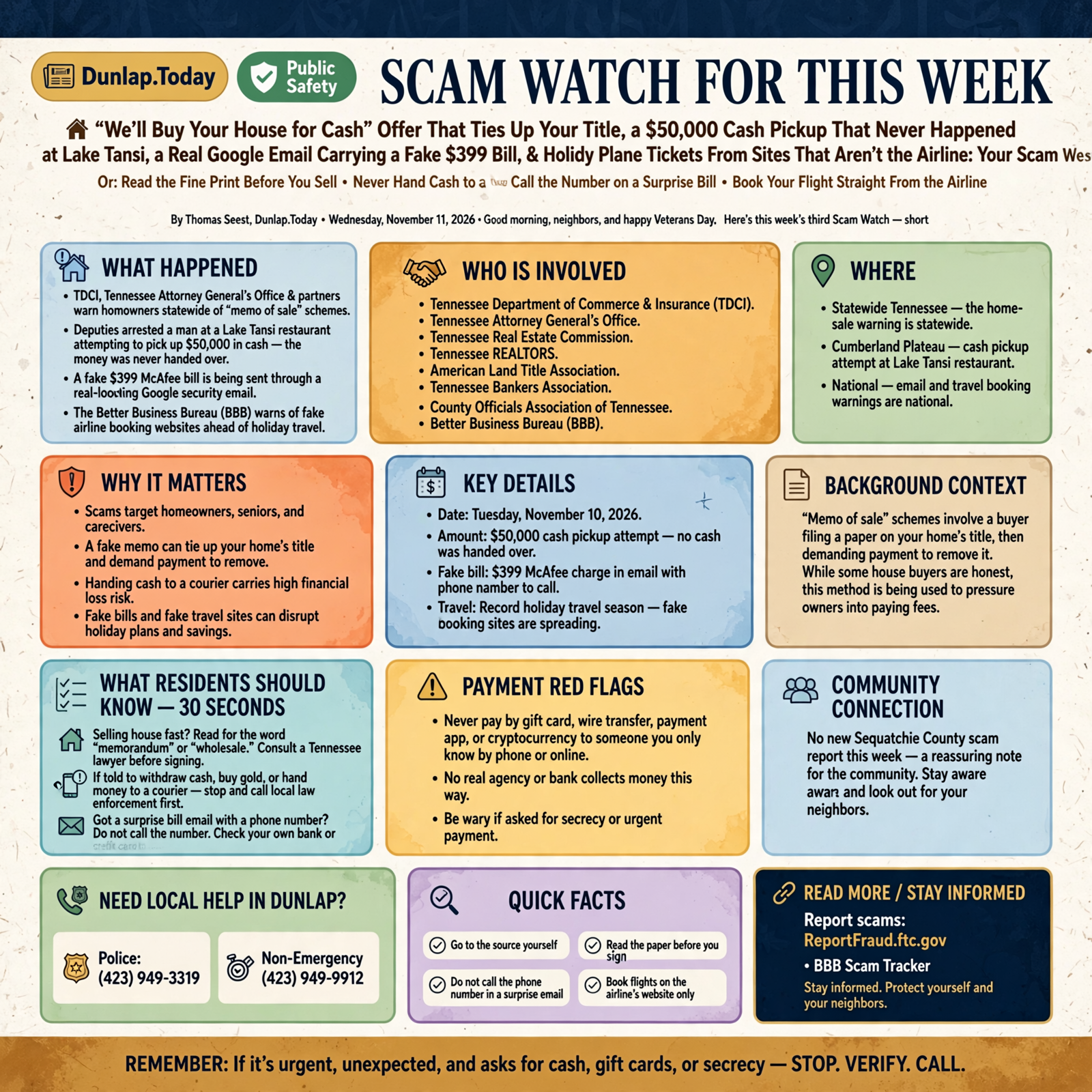
🏠 A "We'll Buy Your House for Cash" Offer That Ties Up Your Title, a $50,000 Cash Pickup That Never Happened at Lake Tansi, a Real Google Email Carrying a Fake $399 Bill and Holiday Plane Tickets From Sites That Aren't the Airline: Your Scam Watch for This Week

Or: Read the Fine Print Before You Sell, Never Hand Cash to a Courier, Never Call the Number on a Surprise Bill and Book Your Flight Straight From the Airline
By Thomas Seest, Dunlap.Today · Wednesday, November 11, 2026
Good morning, neighbors, and happy Veterans Day. Here’s this week’s third Scam Watch, short enough to finish before the parade. All four items share one easy habit: go to the source yourself. Check the paper before you sign, call the law before you hand over cash, open your own account instead of calling the number in an email, and book on the airline’s own website.
Here’s what’s on the porch: on Tuesday, Nov. 10, the Tennessee Department of Commerce & Insurance (TDCI), the Tennessee Attorney General’s Office and several other groups warned homeowners about “memo of sale” schemes, where a so-called cash buyer files a paper on your home’s title and then wants money to remove it; up the plateau in Cumberland County, deputies say they arrested a man who came to a Lake Tansi restaurant to pick up $50,000 in cash from a scam target, and the money never left that person’s hands; tech security warnings say a real Google security email is being used to deliver a fake $399 McAfee bill with a phone number to call; and with record holiday travel ahead, the Better Business Bureau (BBB) says to watch for fake airline booking sites. The home-sale warning is statewide Tennessee. The cash pickup is regional, on the Cumberland Plateau. The email and travel warnings are national. We haven’t seen a new Sequatchie County scam report this week, and that’s worth a second cup.
⏱️ What this means for you in 30 seconds
- Somebody wants to buy your house fast for cash? Read the contract for the word “memorandum,” ask if they plan to “wholesale” it, and talk to a Tennessee lawyer before you sign anything you don’t understand.
- Anyone tells you to pull out cash, buy gold or hand money to a courier? Stop and call your local law enforcement first. No real agency or bank collects money that way.
- A surprise bill in your email with a phone number to call? Don’t call it. Check your own bank or card statement instead.
- Booking a flight for the holidays? Book on the airline’s own website or app, not through an ad or a text with a too-good price.
- Never pay by gift card, wire, payment app or cryptocurrency to someone you’ve only met by phone or online.
- Report scams at ReportFraud.ftc.gov or the BBB Scam Tracker.
- Need local help? In Dunlap, call police at (423) 949-3319 or non-emergency dispatch at (423) 949-9912.
🏠 “We Buy Houses for Cash” Can Hide a Paper That Ties Up Your Title

Statewide Tennessee: Tennessee Department of Commerce & Insurance and partners, Nov. 10, 2026
You’ve seen the signs on telephone poles and the postcards in the mailbox: “We buy houses, any condition, cash, fast.” Some of those buyers are honest. But on Tuesday, Nov. 10, TDCI joined the Tennessee Real Estate Commission, the Tennessee Attorney General’s Office, Tennessee REALTORS, the American Land Title Association, the Tennessee Bankers Association and the County Officials Association of Tennessee to warn homeowners, seniors and their caregivers about a rise in “memo of sale” schemes. Here’s how the state says it works:
- A company says it buys houses with cash and promises a quick, guaranteed sale.
- Instead of closing, it records a memorandum (“memo”) of sale with the county on your home’s title. That paper tells other buyers there’s a pending sale, which can keep you from selling to anyone else.
- Then the company refuses to close. To clear the title, it demands money, the state says typically tens of thousands of dollars, even though it broke the deal.
- Some call themselves real estate “wholesalers.” That means they find a third buyer who pays more, and they keep the difference, not you. In Tennessee, wholesalers must clearly disclose that they plan to do that.
Think of it like letting a fellow tie his mule to your gate “just until he comes back with the money.” He never comes back, and now he wants you to pay him to untie it.
What it means for you: The state’s tips are short enough to tape to the fridge: look for the word “memorandum” in any sales contract and work out in writing when it would be removed; ask plainly if the buyer plans to wholesale your property; get everything in writing; check the person’s license with TDCI’s free online search at verify.tn.gov; and if a buyer wants money to release a memo, talk to a licensed Tennessee attorney. If you think it happened to you, file a complaint with the Tennessee Attorney General’s Division of Consumer Affairs. Selling a home place is a big decision, and a good buyer won’t mind you taking a few days and asking your family or a lawyer to look things over.
👉 Read more (The Mountain Press: state consumer alert on “memo of sale” schemes, Nov. 10) · FOX 17: State warns of “memo of sale” schemes (Nov. 10)
💵 A $50,000 Cash Pickup at Lake Tansi That Didn’t Happen

Regional: Cumberland County Sheriff’s Office, arrest Nov. 6, reported Nov. 9, 2026
Here’s a story with a good ending. The Cumberland County Sheriff’s Office says investigators arrested a 26-year-old California man on Friday, Nov. 6, who they say had traveled to Crossville to pick up $50,000 in cash from a person targeted in a scam. The pickup was set for the 19th Hole Restaurant at Lake Tansi. He’s charged with attempted theft and a computer-crime offense. Those are accusations, and he’s presumed innocent unless proven guilty in court.
The sheriff’s office said the arrest was part of a nationwide effort aimed at organized fraud schemes that prey on older adults, with help from the Tennessee Bureau of Investigation, the FBI and other agencies. The best part: the word is “attempted.” The cash stayed with its owner.
Think of a cash courier like a stranger who shows up at the barn saying your neighbor sent him to fetch your best saddle. Your neighbor would’ve just called you himself.
What it means for you: The sheriff’s office put it plainly. If anyone tells you to withdraw cash, buy gold or hand valuables to a courier, stop and call local law enforcement before you hand over anything. Scammers often pretend to be trusted officials, ask you to keep it secret and rush you before you can talk to your bank or the police. Remember this one: no real government agency, bank or police department sends somebody to your house or a restaurant to collect your money. In Dunlap, call police at (423) 949-3319. If you already handed over money, call your bank and local police right away, because quick reports help investigators like these.
👉 Read more (Chattanoogan.com: man arrested on way to pick up $50,000 at Crossville restaurant, Nov. 9) · WVLT (Nov. 9)
📧 A Real Google Email With a Fake $399 Bill Inside. Don’t Call the Number
National: University of Michigan IT security warning (Oct. 6) and security reports (Nov. 2 and Nov. 9, 2026)
Most of us have learned to check who sent an email. This trick is sneakier, and it’s still circulating. The University of Michigan’s IT security team warned about it in October, and security writers have kept flagging it into November. Here’s how it works:
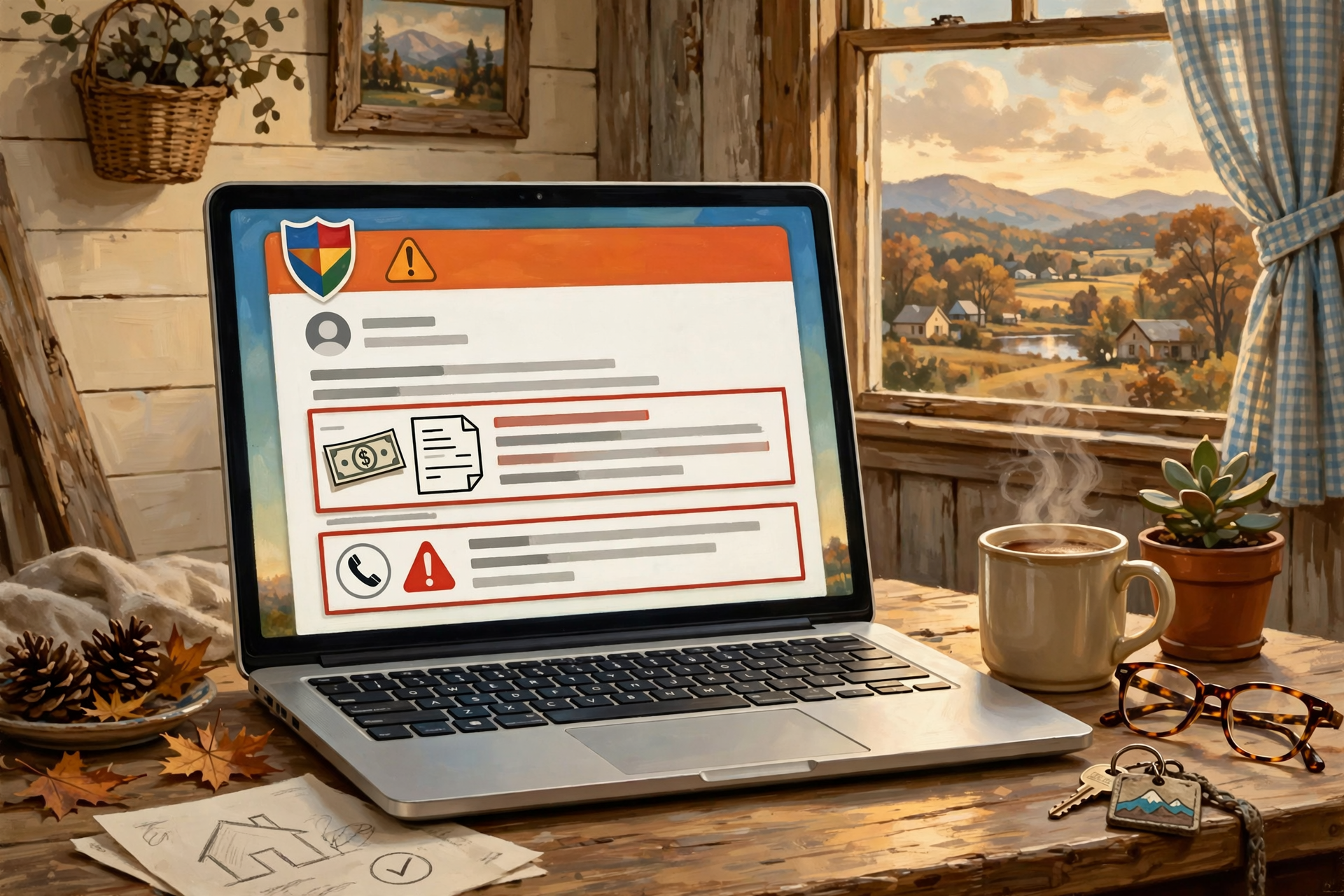
- A scammer types a fake $399 McAfee invoice and a phone number into a name box on their own Google account.
- Google then sends a real, genuine security alert (“App password created”) that repeats that text, and the scammer forwards it to you.
- Because the email really did come from Google, it can slip past spam filters. If you click the real Google buttons, you’ll find nothing wrong with your account, because it was never about your account.
- That leaves one thing to do: call the number. That’s where the “refund” pitch, the request to let them onto your computer and the request for money begin.
It’s a bit like a real feed-store receipt with somebody else’s name on it and a stranger’s phone number scribbled at the bottom. The paper is real. The note on it isn’t.
Fake emails wearing big-name logos are common. Quartz, citing Check Point security figures, reported that Microsoft‘s name showed up in 33% of brand-phishing attempts in the third quarter of 2026, followed by Apple and Google at 8% each, then LinkedIn and Amazon.
What it means for you: Remember this rule: never call a phone number printed in a surprise bill or “charge” email. If you’re worried, check your own bank or card statement. For Google, go straight to myaccount.google.com/notifications to see your real security activity, and notice that a fake alert names an email address that isn’t yours. For Amazon messages, Amazon says you can forward a suspicious message to verify@amazon.com to check it. If you already called and let someone onto your computer, turn off the internet, run your security software, change passwords from a different device and call your bank.
👉 Read more (University of Michigan Safe Computing phishing alert) · How the app-password scam works (Nov. 2) · Quartz: most-impersonated brands (Nov. 9)
✈️ Holiday Plane Tickets: Book With the Airline, Not a Look-Alike

National: Better Business Bureau of Greater Houston via KPRC, Nov. 10, 2026
Lots of Valley families are working out how to get Grandma home for Thanksgiving or Christmas. KPRC in Houston reported on Monday, Nov. 10, that a record 122 million Americans are forecast to travel over the holidays, and the BBB is warning about fake third-party airline booking websites pushed through social media ads, texts and other messages with tempting prices.
Leah Napoliello of the BBB of Greater Houston said you can lose two ways. Sometimes “you actually didn’t book any tickets whatsoever.” Other times the tickets are real, but “there are a bunch of extra fees tacked on” that you wouldn’t pay booking straight with the airline.
It’s like buying a bushel of apples from a fellow parked down the road from the orchard. The orchard’s right there, and you’ll know what you’re getting.
What it means for you: The BBB’s tips: be wary of unusually cheap airfare, especially in ads or messages you didn’t ask for; don’t rush to click links in texts or social media; search the site’s name plus the word “scam” before paying; and compare with the airline’s own website, where booking directly avoids surprise fees. Type the airline’s address yourself or use its official app. If you paid a site that turns out to be fake, call your card company right away and report it at ReportFraud.ftc.gov.
👉 Read more (KPRC Click2Houston: How to avoid fake airline booking sites, Nov. 10)
✅ Your Front-Porch Scam Checklist
- ✅ Selling your home? Look for the word “memorandum” in the contract before you sign.
- ✅ Ask any cash buyer straight out: “Do you plan to wholesale this?”
- ✅ Check a buyer’s or agent’s license free at verify.tn.gov.
- ✅ A buyer wants money to remove a memo from your title? Call a Tennessee attorney, then the Attorney General’s consumer office.
- ✅ Told to pull out cash, buy gold or meet a courier? Stop and call local law enforcement first.
- ✅ Somebody says keep it secret from your bank or family? That’s the scam talking.
- ✅ Surprise bill in your email? Don’t call the number in it. Check your own statement.
- ✅ A security alert names an email address that isn’t yours? It’s not about you. Delete it.
- ✅ Booking holiday flights? Use the airline’s own website or app, typed in yourself.
- ✅ Never pay strangers with gift cards, wire transfers, payment apps or cryptocurrency.
- ✅ Already paid, signed or called? Call your bank first, then report it at ReportFraud.ftc.gov, BBB Scam Tracker and local police.
The practical rule: Go to the source yourself. Read the paper, call the law, open your own account and book with the airline. Never let the stranger hand you the phone number, the courier or the link.
— Dunlap.Today
📚 Plain-English Glossary
- Memorandum (memo) of sale: A paper filed in county records saying a home is under contract. It can stop the owner from selling to anyone else until it’s removed.
- Title: The legal record of who owns a property. A “cloud” on the title is anything that makes it hard to sell cleanly.
- Real estate wholesaler: Someone who signs a contract to buy your home and then sells that contract to another buyer for more money, keeping the difference.
- TDCI: The Tennessee Department of Commerce & Insurance, the state office that licenses real estate agents and many other professions.
- Cash courier: A person sent by scammers to pick up cash, gold or valuables in person from a victim.
- Callback scam: A fake bill or warning that gives you a phone number to call, so a scammer can talk you into paying or letting them onto your computer.
- Phishing: Fake emails, texts or websites dressed up to look like a real company, meant to get your money or passwords.
- Third-party booking site: A website that sells airline tickets but isn’t the airline itself. Some are real businesses; some are fakes.
❓ Frequently Asked Questions

Are all “we buy houses for cash” companies scams?
No. Some are honest businesses. The state’s warning is about buyers who record a memo of sale, don’t close and then demand money to clear it. Read the contract, ask if they plan to wholesale, get everything in writing and check licenses at verify.tn.gov.
I already signed with a cash buyer and now they want money to release a memo. What do I do?
Don’t panic and don’t pay right away. The state says to talk to a licensed Tennessee attorney, and you can file a complaint with the Tennessee Attorney General’s Division of Consumer Affairs.
Why would anybody hand $50,000 in cash to a stranger?
Because scammers are good at scary stories. They pretend to be officials, say your money is in danger or a loved one is in trouble, and tell you to keep it secret. The sheriff’s office says if anyone tells you to withdraw cash, buy gold or hand money to a courier, call law enforcement first.
Is the Lake Tansi case closed?
No. The man is charged, not convicted. The Cumberland County Sheriff’s Office says his next court date is Dec. 7, and investigators are working with the FBI on more leads.
I got a Google “app password created” email with a $399 charge. Was my account hacked?
According to the security warnings, no. The alert is about the scammer’s own Google account, not yours. Check your real activity at myaccount.google.com/notifications, and don’t call the number in the email.
I called the number and let them onto my computer. Now what?
Turn off Wi-Fi or unplug the internet cable, run your security software and change important passwords from a different device, starting with email and banking. Call your bank. A trusted local computer shop can help if you’re not comfortable doing it yourself.
How can I tell if an airline booking site is real?
The safest way is to skip the question: type the airline’s web address yourself or use its official app. If you do use another site, search its name with the word “scam” and compare the price with the airline’s own site before paying.
I already sent money in one of these scams. Is it too late?
No, and you’re not alone. Call your bank, card company or payment app right away and ask them to stop or reverse the payment. Then report it at ReportFraud.ftc.gov and BBB Scam Tracker, and call local police. In Dunlap, that’s (423) 949-3319.
🔗 Other Resources

- The Mountain Press: Consumer Alert on predatory “memo of sale” scams (Nov. 10, 2026)
- 3B Media News: Tennessee regulators warn homeowners of “memo of sale” cash-buyer scams (Nov. 10, 2026)
- Tennessee Department of Commerce & Insurance: News · TDCI license lookup (verify.tn.gov)
- TN Attorney General: Scams, Schemes & Swindles
- Chattanoogan.com: Cumberland County cash-pickup arrest (Nov. 9, 2026)
- University of Michigan Safe Computing: “App password created” phishing alert
- Amazon: How to check if a message is really from Amazon
- KPRC: How to avoid fake airline booking sites (Nov. 10, 2026)
- National Elder Fraud Hotline (U.S. Justice Department): 1-833-372-8311 · AARP Fraud Watch Network Helpline: 877-908-3360
- Report a scam: ReportFraud.ftc.gov · FBI IC3 · BBB Scam Tracker
🌄 Rest Easy: Going to the Source Takes Two Minutes and Saves a Lot of Worry

Here’s the calm takeaway: you don’t have to be a lawyer, a detective or a computer whiz. Whether it’s a cash offer on the home place, a stranger coming for your money, a surprise bill in your inbox or a too-cheap plane ticket, the fix is the same. Go to the source yourself and take your time. And this week brought good news from up the plateau: somebody’s $50,000 stayed right where it belonged. Share this with the neighbor thinking about selling, the grandparent who handles the bills and the family booking holiday flights. And to every veteran in the Valley on this Veterans Day, thank you. We’ll keep watch and bring you what’s new. Read Dunlap.Today and sign up for our newsletter for plain-English scam alerts and Valley news.
Know about an upcoming event or story in the Dunlap, TN area? Submit it here.

0 Comments