
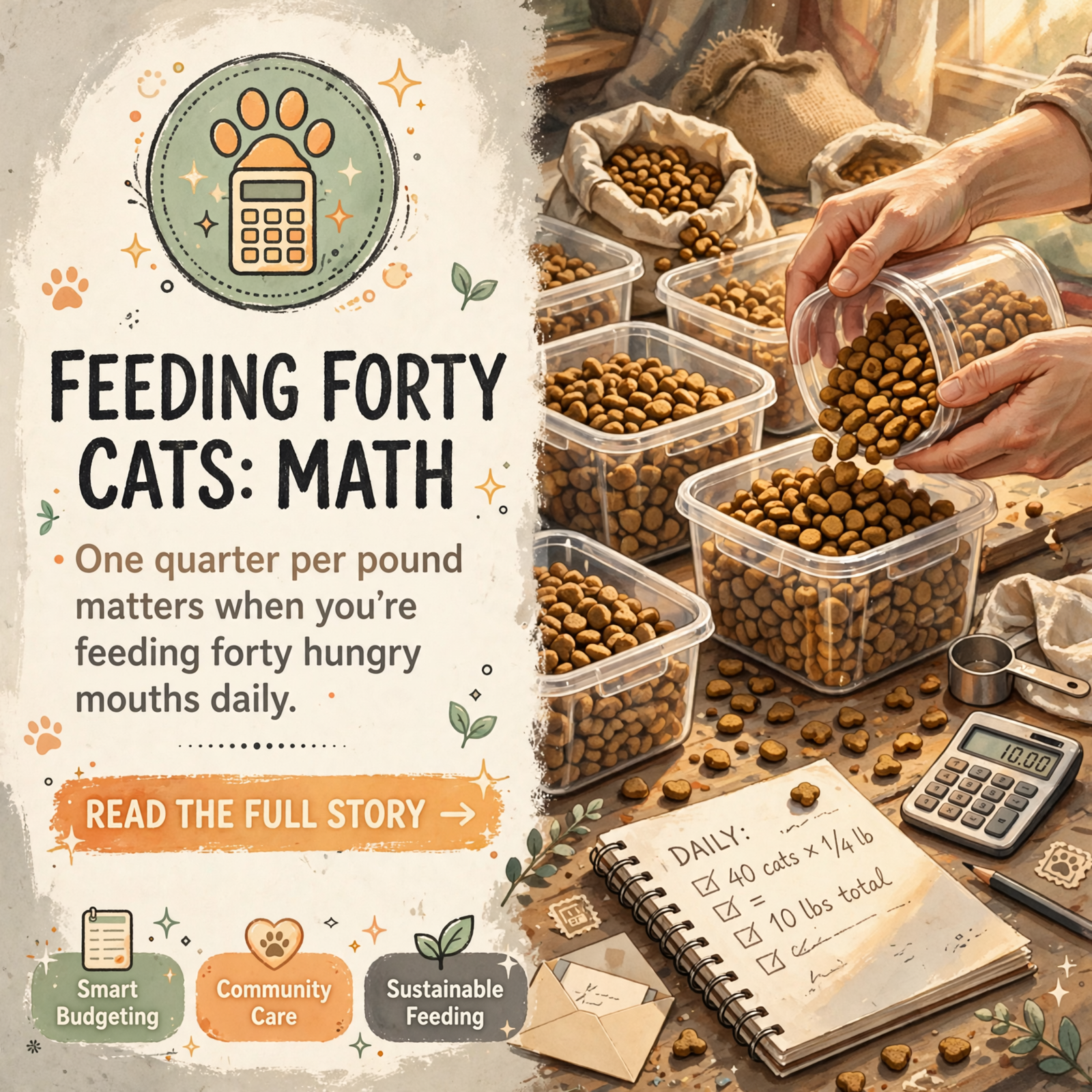
💰 What Does It Actually Cost to Feed 40 Community Cats?

🐾 The Scaredy Cat Project — Article #16
We’ve spent quite a few articles walking through the meat department.
Chicken hearts.
Gizzards.
Liver.
Eggs.
Venison.
Rabbit.
Fish.
Beef heart.
Pork.
Chicken thighs.
But eventually we have to stop asking:
“Is this ingredient useful?”
and ask the question that determines whether any of this is sustainable:
“What does it actually cost to feed roughly 40 cats?”
🧮 Forty Cats Turn Grocery Shopping Into Accounting
If you have one house cat, a few dollars either way on a bag of food may not change the household budget very much.
With forty cats, every small difference gets multiplied.
A quarter per pound matters.
Waste matters.
Driving across the county for a bargain matters.
Whether the cats actually eat what you bought matters.
And whether one food contains more calories per pound than another matters.
Suddenly we’re not just feeding cats.
We’re managing inventory.
🐱 Start With a Rough Feeding Benchmark

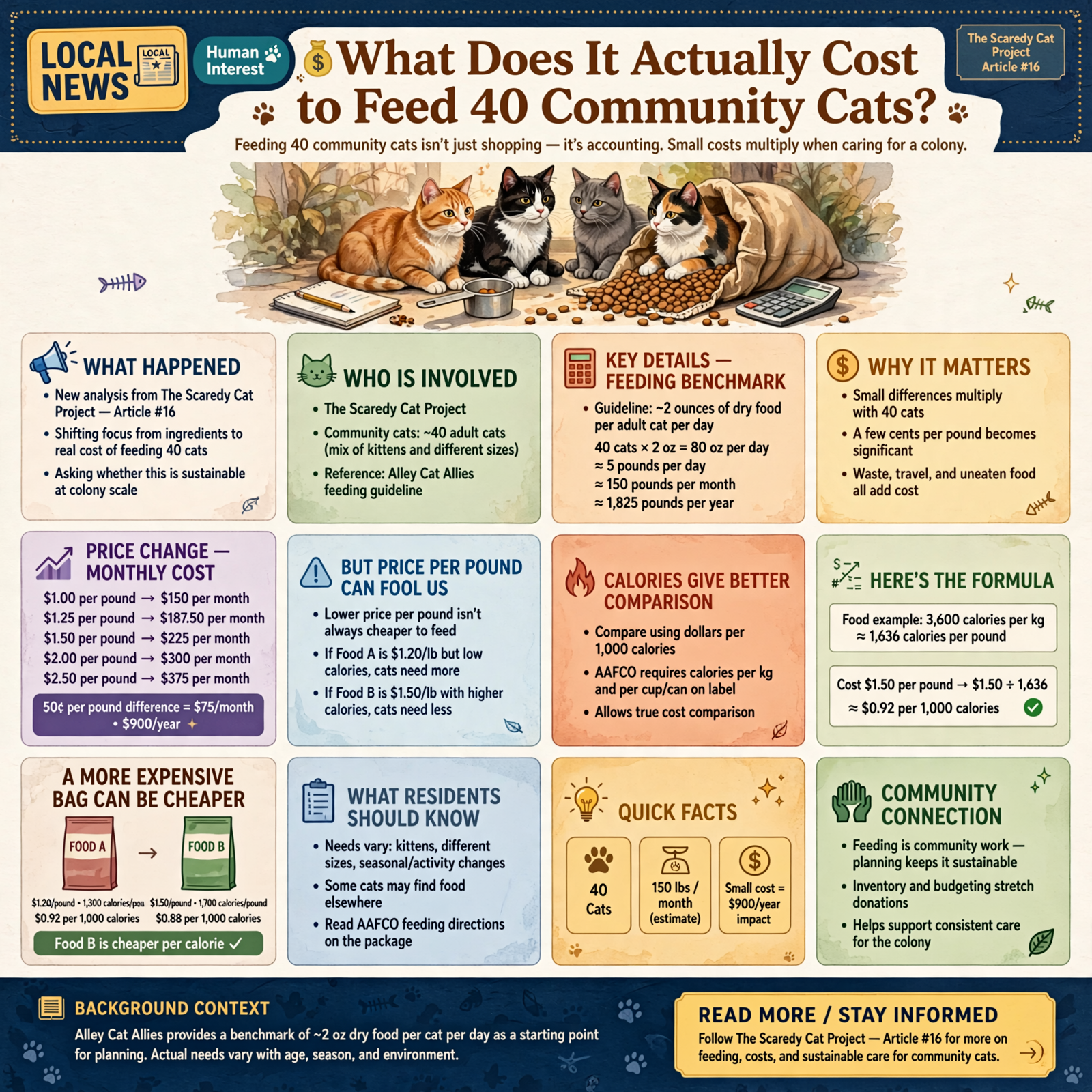
Alley Cat Allies gives a general guideline of about 2 ounces of dry food per adult cat per day when dry food is the primary food, while emphasizing that individual needs vary.
For forty adult cats, that rough benchmark becomes:
- 🐱 40 cats
- 🥣 2 ounces per cat per day
- ⚖️ 80 ounces per day
- 📦 5 pounds per day
- 📅 About 150 pounds over 30 days
Over a year, that would be roughly:
1,825 pounds of dry food.
That is only a planning benchmark.
Our actual group includes kittens, cats of different sizes, seasonal changes, different activity levels and animals that may obtain some food elsewhere.
But 150 pounds a month gives us a place to begin.
💵 Now Watch What Happens When Price Changes

If we were really using 150 pounds of food per month, then:
At $1.00 Per Pound
$150 per month.
At $1.25 Per Pound
$187.50 per month.
At $1.50 Per Pound
$225 per month.
At $2.00 Per Pound
$300 per month.
At $2.50 Per Pound
$375 per month.
A fifty-cent difference per pound becomes:
$75 per month.
Or:
$900 per year.
At our scale, little numbers stop being little.
⚠️ But Price Per Pound Can Fool Us

This is where the math gets more interesting.
Suppose Food A costs:
$1.20 per pound.
Food B costs:
$1.50 per pound.
Food A looks cheaper.
But what if Food B contains substantially more usable calories per pound?
Then the cats may need less of it.
And suddenly the supposedly expensive food may be cheaper to feed.
🔥 Calories Give Us a Better Comparison

AAFCO requires pet-food labels to provide caloric content in kilocalories per kilogram and in a familiar unit such as calories per cup or can.
That gives us a much better tool.
Instead of only comparing:
dollars per pound
we can calculate:
dollars per 1,000 calories.
🧮 Here’s the Formula

Suppose a food contains:
3,600 calories per kilogram.
A kilogram is about 2.2 pounds.
That means the food contains roughly:
1,636 calories per pound.
If the food costs $1.50 per pound:
$1.50 ÷ 1.636 = about $0.92 per 1,000 calories.
Now we have a number we can compare with another food.
📊 A More Expensive Bag Can Be Cheaper Food

Imagine two hypothetical dry foods.
Food A
Price: $1.20 per pound
Calories: 1,300 per pound
Cost per 1,000 calories:
about $0.92
Food B
Price: $1.50 per pound
Calories: 1,700 per pound
Cost per 1,000 calories:
about $0.88
The supposedly expensive food is actually cheaper per calorie.
That’s why I no longer want to compare bags by sticker price alone.
🥣 Feeding Directions Matter Too

AAFCO requires feeding directions on complete and balanced foods and emphasizes that those directions are guidelines that may need adjustment for the particular animal.
That gives us another useful comparison.
For each food, record:
- 📦 Bag weight
- 💵 Bag price
- 🔥 Calories per cup
- 🥣 Recommended daily quantity
- 🐱 How much our cats actually consume
The label gives us a starting point.
The cats give us the real-world answer.
🗑️ Waste Can Destroy a Bargain

Suppose a cheap food costs $1 per pound.
Wonderful.
But suppose 20 percent of it regularly gets left behind.
Now our effective usable-food cost is closer to:
$1.25 per pound actually eaten.
And that’s before considering the mess.
Alley Cat Allies recommends watching how quickly community cats eat: if food is consistently gone within about 15 minutes, they may need more; if food is still sitting after about 30 minutes, the caregiver may be serving too much.
That’s not just good colony management.
It’s cost control.
⏱️ The 15-Minute and 30-Minute Test Is Basically Inventory Management

If forty cats clean everything up immediately every day, we’re probably under-serving.
If several pounds are consistently left sitting around, we’re over-serving.
Either way, the feeding station tells us something.
If Food Is Gone in 15 Minutes
Consider increasing the amount slightly.
If Food Remains After 30 Minutes
Consider decreasing the amount.
That feedback loop may save a surprising amount of food over a year.
🦝 Waste Isn’t Just Money in the Trash

Food left outside can also feed:
- 🦝 Raccoons
- 🦨 Skunks
- 🐀 Rodents
- 🐜 Insects
- 🐦 Birds
Alley Cat Allies specifically recommends removing uneaten food and keeping feeding locations clean to reduce insects and wildlife attraction.
So reducing waste helps:
the budget, sanitation and wildlife management.
🥫 Wet Food Makes Price Comparisons Trickier

Wet food often looks expensive per pound.
And it usually is more expensive per calorie than dry food.
But it contains much more water.
That moisture has value.
AAFCO specifically cautions that calorie comparisons between wet and dry food can be misleading when made only by weight because canned foods contain far more moisture.
So if we want to compare dry and wet food fairly, we should look at:
- 🔥 Calories
- 💵 Cost per calorie
- 💧 Moisture
- 😸 Palatability
- 🥣 How much gets eaten
💧 Water Is Part of the Feeding Budget Too

Cats need clean, fresh water every day.
Alley Cat Allies emphasizes fresh water year-round and notes that additional water becomes particularly important in hot weather.
Water itself may be inexpensive.
But reliable water access may require:
- 🥣 Bowls
- 🧹 Cleaning
- 🌡️ Heated bowls in winter
- 🌳 Shade in summer
- 🚰 Refilling
Those are part of colony operations even if they don’t appear on the cat-food receipt.
❄️ Winter Changes the Numbers

Outdoor cats can need additional food during cold weather.
Alley Cat Allies recommends increasing food portions during winter to help cats maintain energy and body heat.
That means our annual food budget should not assume every month is identical.
We may eventually need:
🌸 Spring Baseline
Normal feeding levels.
☀️ Summer Baseline
Strong emphasis on water and minimizing food spoilage.
🍂 Fall Baseline
Normal feeding while preparing freezer inventory for winter.
❄️ Winter Baseline
Potentially higher calorie requirements.
That seasonal planning may make bulk buying much more useful.
🐾 Kittens Make the Budget Messier

Kittens aren’t simply smaller adults.
Cornell notes that cats have different nutritional requirements depending on life stage, including kittenhood, adulthood, pregnancy and lactation.
That matters because our colony isn’t forty identical adult cats.
We may have:
- 🐾 Kittens
- 🐱 Adults
- 🤰 Pregnant females
- 🍼 Nursing mothers
- 👴 Older cats
So the real budget needs enough flexibility to handle animals whose calorie and nutritional needs aren’t identical.
📦 “All Life Stages” May Simplify Colony Logistics

Cornell notes that some complete foods are formulated for all life stages, which can simplify feeding in households containing cats of different ages.
That concept is particularly interesting for a colony.
It may not be the perfect solution for every individual animal.
But operational simplicity matters when you have forty mouths appearing at the same feeding station.
One complete food appropriate for multiple life stages could reduce:
- 📦 Inventory complexity
- 🥣 Feeding mistakes
- 💵 Multiple-product purchasing
- 🧊 Storage clutter
That’s worth investigating.
🍗 Supplemental Foods Have a Cost Too

We’ve spent this series investigating:
Chicken hearts.
Gizzards.
Liver.
Eggs.
Venison.
Rabbit.
Fish.
Beef heart.
Pork.
Chicken thighs.
Some may be cheap.
Some may be free.
But none is truly costless.
💵 Purchase Cost
What did we pay?
🚗 Pickup Cost
How far did we drive?
🧊 Storage Cost
Does it require freezer space?
🍳 Preparation Cost
Does it require cooking and cutting?
🗑️ Waste
How much gets discarded?
⏱️ Time
How much human effort does it require?
“Free chicken” that requires two hours of driving and an hour of processing isn’t actually free.
🚗 Distance Can Erase a Food Bargain

Suppose a store 30 miles away has cat food for $5 less per bag.
Great.
But if we drive 60 miles round trip solely for that food, fuel and vehicle cost matter.
If we’re already going there for another reason, that’s different.
So perhaps our buying rule becomes:
Never evaluate a bargain without considering how we’re getting it home.
🧊 Freezer Space Has Economic Value
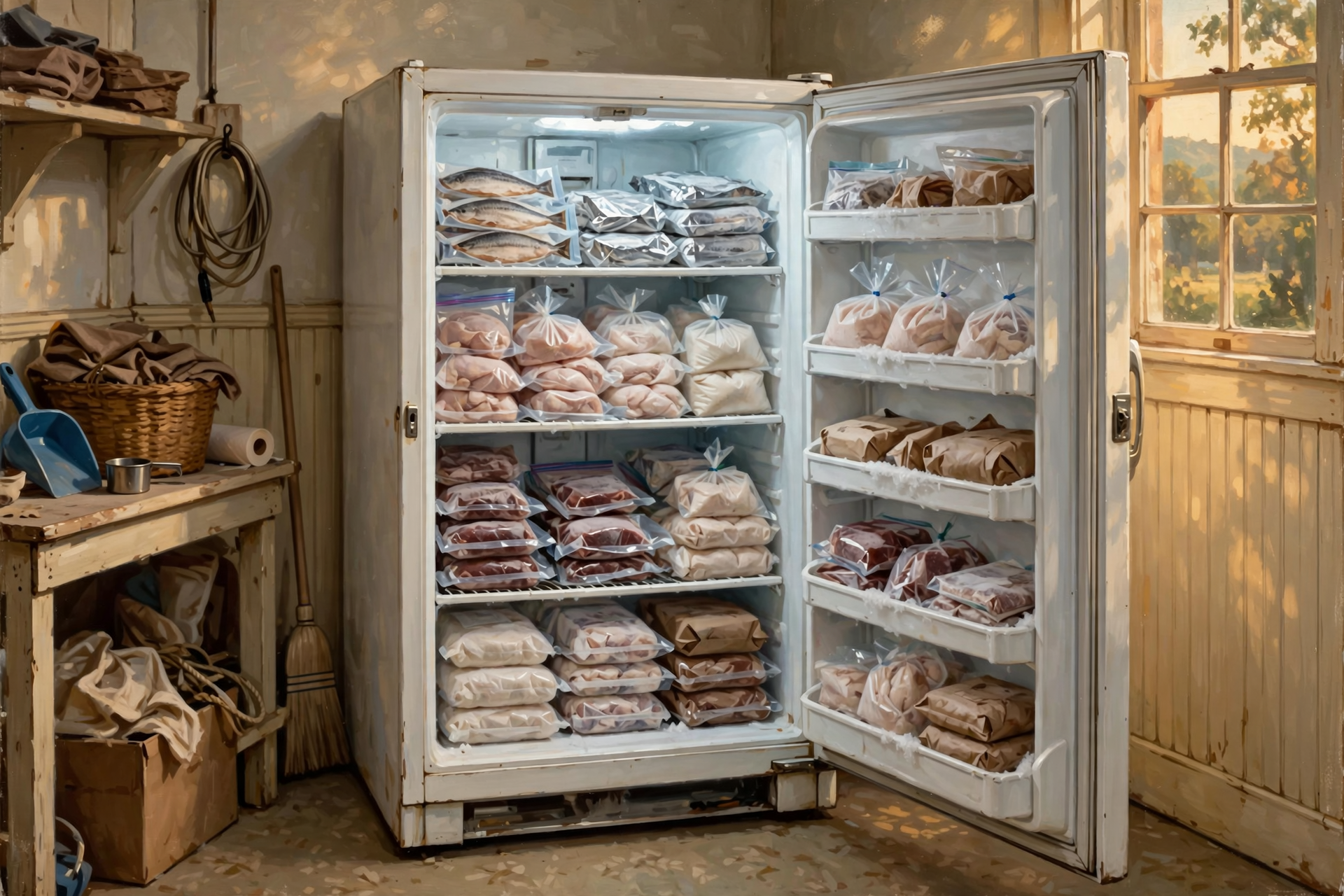
We’ve mentioned the community-freezer idea repeatedly.
Here’s why it matters financially.
A freezer lets us buy when:
- 🍗 Chicken thighs are deeply discounted
- ❤️ Hearts are available cheaply
- 🦌 Venison is donated
- 🐟 Fish is available in bulk
- 🥩 A processor has an opportunity
Without freezer capacity, bargains have to match today’s feeding schedule.
With freezer capacity, we can separate:
when we buy
from:
when we feed.
That is a major economic advantage.
⚡ But Freezer Space Isn’t Free Either
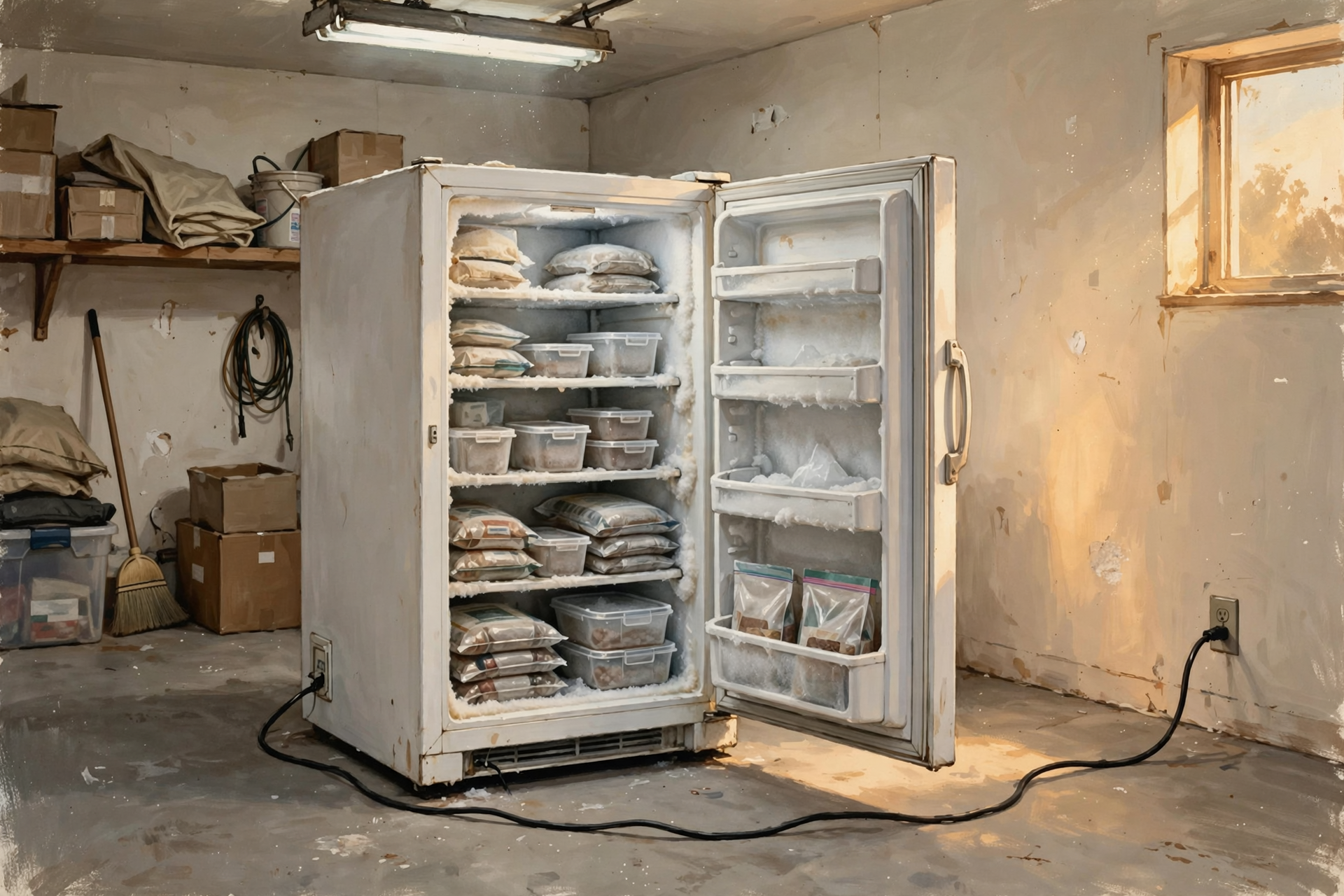
A freezer costs money.
It uses electricity.
It requires space.
It needs maintenance.
And if it fails while full, the loss can be substantial.
So eventually our cost model should include:
- 🧊 Equipment cost
- ⚡ Electricity
- 🔧 Maintenance
- 📦 Packaging
- ⚠️ Spoilage risk
We’re probably not going to calculate the cost of every kilowatt-hour every time we feed Scaredy.
But we should know the cost exists.
🥣 Supplements Can Save Money—or Quietly Increase It

Suppose we start with affordable complete dry food.
Then we add:
- 🥫 Wet food
- 🍗 Chicken
- ❤️ Heart
- 🥚 Egg
- 🐟 Tuna
If those additions replace more expensive food or reduce waste, they may save money.
If they simply get added on top of everything we were already feeding, they may increase the food budget.
This is why we need to measure.
📊 The Number I Really Want: Cost Per Cat Per Day

Ultimately, this may be our simplest scoreboard.
Take the entire monthly feeding cost:
food + supplements + realistic feeding-related costs
and divide by:
cat-days.
If we feed 40 cats for 30 days:
40 × 30 = 1,200 cat-days.
If our monthly food cost is $240:
$240 ÷ 1,200 = $0.20 per cat per day.
If it is $360:
$0.30 per cat per day.
Now we have a number we can track over time.
📅 Monthly Cost Is Useful. Daily Cost Is More Useful.

Imagine we know:
September: $0.29 per cat per day
October: $0.24
November: $0.31
Now we can ask why.
Was November colder?
Were there more kittens?
Did we switch foods?
Did we buy expensive wet food?
Did someone donate chicken?
Did waste increase?
That’s real information.
📈 Cost Per Cat Per Day Also Lets Us Compare Colonies

Suppose another caregiver feeds twelve cats.
They spend less total money than we do.
Of course they do.
They feed fewer cats.
But if they spend:
$0.40 per cat per day
while we spend:
$0.25 per cat per day
now we have something useful to compare.
Maybe they use better food.
Maybe we buy more efficiently.
Maybe their cats need more calories.
The number doesn’t tell us who’s right.
It gives us a question worth investigating.
🔥 Cost Per 1,000 Calories Tells Us Something Different

Cost per cat per day tells us what we’re spending.
Cost per 1,000 calories tells us what the food itself costs energetically.
I think we should track both.
💰 Cost Per Cat Per Day
Operational metric.
🔥 Cost Per 1,000 Calories
Food comparison metric.
Together, they tell us much more than bag price.
📋 The Scaredy Cat Feeding Cost Scorecard
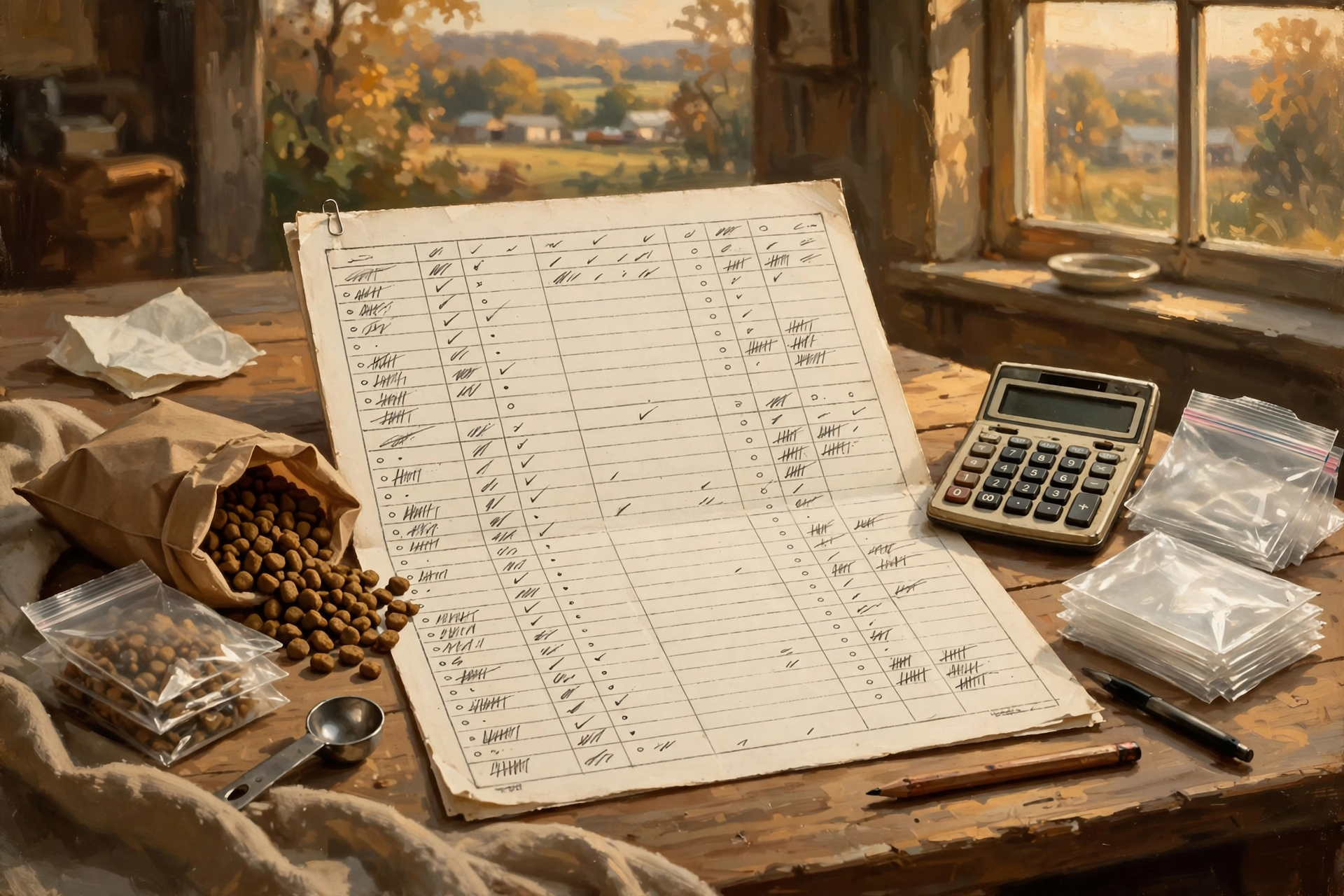
I think we now have enough experience to create another standard scorecard.
🐱 Cat Count
How many animals are actually being fed?
📦 Complete Food Pounds Used
How much did we go through?
🔥 Calories Purchased
Use the calorie statement from the label.
💵 Complete Food Cost
Actual amount spent.
🍗 Supplemental Food Cost
Meat, eggs, fish, wet food and other extras.
🎁 Donated Food Value
Track separately so donations don’t make the true resource requirement invisible.
🗑️ Estimated Waste
Food left behind or spoiled.
🚗 Acquisition Cost
Meaningful special trips.
🧊 Storage and Packaging
Freezer bags, containers and other recurring expenses.
💰 Cost Per Cat Per Day
Our primary operational number.
🔥 Cost Per 1,000 Calories
Our product-comparison number.
🎁 Donations Need Their Own Column

This is important.
Suppose neighbors donate $100 worth of food.
Our cash expense drops dramatically.
Wonderful.
But the cats still consumed $100 worth of resources.
If we only track what came out of our pocket, we could fool ourselves into thinking the feeding system costs less than it really does.
So I would track:
cash cost
and:
total resource value.
That way we understand both.
🤝 Donations Can Still Change Everything

Even if donated food isn’t economically “free” to society, it can make the colony financially sustainable for the caregiver.
That’s important.
One person donating one bag a month may not sound dramatic.
But if ten people each donate one bag periodically, the effect becomes substantial.
Community problems are often easier when the community actually participates.
📉 The Cheapest Long-Term Cat Food Is Spay and Neuter
This is where the economics get uncomfortable but obvious.
Imagine we reduce food cost by 10 percent.
Great.
Now imagine the colony grows from 40 cats to 60.
Our clever food savings disappear immediately.
Forty cats at $0.25 per day cost:
$10 per day.
Sixty cats at the same rate cost:
$15 per day.
That’s:
$1,825 more per year.
And that’s before veterinary care or anything else.
So from a purely economic perspective:
spay and neuter isn’t separate from the feeding budget.
It is one of the most important parts of the feeding budget.
🐾 Every Kitten We Prevent Is a Food Bill We Never Create

That sounds cold.
It isn’t.
It’s exactly the opposite.
Every unwanted litter creates more animals competing for:
- 🥣 Food
- 💧 Water
- 🏡 Shelter
- 💉 Veterinary care
- ❤️ Human attention
If we can prevent that litter through spay and neuter, we improve the lives of the cats already here.
🏡 Adoption Changes the Economics Too

Suppose one friendly kitten finds a home.
The colony drops from 40 to 39.
That doesn’t sound dramatic.
But that cat’s lifetime food responsibility has moved to a household that specifically chose to care for it.
That creates more resources for the cats that remain.
So our project slogan:
Feed them. Fix them. Find them homes when we can.
is also a financial strategy.
🧮 The Real Goal Is Not Minimum Cost

This is probably the most important point in the article.
The goal is not:
How cheaply can we keep forty cats alive?
That’s the wrong question.
The goal is:
What is the lowest sustainable cost at which we can provide adequate nutrition, clean water and humane care while reducing the future colony population?
Those are very different goals.
❤️ Cheap Food That Creates Problems Isn’t Cheap

If a food is nutritionally inadequate, cheap doesn’t matter.
If cats refuse to eat it, cheap doesn’t matter.
If half gets fed to raccoons, cheap doesn’t matter.
If it requires expensive supplements to make it useful, cheap doesn’t matter.
If driving to buy it costs more than we save, cheap doesn’t matter.
If it makes managing forty cats much harder, cheap doesn’t matter.
We’re looking for:
efficient nutrition.
Not merely cheap ingredients.
🐱 Scaredy Has a Different Accounting Method
Scaredy’s financial model is simpler.
She calculates food cost using the following formula:
Tom has money + store has tuna = tuna should appear.
She has not yet expressed much concern about long-term sustainability.
This is another reason Scaredy remains in quality control rather than finance.
📊 Our First Scaredy Cat Budget Spreadsheet

If I were starting the tracking today, I would record:
- 📅 Date
- 🐱 Estimated cat count
- 🐾 Estimated kitten count
- 📦 Food brand
- ⚖️ Bag weight
- 💵 Purchase price
- 🔥 Calories per cup or kilogram
- 🥣 Pounds or cups served
- 🗑️ Estimated leftovers
- 🍗 Supplemental food
- 💵 Supplemental cost
- 🎁 Donations
- 🌡️ Weather notes
- 💰 Cost per cat per day
We don’t need laboratory precision.
We need enough data to see patterns.
📈 Three Months of Data Could Teach Us a Lot

After three months, we might know:
Which food costs less per calorie.
Which food creates less waste.
Which supplements actually help.
How winter changes consumption.
Whether sale buying saves money.
How much donated food matters.
Whether the cat count is rising or falling.
That’s much more useful than another argument on the internet about which cat-food brand somebody likes.
🔜 Next: Dry Food vs. Wet Food—Which Makes More Sense When You’re Feeding a Colony?

Now that we have a cost framework, we can tackle one of the biggest pet-food arguments.
Dry versus wet.
But we’re not going to approach it as a tribal debate.
We’re going to compare:
- 🔥 Calories
- 💧 Moisture
- 💵 Cost
- 📦 Storage
- 🗑️ Waste
- 🌡️ Outdoor weather
- 😸 Palatability
- 🥩 Nutritional completeness
Then we’ll ask the only question that matters:
What combination works best for the cats we’re actually feeding?
📣 What Does It Cost You to Feed Community Cats?

If you feed stray, feral or community cats around Dunlap or Sequatchie County, I’d like to compare notes.
How many cats are you feeding?
How much food do you use?
What does it cost each month?
Where do you buy it?
Do you buy in bulk?
Do neighbors donate?
Have you found a food the cats eat with very little waste?
Have you found a sale strategy that makes a meaningful difference?
If several local caregivers share their numbers, we may eventually be able to build a realistic Sequatchie County community-cat feeding benchmark.
❤️ Feed Them. Fix Them. Find Them Homes When We Can. Help the Rest Age Gracefully.

The Scaredy Cat Project started with a cat missing her tuna.
It has gradually turned into a lesson in nutrition, agriculture, food recovery, inventory and now accounting.
That seems appropriate.
Forty cats don’t need one brilliant idea.
They need a system that works every day.
Good complete food.
Useful supplements.
Clean water.
Less waste.
Smart purchasing.
Local help.
Spay and neuter.
Adoption where possible.
And enough measurement that we can tell whether we’re actually improving.
The cheapest feeding program isn’t necessarily the best one.
The best one is the feeding program we can afford to sustain while giving the cats what they actually need.
🐾 Feed them. Fix them. Find them homes when we can. Help the rest age gracefully.
🔎 Sources & Further Reading

- Alley Cat Allies — Community & Feral Cat Feeding Tips
- Alley Cat Allies — Best Practices: Community Cat Colony Care
- Cornell University College of Veterinary Medicine — Feline Health Center, Feeding Your Cat
- Association of American Feed Control Officials — Reading Labels
- Association of American Feed Control Officials — Calories




0 Comments