
⚾ Check the Work, Even the Judge’s: An Appeals Court Pulls a Case Over Made-Up Citations, Doc Review Isn’t Dead, and AI Meeting Notes Become Evidence

Or: 5th Circuit Reassigns Mississippi Case After AI-Tainted Orders, Law.com Says Document Review Still Needs Humans, No AI Model Tops 60% on ContractBench and the EU’s Human-Review Test: The Week’s eDiscovery AI News in Plain English
By Thomas Seest, Dunlap.Today · Friday, October 23, 2026
Remember when baseball added instant replay? For a hundred years, the umpire’s call was the call. Then everybody realized that even the best umpire misses one now and then, and the fix wasn’t firing umpires. It was checking the tape.
This week, a federal appeals court checked the tape on a federal judge. His orders in a Mississippi case cited parties, quotes and even a court case that don’t exist, and a law clerk had used an AI tool on an early draft. The appeals court sent the case to a different judge. Meanwhile, a columnist argued that AI hasn’t killed document review, a new test found no AI model scored above 60% on contract review, and a viral post reminded everyone that AI meeting notes are records too.
Here’s this week’s roundup: when a judge’s orders need a replay, why doc review still needs people, an AI contract test with no passing grade, Europe’s human-review rule, AI meeting notes as evidence, and a few numbers and tools worth knowing.
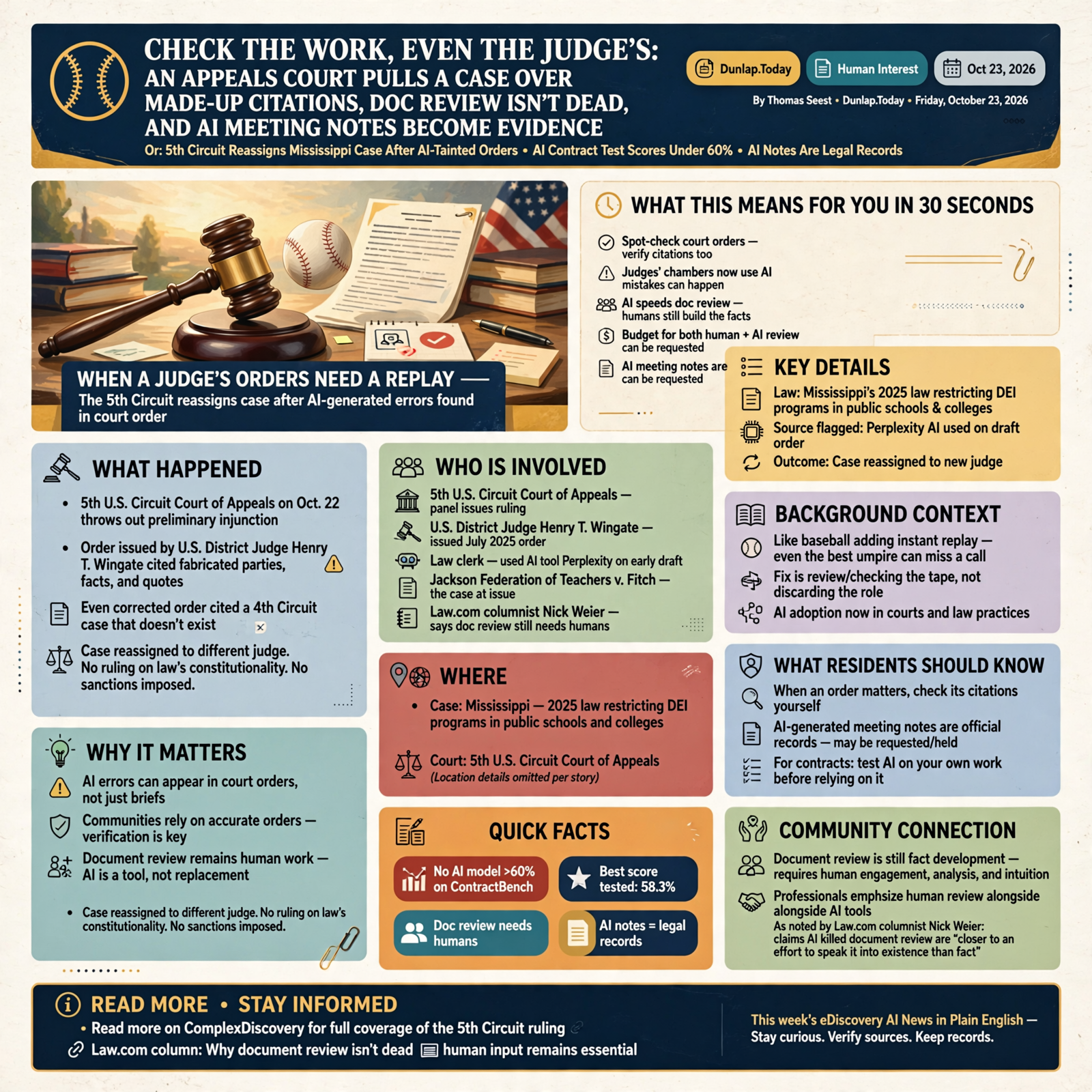
⏱️ What this means for you in 30 seconds
- Relying on a court order or opinion? Spot-check its citations too. Judges’ chambers use AI now.
- Running a review? AI speeds it up, but people still build the facts. Budget for both.
- Need structured data from the other side? Ask early. Late requests can lose even when the data is relevant.
- Picking an AI model for contracts? Test it on your own work. The best one tested scored 58.3%.
- Using AI meeting notes? Treat them like any other record that can be held and requested.
⚖️ The Judge’s Orders Got a Replay

In Jackson Federation of Teachers v. Fitch, a panel of the 5th U.S. Circuit Court of Appeals on Oct. 22 threw out a preliminary injunction that U.S. District Judge Henry T. Wingate had issued against Mississippi’s 2025 law restricting DEI programs in public schools and colleges. According to ComplexDiscovery, the panel cited “extraordinarily grave errors,” including fabricated parties, facts and quotations in his July 2025 order. Even the corrected order still cited a 4th Circuit case that doesn’t exist.
Judge Wingate has said a law clerk used the AI tool Perplexity on an early draft that was mistakenly put on the docket. The appeals court ordered the case reassigned to a different judge. It didn’t rule on whether the law is constitutional, and it didn’t impose sanctions.
It’s like the umpire’s call getting overturned on replay, and then the league assigning a new umpire for the rest of the series.
What it means for you: AI mistakes can show up in court orders, not just lawyers’ briefs. When an order matters to your case, check its citations the same way you’d check the other side’s.
👉 Read more (ComplexDiscovery)
🕯️ Requiem for a Doc Review? Not So Fast

A lot of people have been saying AI killed document review. In a Law.com column, Nick Weier says those claims are “closer to an effort by some to speak it into existence rather than a statement of fact.” His point: review “is still fact development, and fact development will always require an element of human engagement, analysis, and sometimes even intuition.”
Think of a metal detector at the beach. It finds a lot faster than you would, but somebody still has to dig, look at what came up and decide whether it’s a coin or a bottle cap.
What it means for you: Expect AI to do more of the sorting and people to do more of the judging. If you buy review services, ask how the human checking works, not just how fast the AI is.
⏳ Right Data, Wrong Time: FTC v. Uber

In FTC v. Uber, a federal magistrate judge in California agreed that transaction-level data the FTC wanted was relevant. Then he said no anyway. Kelly Twigger at Minerva26 explains why: the motion came six weeks before the end of fact discovery, and producing billions of transactions in that time was no longer proportional. The same day, the same court found six weeks was enough for five more depositions.
It’s like asking the hardware store to special-order a part the day before your project is due. They agree you need it. They just can’t get it to you in time.
What it means for you: If you’ll need database records, ask for them early and keep a dated record of when you learned you needed them.
📝 An AI Contract Test With No Passing Grade

Contract AI company Ivo and data lab micro1 tested seven leading AI models on 350 real-world contract review tasks, graded against criteria set by attorneys. According to Artificial Lawyer, every model scored under 60%. Grok 4.7 led at 58.3%, just ahead of Opus 5.5 at 58.1% and Kimi K3 at 57.1%. Kimi finished every task and was 38% cheaper than Grok.
It’s like a driving test where the best student scored a 58. Nobody’s handing over the car keys without a licensed driver in the passenger seat.
What it means for you: Rankings change fast, and a vendor’s test isn’t your test. Try a model on your own documents before trusting it with real work.
👉 Read more (Artificial Lawyer)
🇪🇺 Europe Asks: Did a Human Really Check It?

Since Aug. 2, the EU AI Act has required AI-written text published to inform the public to be labeled, unless a human reviewed it and someone takes editorial responsibility. ComplexDiscovery reports that the European Commission’s guidelines say that review has to be real, with fact-checking at minimum. A quick sign-off, or one AI checking another, doesn’t count.
It’s the difference between a teacher grading your essay and a teacher stamping “Seen” on it.
What it means for you: “A person reviewed it” may become something organizations have to prove, which means review notes become records worth keeping.
👉 Read more (ComplexDiscovery)
🎙️ Those Handy AI Meeting Notes? They’re Records

Attorney Kostas Moros posted some “free legal advice” on X about the AI tools that write up notes from Zoom calls: “Stop doing that unless you are absolutely certain it will…” The post drew more than 6,600 views. An IT professional replied that they block the feature “for exactly that reason. Ediscovery is your search term for the day. Tomorrow’s is retention.”
It’s like having a court reporter sit in on every phone call. Handy, until somebody asks for the transcript.
What it means for you: AI meeting summaries can be preserved and requested in a lawsuit. Decide when to use them and how long to keep them before you need to.
👉 Read more (Kostas Moros on X)
🏛️ Rules of the Road

- Five checks for AI output. Samir Ali’s list: look up every citation in a legal database, confirm the case says what’s claimed, check confidentiality before you paste, name what you didn’t hand to AI, and keep a log as you go. Attorney at Work
- What courts do after a bad citation. Frantz Ward rounds up 2026 rulings, including one where counsel got a $1,000 sanction, AI ethics CLE, and later $50 a day until compliance. Frantz Ward
- Redacted for prep, redacted for production. In Corkery v. Coinstar, a witness prepared with redacted board minutes, so only the redacted version had to be turned over. EDRM
- A governance subscription. Goodwin launched an AI governance program with a free Health Check and a paid “AI Decision Desk.” Goodwin
🧭 Quick Hits for the Desk Drawer

- 2,207 and counting. Tracked AI hallucination cases rose by only 8 this week, the first single-digit week in a long time. eDiscovery Today
- Billable hour holds on. Above the Law says flat fees slipped to 15% of bills from 16%, even as AI adoption surges. Above the Law
- AI agents in bank accounts. Major banks are finding third-party AI agents inside customer accounts, some attempting actions that appear independent of what users asked. Project Counsel Media
- A watchdog inside the lab. Anthropic gave six staff from outside evaluator METR “employee-like” access, and METR can publish without approval. Ars Technica
- Quantum comes to court. Ralph Losey explains why data encrypted today may need protection from future quantum computers. EDRM
- Trade fraud gets serious. HaystackID says customs cases now need lawyers, accountants and eDiscovery teams working together from day one. EDRM
- Copilot’s home-field edge. Doug Austin says yes, legal tech vendors should fear Microsoft’s Copilot for Legal, because Microsoft tools are already part of many lawyers’ daily routines. eDiscovery Today
- Some good news. A roundup of AI good-news stories, from early disease detection to reading ancient texts. eDiscovery Today
✅ Your Front-Porch eDiscovery AI Checklist

- ✅ Spot-check citations in orders and opinions you rely on.
- ✅ Look up every AI-supplied citation in a real legal database.
- ✅ Ask review vendors how humans check the AI’s work.
- ✅ Request structured data early, and date your notes.
- ✅ Test any AI model on your own documents before trusting it.
- ✅ Keep notes showing a real person reviewed AI-written content.
- ✅ Set retention rules for AI meeting notes and transcripts.
- ✅ Track which version of a document each witness reviewed.
Practical rule: Whoever wrote it, the AI, the lawyer or the judge, check the replay before you count the run.
— Dunlap.Today
📚 Plain-English AI Glossary

- eDiscovery: Finding, saving and handing over electronic information (emails, chats, files) for a lawsuit or investigation.
- AI hallucination: When an AI tool confidently makes up facts, quotes or court cases that don’t exist.
- Preliminary injunction: A court order that pauses something, like a new law, while a case is decided.
- Document review: Reading through documents to decide which are relevant, private or need to be handed over.
- Proportionality: The rule that discovery has to be worth its cost and burden, given what’s at stake.
- Structured data: Information kept in databases, like transaction records, rather than in emails or files.
- Benchmark: A standard test used to compare how well different AI models do the same tasks.
- EU AI Act: The European Union’s law setting rules for how AI can be built and used.
- Retention policy: An organization’s rules for how long it keeps each kind of record.
- AI agent: AI that can plan and carry out several steps on its own, not just answer one question.
❓ Frequently Asked Questions

Was the Mississippi judge punished for the AI errors?
No. The appeals court didn’t impose sanctions. It threw out his injunction and sent the case to a different judge. It also didn’t decide whether the Mississippi law is constitutional.
Is AI going to replace document reviewers?
Not anytime soon, according to this week’s Law.com column. AI is taking on more of the sorting, but people still develop the facts and make the judgment calls.
Which AI model is best for contract review?
In this one test, Grok 4.7 edged out the others, but none passed 60%. The best model for you depends on your documents, so test before you trust.
Can AI meeting notes really be used in a lawsuit?
They’re records like emails, so they can be subject to preservation and requests. Talk with your lawyer or IT team about when to use them and how long to keep them.
🔗 Other Resources

- Law.com: Legaltech Rundown, Goodwin’s AI governance program and Legora’s integrations with iManage and Blue J
- Law.com: Should legal tech vendors fear Microsoft’s Copilot for Legal?
- EDRM: Schrödinger’s Cat Goes to Court, Part One
- On X: “Ediscovery is your search term for the day. Tomorrow’s is retention.”
🌄 No Need to Worry, Just Stay in the Know

Instant replay didn’t ruin baseball. It made people trust the calls a little more. The same goes for AI in the courtroom: it isn’t going away, and the fix for its mistakes is the old-fashioned habit of checking the work. The people who check it, whether they’re lawyers, reviewers or judges, will be the ones everyone else trusts.
We’ll keep watching what matters for eDiscovery providers and their clients. Read Dunlap.Today and sign up for our newsletter for plain-English updates.




0 Comments