
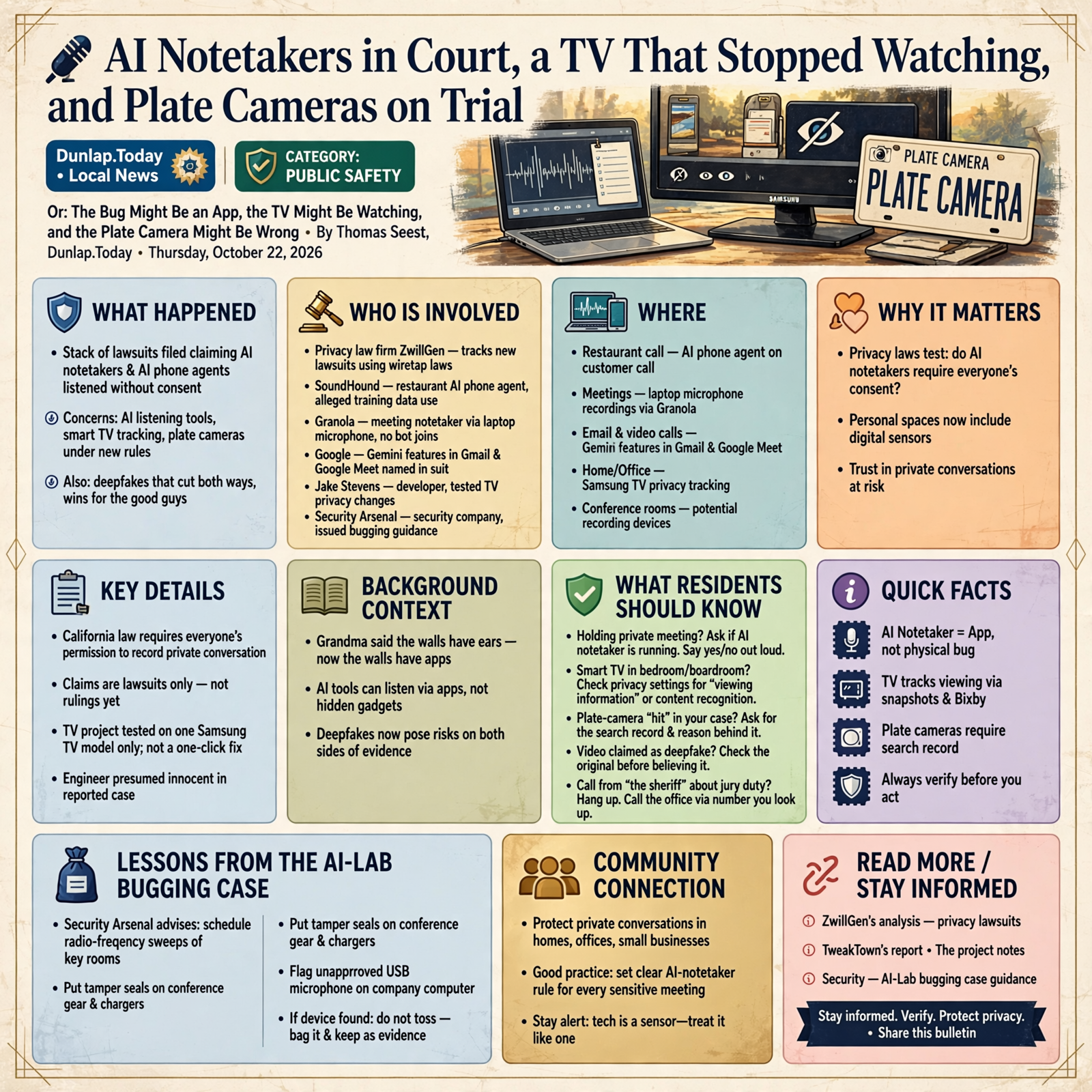
🎙️ AI Notetakers in Court, a TV That Stopped Watching, and Plate Cameras on Trial

Or: The Bug Might Be an App, the TV Might Be Watching, and the Plate Camera Might Be Wrong
By Thomas Seest, Dunlap.Today · Thursday, October 22, 2026
Grandma always said the walls have ears.
These days the walls have apps. This week’s top surveillance story isn’t a gadget hidden under a table. It’s a stack of lawsuits claiming AI notetakers and AI phone agents listened in on conversations without everyone’s permission.
Here’s the roundup for folks who buy bug sweeps and the private investigators who do the work: AI listeners in court, a smart TV that got told to stop watching, plate cameras under new rules, deepfakes that cut both ways, and a few wins for the good guys.
⏱️ What this means for you in 30 seconds
- Holding a private meeting? Ask whether anyone is running an AI notetaker, and say yes or no out loud.
- Smart TV in the bedroom or board room? Check its privacy settings and look for “viewing information” or content recognition.
- A plate-camera “hit” in your case? Ask for the search record and the reason behind it.
- Somebody says a video is a deepfake? Check the original before you believe it, either way.
- Got a call from “the sheriff” about jury duty? Hang up and call the office back on a number you look up.
🎙️ When the Bug Is an App

The privacy law firm ZwillGen tracked new lawsuits that use wiretap laws against AI listening tools. One says a restaurant’s AI phone agent, run by SoundHound, transcribed a customer’s call and kept her data to train its AI. Another targets Granola, a meeting notetaker that records through your own laptop’s microphone, with no bot joining the call. A third goes after Gemini features in Gmail and Google Meet.
These are claims, not rulings. But California requires everyone’s permission before a private conversation is recorded, and these suits test whether AI notetakers count.
It’s like Cousin Billy taking notes at Thanksgiving dinner. Fine, as long as everybody knows he’s writing it down.
What it means for you: A bug sweep can’t find software running on a guest’s laptop. Make an AI-notetaker rule part of every sensitive meeting.
📺 The TV That Stopped Watching

A developer named Jake Stevens says he used OpenAI’s Codex coding tool to unlock his Samsung TV after another AI tool refused. Then he switched off the feature that takes snapshots of the screen to see what’s playing, the same tracking on HDMI inputs, and the Bixby voice assistant’s always-ready listening. He says the TV now runs three times faster.
His own project notes are more careful: he tested it on one TV model only, and it isn’t a one-click fix for everybody. Don’t try this on your own TV unless you’re ready to break it.
What it means for you: The TV on the wall is a sensor. Make sure your sweep team counts it, and check its privacy settings yourself.
👉 TweakTown’s report · The project notes
🔦 Lessons From the AI-Lab Bugging Case

A security company called Security Arsenal used the arrest of a former OpenAI engineer, accused of planting a recorder in an executive conference room, to explain what companies can actually catch. Its advice: schedule radio-frequency sweeps of key rooms, put tamper seals on conference gear and chargers, and flag any unapproved USB microphone that shows up on a company computer.
One more tip: if you find a device, don’t toss it. Bag it and keep it as evidence. The engineer is presumed innocent.
🗺️ AI Can Guess Where Your Photo Was Taken
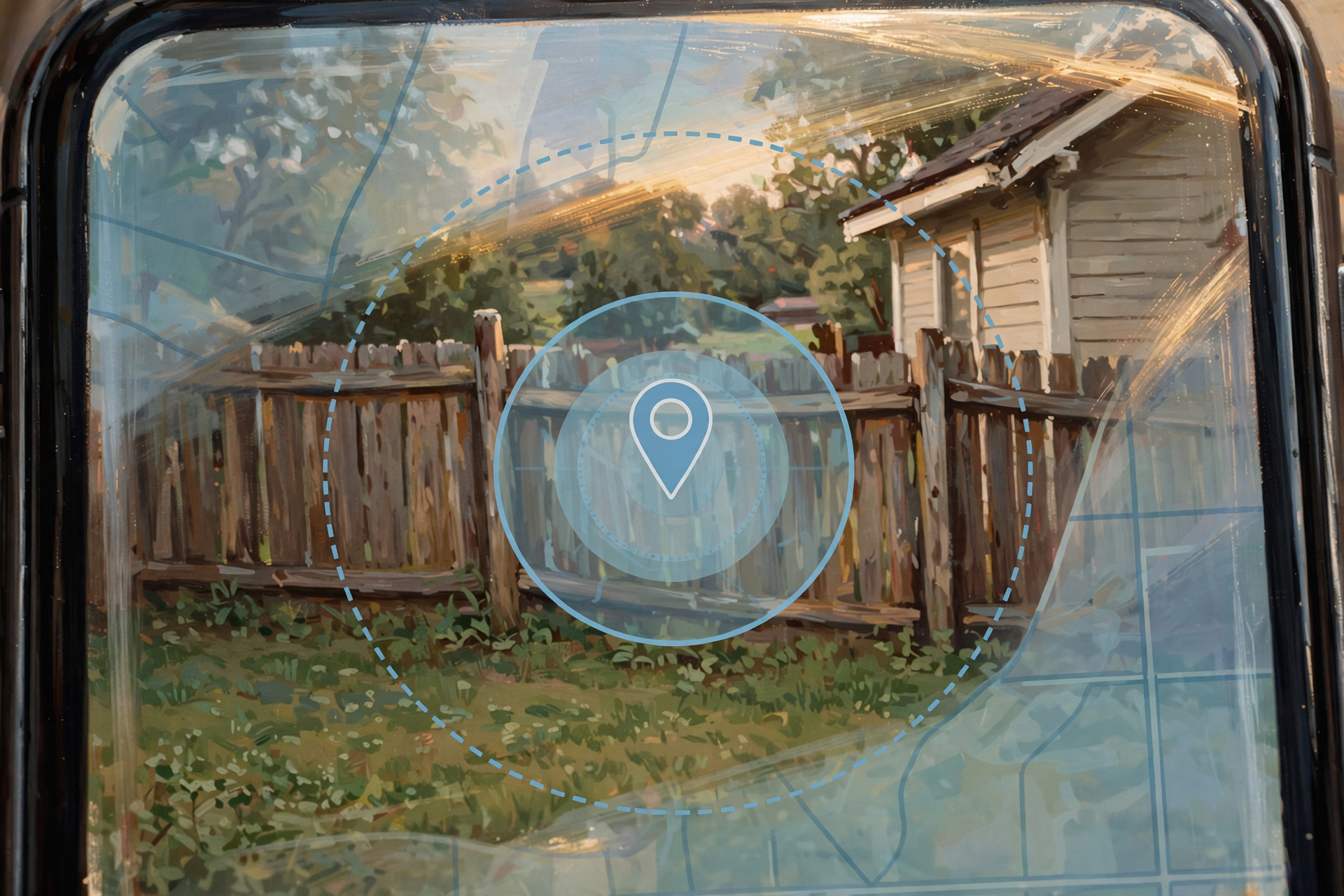
The investigators at Bellingcat tested AI models on 52 photos that had never been posted online. The best placed more than half within about 15 miles, and several pinned at least 10 within about six-tenths of a mile. But even the best sometimes gave a wrong answer with total confidence.
What it means for you: A picture of your backyard can say more than you think. And if a PI tells you AI found a location, ask whether a human double-checked it.
🚘 Plate Cameras on Trial
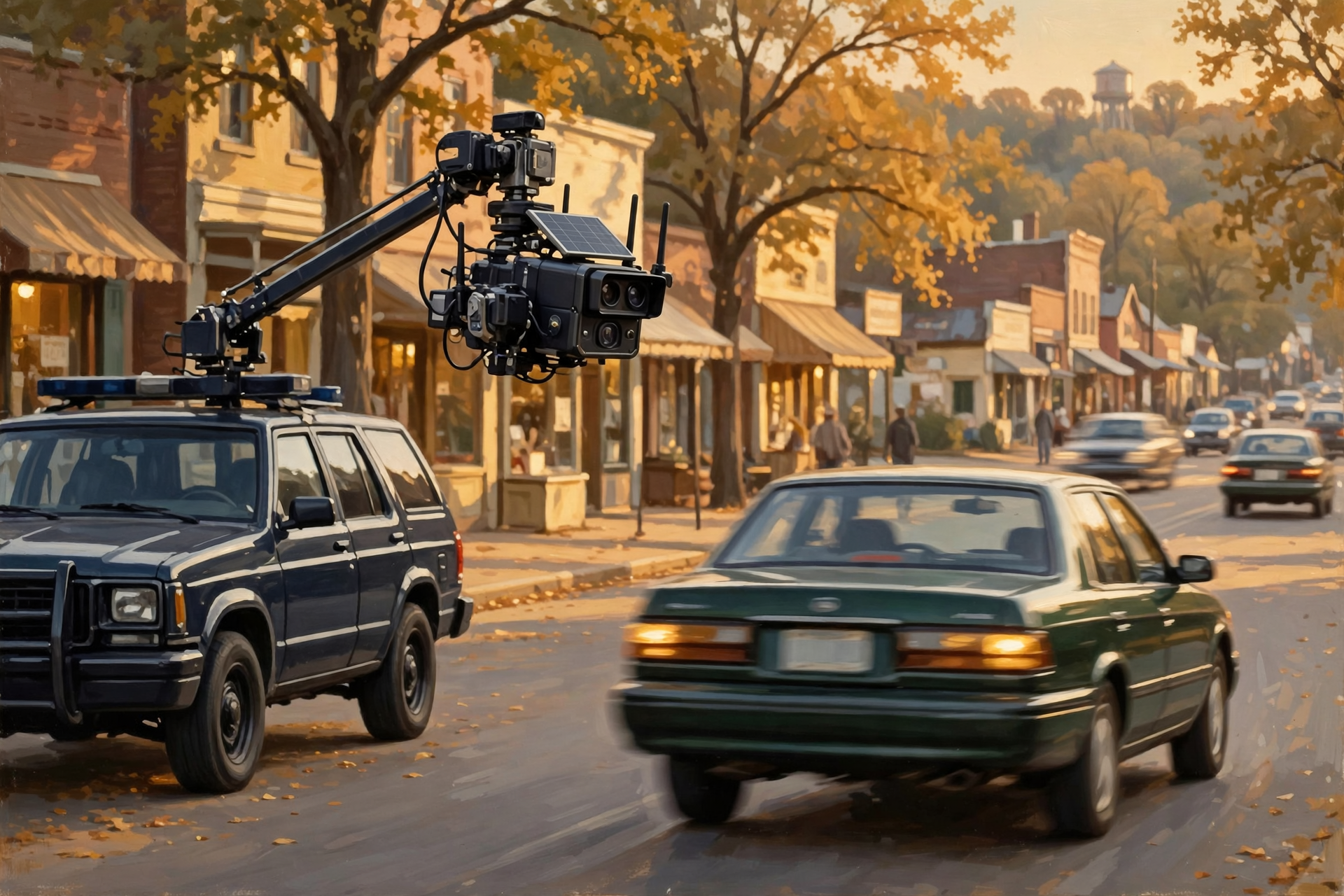
Reno’s city council voted 5–2 to swap Flock for an Axon contract worth about $21.8 million over eight years. It includes more than 200 plate readers, drones, and AI software that drafts police reports from body-camera audio. San Diego police will stop letting officers pick “other” as the reason for a plate-camera search, and a council committee voted to draft an ordinance ending the city’s Flock contract. Pennsylvania’s House voted 190–13 to require warrants for plate-camera database searches, though the Senate is short on time this year.
And in Richmond, Virginia, police admit a Flock lead sent them to the wrong car. The owner says it was towed and wrecked in the process.
It’s like the tractor’s GPS telling you you’re in the north field when you’re standing in the south pasture. The machine is usually right, until it isn’t.
What it means for you: If a plate-camera hit shows up in your case, ask for the search record, the reason given, and any body-camera video.
👉 Reno vote · San Diego · Pennsylvania · Richmond
👤 Faces in the Crowd

Police in Bedfordshire, England, say live facial-recognition cameras produced 260 alerts and helped lead to 105 arrests in about a year. In France, the justice minister says police will compare rioters’ faces against police files and photos from TikTok, Instagram, and Discord.
What it means for you: If you travel or attend big events overseas, assume cameras may be matching faces in real time. And public photos can become identification leads.
👉 BBC on Bedfordshire · Biometric Update on France
🎭 Deepfakes Cut Both Ways

An Oregon news outlet called a viral video of a county candidate a “deepfake,” then retracted the story when new photos showed the video was real. On TikTok, AI-edited clips are taking real police arrest footage and making officers appear to grope detainees; TikTok removed the examples a reporter flagged. In South Korea, the agency behind the band TXT promised legal action, with “no settlement or leniency,” over malicious posts targeting member Soobin. And Newsweek found voice-clone scam warnings in eight states, many involving fake deputies.
It’s like Grandma’s biscuit recipe. Change one ingredient and it still looks like her biscuits, but it isn’t.
What it means for you: “That’s fake” and “that’s real” both need proof. Go back to the original video or call before you decide.
👉 Oregon retraction · Altered arrest videos · TXT statement · Voice-clone map
📱 “Stalking Apps” That Mostly Sell Subscriptions

Security firm Bitdefender looked at TikTok ads promising to catch a cheating partner or find anyone from a phone number, many using AI-made shock videos. One app ran more than 3,000 ads in a month. Another app an ad pointed to turned out to be a simple photo-stamping camera with no spying ability at all, just a subscription.
What it means for you: Don’t buy them. And if you’re worried someone is spying on your phone, real stalkerware usually comes from outside the app store. Talk to a domestic violence advocate or a trusted pro before you remove anything.
👉 iGizmo’s report on Bitdefender’s findings (in Italian)
🛡️ Wins for the Good Guys

UCLA researchers built a detector that uses light, not just computer chips, to spot deepfake videos. It reached about 97.8% accuracy in one test. RealityChek released add-ons that let ChatGPT, Claude, and Grok check uploaded content for deepfakes. In Alabama, prosecutors dropped impersonation charges against private investigator Tobi Libbra; her lawyer says a recording shows she identified herself properly. And in Denmark, police arrested two men suspected of spying on a drone-detection company. They’re presumed innocent.
One more to watch: a startup called Maxinsights raised $30 million to pay thousands of people to wear cameras while they cook, clean, and work, so robots can learn from the footage.
What it means for you: If you’re a PI, record your interviews where the law allows. And if you have household staff or contractors, ask whether anyone is wearing a camera on the job.
👉 UCLA detector · RealityChek · Libbra case · Denmark · Maxinsights
— Dunlap.Today
📚 Plain-English AI Glossary

- AI notetaker: An app that listens to a meeting and writes up what was said.
- Wiretap law: Rules about when it’s legal to record or listen in on a conversation. Some states, like California, require everyone’s permission.
- ACR (automatic content recognition): A smart-TV feature that samples what’s on screen to figure out what you’re watching.
- Wake word: The phrase that tells a voice assistant to start listening.
- ALPR: Automated license plate reader, a camera that reads and logs plates as cars pass.
- Live facial recognition: Cameras that compare faces to a watchlist in real time.
- Deepfake: A fake video, photo, or voice made with AI to look or sound like a real person.
- Stalkerware: Hidden software that secretly tracks someone’s phone.
- TSCM: Technical surveillance countermeasures, the professional name for a bug sweep.
❓ Frequently Asked Questions

Is it legal for someone to run an AI notetaker in my meeting?
It depends on your state and whether everyone agreed. New lawsuits are testing this right now. The simple fix is to ask at the start of every meeting.
Is my smart TV spying on me?
Many smart TVs collect information about what you watch. Check the privacy settings and turn off viewing-information features you don’t want.
Can a plate camera get the wrong car?
Yes. In Richmond, police admit a plate-camera lead sent them to the wrong vehicle. If it happens to you, ask for the records and talk to a lawyer.
How do I know if a video is a deepfake?
Find the original source, compare other angles, and look for older copies. Don’t trust a label, or a denial, by itself.
Do those TikTok “find anyone” apps work?
Bitdefender says the ones it checked mostly sell subscriptions. Spying on someone’s phone without permission can also be a crime.
✅ This Week’s Counter-Surveillance Checklist

- ✅ Set an AI-notetaker rule for private meetings
- ✅ Check your smart TV’s privacy settings
- ✅ Make sure your sweep team counts TVs and conference gear
- ✅ Don’t throw away a device you find; keep it as evidence and call a lawyer
- ✅ Ask for the search record behind any plate-camera hit in your case
- ✅ Verify a video’s original source before calling it real or fake
- ✅ Hang up on “sheriff” calls about jury duty and call back on a listed number
- ✅ Skip any app that promises to spy on a partner
Practical rule: The newest listeners are apps, TVs, and cameras nobody thought to check, so ask who’s recording, check the settings, and verify before you believe.
Sources
Know about an upcoming event or story in the Sequatchie Valley? Submit it here.




0 Comments