
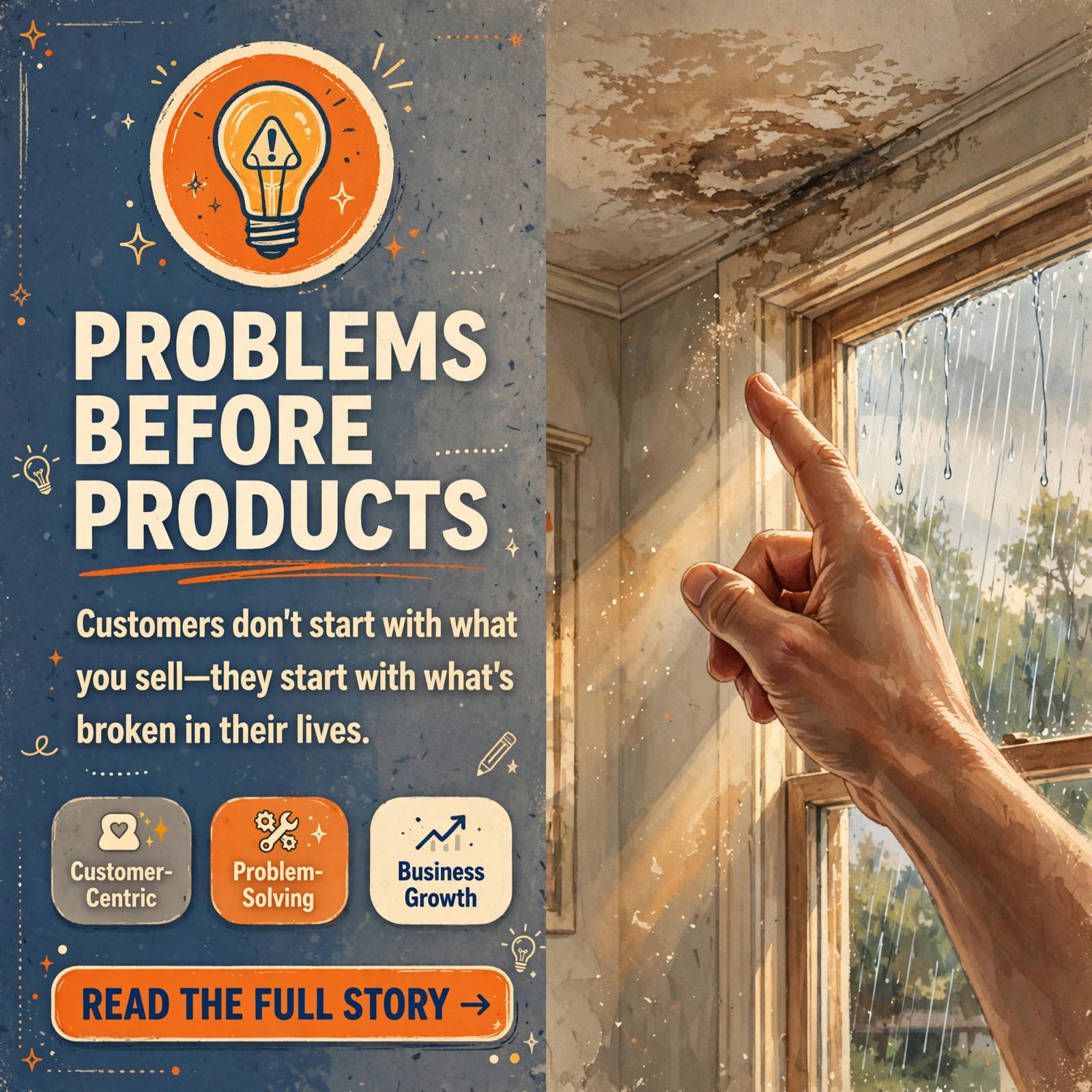
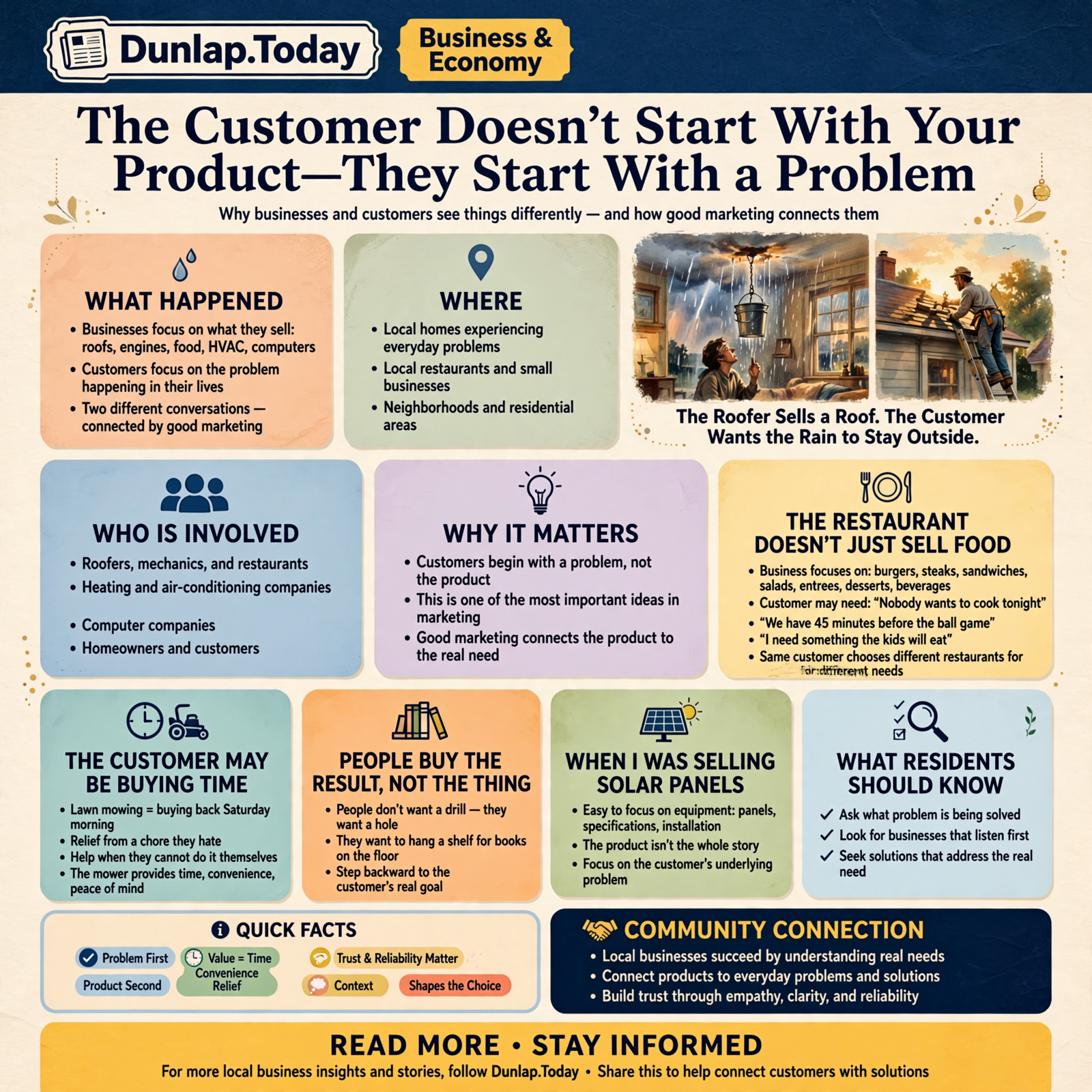
The Customer Doesn’t Start With Your Product—They Start With a Problem

Businesses spend a lot of time thinking about what they sell.
Roofers think about roofs.
Mechanics think about engines, brakes and transmissions.
Restaurants think about food.
Heating and air-conditioning companies think about furnaces, heat pumps and air conditioners.
Computer companies think about computers.
But customers usually don’t begin there.
They begin with something happening in their lives.
A leak.
A car that won’t start.
A house that’s too hot.
A family that’s hungry.
A bill that’s too high.
A job that takes too long.
A problem they don’t understand.
A task they don’t want to do themselves.
That difference may be one of the most important ideas in marketing.
The business usually starts with the product. The customer usually starts with the problem.
The Roofer Sells a Roof. The Customer Wants the Rain to Stay Outside.

Imagine waking up during a thunderstorm and discovering water dripping from the ceiling.
Your first thought probably isn’t:
“I am interested in purchasing a residential roofing system.”
Your thought is more likely:
“Oh no. The roof is leaking.”
The roofer thinks about:
- shingles,
- flashing,
- underlayment,
- ventilation,
- decking,
- labor,
- and warranties.
The homeowner may initially think about:
- stopping the leak,
- protecting the house,
- avoiding mold,
- preventing more damage,
- figuring out how much this is going to cost,
- and finding somebody trustworthy quickly.
Those are related conversations.
But they are not the same conversation.
Good marketing connects them.
The Restaurant Doesn’t Just Sell Food

Consider a restaurant.
From the business side, the owner may think in terms of:
- burgers,
- steaks,
- sandwiches,
- salads,
- entrees,
- desserts,
- and beverages.
But the customer may be trying to solve:
“Nobody wants to cook tonight.”
Or:
“We have 45 minutes before the ball game.”
Or:
“My parents are visiting and I want somewhere we can sit and talk.”
Or:
“I need something inexpensive that all three kids will actually eat.”
The food matters.
But the situation matters too.
That’s why the same customer might choose completely different restaurants on different days.
The Customer May Be Buying Time

Many products are really disguised purchases of time.
Think about lawn mowing.
As a kid mowing lawns, I might have thought I was selling:
“I will cut your grass.”
And technically, I was.
But the homeowner might have been buying something else.
Maybe they were buying:
- their Saturday morning back,
- relief from doing a chore they hated,
- help because they physically couldn’t do it anymore,
- a better-looking yard,
- or simply one less thing to worry about.
The lawn mower was the mechanism.
The value could be time, convenience, appearance, relief or independence.
Sometimes People Buy the Result, Not the Thing

This principle appears everywhere.
People don’t necessarily want a drill.
They want a hole.
They may not even want the hole.
They want to hang a shelf.
They may not really want the shelf.
They want somewhere to put the books that are currently stacked on the floor.
Every time you move one step backward, you get closer to the customer’s actual objective.
This is useful because businesses can become so familiar with their products that they forget why anyone wanted them in the first place.
When I Was Selling Solar Panels, the Product Wasn’t the Whole Story

When I was selling solar panels as a kid, it would have been easy to focus on the equipment.
Panels.
Specifications.
Installation.
Technology.
But a potential buyer wasn’t necessarily interested in becoming a solar-panel enthusiast.
They might have cared about:
- reducing energy costs,
- using less conventional energy,
- taking advantage of available incentives,
- trying a new technology,
- becoming more self-sufficient,
- or preparing for future energy prices.
The panels were a means to an end.
That distinction matters.
If I only explained the equipment, I might miss the reason the person cared.
Early Computers Had the Same Problem

Years later, personal computers faced a similar marketing challenge.
Today, owning a computer seems ordinary.
But in the early personal-computer era, somebody looking at an Atari 800 or another early machine could reasonably ask:
“What would I actually do with this?”
That’s a much harder marketing question than:
“Which model should I buy?”
The computer manufacturer could talk about:
- memory,
- processors,
- graphics,
- storage,
- ports,
- and expansion.
But the potential customer might care about:
- writing documents,
- keeping records,
- learning programming,
- playing games,
- helping children learn,
- managing a small business,
- or simply understanding where technology was headed.
The technical features mattered only when they connected to something the customer wanted to accomplish.
A Dot-Matrix Printer Wasn’t Really About Dots
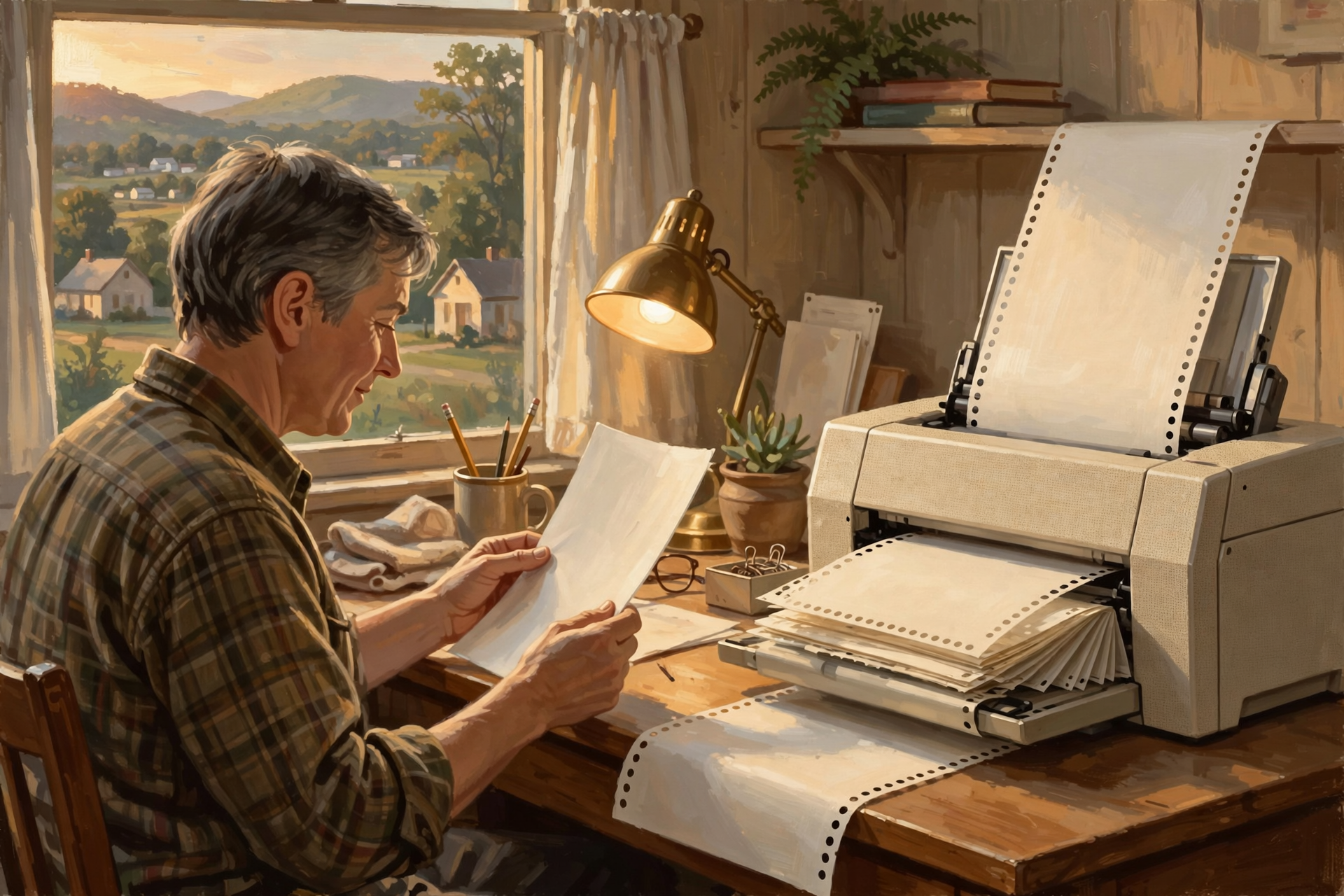
The same thing applies to early printers.
A dot-matrix printer was a fascinating piece of equipment.
But the customer probably wasn’t buying it because they had a lifelong passion for tiny pins striking an ink ribbon.
They wanted to turn what was on the computer screen into something physical.
They wanted:
- a printed letter,
- an invoice,
- a report,
- a mailing list,
- a school assignment,
- a business form,
- or a permanent copy of something they had created.
The printer solved a practical problem.
The technology was simply how it solved it.
Businesses Often Fall in Love With Their Features

This is where marketing frequently goes wrong.
The business knows the product extremely well.
So it begins talking about:
- features,
- specifications,
- materials,
- technology,
- processes,
- and technical improvements.
Those details may matter.
But the customer may still be wondering:
“What does this do for me?”
A heating and air-conditioning company might advertise:
VARIABLE-SPEED INVERTER COMPRESSOR!
The homeowner may think:
“Okay. Is my house going to be more comfortable, and will my electric bill go down?”
That’s the translation marketing has to make.
Features Explain What It Has. Benefits Explain Why You Care.

A useful distinction is:
Feature: what the product has or does.
Benefit: why that feature matters to the customer.
For example:
Feature: A cordless drill has a high-capacity battery.
Benefit: You can work longer before stopping to recharge it.
Feature: A restaurant offers online ordering.
Benefit: Dinner can be ready when you arrive.
Feature: A contractor provides a written warranty.
Benefit: You have clearer protection if something goes wrong.
Feature: A business offers text-message appointment reminders.
Benefit: You’re less likely to forget the appointment.
The feature is real.
The benefit connects it to the customer’s life.
But Even Benefits May Not Go Far Enough

Suppose a business says:
“Our new furnace is 25 percent more efficient.”
That’s useful.
But the customer may still wonder:
“What does that mean for my monthly bill?”
Or:
“Will the back bedroom finally stay warm?”
Or:
“Will this be quieter than the old one?”
The deeper marketing question is not merely:
What benefit does this feature provide?
It’s:
What outcome does the customer actually care about?
The Same Product Can Solve Different Problems for Different People

This is where customer understanding becomes more interesting.
Two people may buy exactly the same product for completely different reasons.
Consider a pickup truck.
One customer needs it to tow equipment.
Another wants room for the family.
Another likes the image associated with the truck.
Another needs four-wheel drive for rural property.
Another simply likes driving trucks.
Same product.
Different motivations.
Good marketing recognizes that customers don’t all arrive through the same door.
The Problem May Be Emotional Too

Not every problem is mechanical or financial.
Sometimes the customer is trying to change how they feel.
A person may buy:
- a nicer car because they feel successful driving it,
- a security system because they want peace of mind,
- a vacation because they need a break,
- a gift because they want someone to feel appreciated,
- or a home renovation because they want to feel proud of their house again.
This doesn’t mean every purchase is irrational.
It means humans are not spreadsheets.
We make decisions for combinations of practical, emotional, social and financial reasons.
Marketing works better when it understands all of them.
Sometimes the Customer Doesn’t Yet Know What the Problem Is

This is particularly important when selling something new.
When solar technology was unfamiliar, people might not have been actively searching for solar panels.
When home computers were unfamiliar, families weren’t necessarily walking around thinking:
“We urgently need eight-bit computing capability.”
The business may first need to help people recognize an opportunity.
That creates a different kind of marketing.
You’re not merely saying:
“Choose my solution.”
You’re saying:
“Here’s a possibility you may not have considered.”
This is where education becomes especially important.
New Technology Often Has to Teach the Problem and the Solution

Emerging technologies frequently face a difficult marketing challenge.
The customer may not understand:
- the problem,
- the category,
- the solution,
- or why now is the right time to act.
That happened with personal computers.
It happened with the internet.
It happened with smartphones.
It’s happening again with artificial intelligence.
Many people aren’t currently asking:
“Which AI workflow should I implement?”
They’re asking:
“What would I actually use AI for?”
That is essentially the same kind of educational challenge early computer sellers faced.
Then, Now & Next: Understanding the Customer’s Problem

Then
When I was mowing lawns or painting houses, understanding the customer could be extremely direct.
You were standing in front of them.
You could ask:
“What do you need done?”
The feedback loop was immediate.
They told you.
You listened.
You figured out whether you could help.
Now
Businesses today have far more ways to understand customer needs.
They can learn from:
- sales conversations,
- customer-service calls,
- website searches,
- online reviews,
- search-engine queries,
- social-media comments,
- surveys,
- support tickets,
- email responses,
- and analytics.
A modern business can potentially see patterns across hundreds or thousands of customer interactions.
That is powerful.
But it can also create a strange problem.
Businesses can accumulate enormous quantities of customer data while becoming worse at actually listening to customers.
Next
Artificial intelligence may make pattern recognition much easier.
Businesses may increasingly be able to examine large numbers of customer questions and discover:
- the problems people mention most often,
- the language customers naturally use,
- where people become confused,
- which objections repeatedly stop purchases,
- what customers praise,
- and what causes dissatisfaction.
But even with sophisticated AI, the basic question remains human:
What is this person actually trying to accomplish?
Your Customer’s Words May Be Better Than Your Marketing Words

Businesses often describe things differently from customers.
The business might say:
“We offer comprehensive residential exterior maintenance solutions.”
The customer may say:
“I need somebody to clean my gutters.”
Guess which language is easier to understand?
Listening to how customers describe their own problems can improve:
- website copy,
- advertisements,
- articles,
- headlines,
- sales conversations,
- and even product design.
You don’t have to make marketing sound sophisticated.
You have to make it understandable.
The Customer May Not Use Your Industry’s Vocabulary

This matters especially in specialized industries.
A customer may not know the proper name of the thing that failed.
They might say:
“That little box by the furnace is making a weird noise.”
The technician may instantly know what they’re describing.
The customer does not need to pass an HVAC vocabulary test before receiving help.
Good marketing meets people where they are.
That includes the words they use.
Ask Better Questions

If you run a business, try asking customers questions such as:
- What were you trying to solve when you first contacted us?
- What worried you most before buying?
- What alternatives did you consider?
- Why did you choose us?
- What almost stopped you?
- What mattered more than you expected?
- What was confusing?
- What would you tell someone considering the same decision?
Those answers may teach you more than another meeting about advertising.
Don’t Confuse the Product With the Value

Products change.
Customer needs are often more durable.
Think about communication.
People once bought:
- letters,
- telegrams,
- telephone service,
- fax machines,
- email access,
- mobile phones,
- text messaging,
- and video calling.
The technologies changed dramatically.
The human need remained:
I need to communicate with somebody who isn’t standing here.
A company that defines itself only by today’s product can be blindsided when a new technology solves the same customer problem better.
This Is Why History Matters

Looking backward helps us understand marketing because it shows which things were temporary and which things were fundamental.
The Atari 800 was a particular product.
The desire to use computers for work, education, creativity and entertainment lasted.
The dot-matrix printer was a particular technology.
The need to move information from digital systems into useful forms lasted.
Solar technology changed dramatically.
The desire for affordable, reliable energy lasted.
Marketing becomes clearer when we stop confusing the tool with the need.
That Matters Even More Looking Forward

Over the next decade, many products and interfaces we use today will change.
Some will disappear.
Some will merge.
Some jobs people currently perform manually may become automated.
Some decisions may increasingly be assisted by AI.
But the underlying human needs will remain much more stable.
People will still want:
- food,
- shelter,
- comfort,
- safety,
- connection,
- convenience,
- status,
- entertainment,
- security,
- health,
- time,
- belonging,
- and solutions to problems.
Technology changes how those needs are met.
Marketing helps connect the need to the solution.
A Simple Exercise for Any Business

Take whatever you sell and finish this sentence:
“My customer doesn’t really want __________. They want __________.”
For example:
A lawn service: My customer doesn’t really want someone operating a mower. They want a neat yard without spending Saturday morning doing it.
A roofer: My customer doesn’t really want shingles. They want a dry, protected home and confidence that the roof won’t fail.
A restaurant: My customer doesn’t just want food. They may want convenience, a family experience, a break from cooking or somewhere to meet friends.
An accountant: My customer doesn’t really want financial statements. They want to understand what’s happening with their money and make better decisions.
A computer consultant: My customer probably doesn’t want technology for its own sake. They want something to work faster, better, cheaper or more reliably.
If you can’t complete that sentence clearly, you may understand your product better than you understand your customer.
The Marketing Lesson

Businesses naturally become experts in what they sell.
That’s necessary.
But customers usually don’t begin with the product.
They begin with life.
Something broke.
Something became expensive.
Something became inconvenient.
Something frightened them.
Something created an opportunity.
Something needs to change.
Your product or service enters the story after that.
The better you understand the customer’s problem, the easier it becomes to explain why your solution matters.
That’s true whether you’re pushing a lawn mower down the street, explaining solar panels in the 1970s, demonstrating an early personal computer, advertising on Google or preparing for a world where an AI assistant may help customers decide what to buy.
The tools change.
The customer still needs a reason to care.
Share This With Someone Building Around a Good Idea
A lot of new businesses begin with a product, service or skill the owner is excited about. The harder lesson is learning to see that offering through the customer’s eyes.
If you know someone starting a business, developing a new service, or trying to explain why customers should care about what they offer, this article may help them think differently about the problem they are really solving.
Send it to someone building something of their own. Understanding the customer’s problem early can shape nearly every marketing decision that follows.
Next: Your Customer Isn’t Everybody

Once we understand that customers begin with problems rather than products, the next question becomes:
Which customers are we actually trying to help?
Almost every business owner has heard some version of:
“Everybody could use what we sell.”
Maybe.
But everybody is rarely your best customer, your easiest customer, your most profitable customer or the person most likely to choose you.
In the next article in Marketing Without the Mumbo Jumbo, we’ll look at why trying to market to everybody can make it harder to connect with anybody.




0 Comments