
Marketing Without the Mumbo Jumbo: What an 11-Year-Old Solar Panel Salesman Learned the Hard Way

Marketing can sound complicated today. We have funnels, algorithms, search engines, social media, customer relationship software, artificial intelligence, analytics, automation and enough acronyms to make a bowl of alphabet soup look poorly organized.
But underneath all of that technology is something much simpler.
People have problems, needs, wants and questions.
Businesses, organizations and entrepreneurs have things that may help them.
Marketing is much of what happens between those two points.
I started learning that lesson a long time ago, although I didn’t know enough at the time to recognize what I was learning.
I Was 11 Years Old and Selling Solar Panels

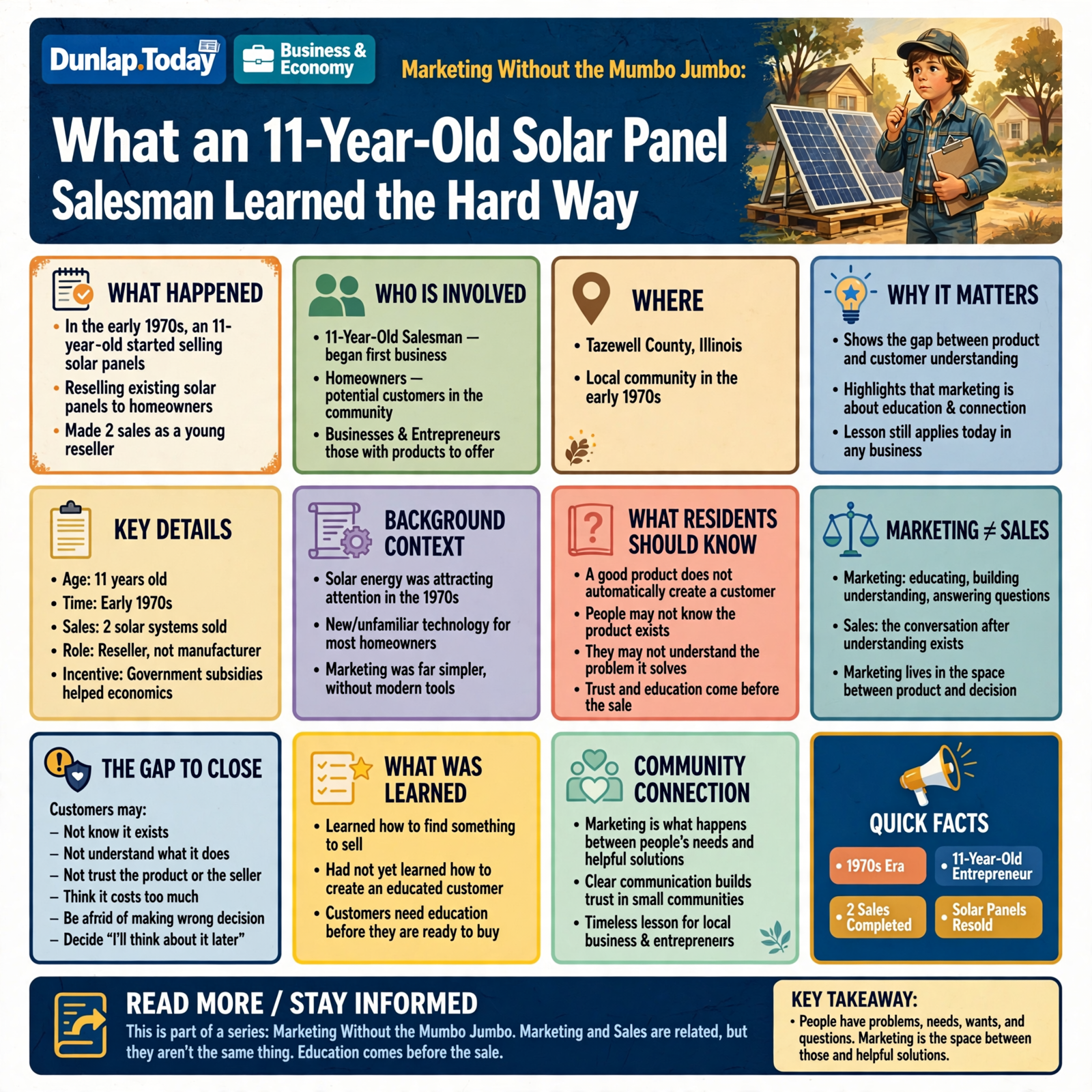
In the early 1970s, when I was about 11 years old, I started what I believe was the first business in Tazewell County, Illinois, selling solar panels.
I wasn’t manufacturing solar panels. I was reselling products that already existed.
There was a legitimate need. Solar energy was attracting attention. Government subsidies helped make the economics more attractive. The product existed, and there were people who could potentially benefit from it.
That sounds like the ingredients for a successful business.
And I did make sales.
I sold two.
For an 11-year-old, selling two solar systems isn’t exactly nothing.
But looking back decades later, I can see something that I didn’t understand then:
I had learned how to find something to sell. I had not yet learned how to create an educated customer who understood why he might want to buy it.
That’s a very different problem.
A Good Product Does Not Automatically Create a Customer

This is one of the first myths we ought to get rid of in this series.
We sometimes assume that if something is useful enough, people will naturally buy it.
They won’t.
They may not know it exists.
They may not understand what it does.
They may not understand the problem it solves.
They may know they have a problem but not realize your product is one possible solution.
They may understand the product perfectly and still not trust it.
They may trust the product but not trust you.
They may want it but believe it costs too much.
They may be able to afford it but be afraid they’ll make the wrong decision.
Or they may simply decide, “I’ll think about it later.”
That distance between a useful product existing and a person deciding to buy it is where a great deal of marketing lives.
The Solar Panels Needed Education Before They Needed Selling

Imagine trying to sell an unfamiliar technology to a homeowner in the early 1970s.
Before asking for the sale, there were much more fundamental questions to answer.
- What is solar energy?
- What exactly will these panels do?
- Will they work here?
- How much energy will they produce?
- What happens on a cloudy day?
- How long will they last?
- What will they save me?
- What do the government incentives actually mean?
- Who installs them?
- What happens if something goes wrong?
- Is this a proven technology or some strange new experiment?
Those aren’t objections to overcome with a clever sales pitch.
They’re reasonable questions from someone being asked to consider something unfamiliar.
The customer needed education.
Only after enough understanding existed did a meaningful sales conversation become possible.
Marketing and Sales Are Related, but They Aren’t the Same Thing

We’ll spend an entire article on this distinction, but it is important enough to introduce now.
Sales asks someone to make a decision.
Marketing helps that person become ready to make one.
That’s simplified, but it’s a very useful place to start.
Marketing can help somebody:
- discover that you exist,
- recognize a problem or opportunity,
- understand possible solutions,
- learn how your solution works,
- decide whether you seem credible,
- compare alternatives,
- reduce uncertainty,
- understand the value,
- and become comfortable taking the next step.
Sales operates inside that larger process.
And after the sale, other things begin to matter too: delivery, customer service, follow-up, reputation and whether that customer recommends you to somebody else.
The Tools Have Changed. The Human Being Hasn’t Changed Nearly as Much.

If I started that solar business today, the toolbox would be almost unrecognizable.
I could have a website.
I could publish videos explaining solar power.
I could answer common questions in articles.
I could appear in Google search results.
Customers could read reviews.
I could use email and text messaging.
I could create calculators showing potential savings.
I could post explanations on Facebook.
I could use artificial intelligence to help produce educational materials, analyze questions and identify patterns in what prospective customers wanted to know.
I might even eventually have to make sure an AI assistant understands my business well enough to recommend it when its owner asks, “Should I consider solar panels for my house?”
Almost everything about the tools has changed.
But consider the person on the other side.
That person still wants to know:
- What is this?
- Does it solve a problem I actually have?
- Will it work?
- Can I trust these people?
- What will it cost?
- What could go wrong?
- Is there a better alternative?
- What should I do next?
Those questions would have sounded familiar in 1973.
They’ll probably sound familiar in 2033.
Marketing Isn’t Just Advertising

Another idea we’ll dismantle throughout this series is that marketing and advertising are interchangeable words.
They aren’t.
Advertising is one tool.
Buying a newspaper ad is advertising.
Running a Facebook ad is advertising.
Paying Google to put your business in front of people searching for a service is advertising.
But marketing is much bigger.
Your business name can be marketing.
Your location can be marketing.
Your reputation is marketing.
Your price communicates something.
Your truck communicates something.
The person answering your telephone communicates something.
Your Google reviews communicate something.
Your warranty communicates something.
Your website communicates something.
The cleanliness of your restaurant communicates something.
The fact that you return a telephone call when you said you would communicates something.
Some of the most powerful marketing in a small community doesn’t look like advertising at all.
Think About the Local Mechanic Everybody Recommends

Imagine two mechanics.
The first spends heavily on advertisements.
The second has been fixing vehicles in the area for 25 years. He explains what’s wrong before doing the work, doesn’t replace things customers don’t need, charges what people consider a fair price and tells somebody when a repair isn’t worth doing.
When a neighbor asks:
“Who do you use?”
people keep giving the second mechanic’s name.
Which one has the stronger marketing?
The first may have more advertising.
The second has built:
- recognition,
- trust,
- reputation,
- customer experience,
- social proof,
- repeat business,
- and referrals.
All of those belong in our marketing conversation.
Sometimes Marketing Means Teaching Instead of Pitching

The solar-panel experience also introduced me to an idea that has become much more important in the modern information economy.
Sometimes the customer doesn’t need a better sales pitch.
The customer needs a better explanation.
Suppose a heating and air-conditioning contractor wants homeowners to consider a new high-efficiency heat pump.
The obvious advertisement might say:
BUY A NEW HIGH-EFFICIENCY HEAT PUMP TODAY!
But the homeowner might actually be wondering:
- What makes one heat pump more efficient than another?
- Will it actually reduce my electric bill?
- How long should my existing unit last?
- Should I repair mine instead?
- What does SEER mean?
- Does a heat pump work when it gets really cold?
- What size do I need?
- What does installation usually involve?
An HVAC company that answers those questions honestly may accomplish more than one shouting “CALL TODAY!” twenty times.
Education can be marketing.
In fact, when customers are considering unfamiliar, expensive or complicated decisions, education may be some of the best marketing available.
Good Marketing Doesn’t Require Tricking Anyone

Marketing sometimes has a bad reputation because people associate it with manipulation.
There certainly is manipulative marketing.
We’ll talk about that later in this series too.
Fake countdown timers, fake scarcity, misleading prices, fake reviews, hidden subscriptions and deliberately confusing cancellation procedures aren’t examples of brilliant marketing simply because they increase a number on somebody’s spreadsheet.
We can define good marketing differently.
Good marketing helps the right person understand a real problem, discover a useful solution, evaluate it intelligently and make an informed decision.
Sometimes that decision will be to buy from you.
Sometimes it shouldn’t be.
A person who doesn’t need what you sell isn’t a marketing failure.
Trying to convince that person to buy it anyway may be.
The Customer Usually Starts With a Problem, Not Your Product

This is another idea we’ll return to repeatedly.
A homeowner usually doesn’t wake up thinking:
“I hope somebody sells me roofing materials today.”
He notices water dripping from the ceiling.
A woman whose car won’t start isn’t dreaming about purchasing automotive diagnostic services.
She needs to get to work.
A restaurant customer isn’t necessarily shopping for a hamburger.
Maybe it’s 6:30 in the evening, everybody is tired, nobody wants to cook and somebody needs to answer the question:
“What are we eating tonight?”
The product matters.
But understanding the situation surrounding the product matters too.
That’s one reason we’ll spend a significant portion of this series learning about customers before spending much time learning about advertisements.
A Simple Way to Think About Marketing

For now, forget funnels, conversion rates, analytics dashboards and marketing automation.
Think about this sequence:
Problem → Awareness → Understanding → Trust → Decision → Experience → Recommendation
A person experiences a need or opportunity.
They become aware that a solution exists.
They understand enough about the solution to evaluate it.
They decide whether they trust the product, organization and people involved.
They make a decision.
They experience the result.
And that experience influences what they do next—and what they tell other people.
Modern marketing can become vastly more complicated than that.
But if we lose sight of that basic human journey, all the technology in the world won’t rescue us.
You Probably Already Know More About Marketing Than You Think

If you’ve ever recommended a restaurant to somebody, you’ve participated in marketing.
If you’ve ever put a sign in front of a church announcing a fish fry, you’ve participated in marketing.
If you’ve told someone why you trust a particular mechanic, contractor, dentist or barber, you’ve participated in marketing.
If you’ve arranged products near the cash register because people might buy them while waiting, you’ve made a marketing decision.
If you’ve changed your business hours because customers kept arriving after you closed, that’s a marketing decision too.
The terminology may be unfamiliar.
The underlying behavior isn’t.
One objective of this series is simply to put names around things people already encounter every day—and then show how those ideas fit together.
What We’ll Learn in This Series

We’re going to build this slowly enough that somebody who has never taken a marketing class can follow it, but deeply enough that a business owner can actually use it.
We’ll explore subjects including:
- what marketing actually is,
- marketing versus advertising and sales,
- understanding customers,
- customer journeys,
- marketing funnels,
- offers and pricing,
- branding and positioning,
- trust and reputation,
- local visibility,
- Google and search engines,
- websites,
- content marketing,
- social media,
- email and customer lists,
- advertising,
- sales and conversion,
- retention and referrals,
- marketing psychology,
- analytics,
- marketing automation,
- ethics and manipulation,
- artificial intelligence,
- and what may happen when our AI assistants begin helping us decide what to buy and whom to trust.
We’ll also stop occasionally and examine marketing in the wild—the restaurant with a full parking lot, the roadside sign that somehow works, the grocery-store aisle, the yard sale, the Facebook post everyone shares, or the local business everybody recommends.
Marketing is happening all around us.
Once you begin noticing it, it’s difficult to stop.
And Consumers Should Understand This Too

This isn’t only a series for people who own businesses.
Understanding marketing also helps us become better consumers.
Why does “most popular” influence us?
Why do reviews affect our decisions?
Why does a full parking lot make us think one restaurant must be better than another?
Why do websites tell us that only two rooms are left?
Why do some companies make subscriptions easy to start and surprisingly difficult to stop?
Why does seeing the same business name repeatedly make it begin to feel familiar?
Those are marketing questions too.
Learning how marketing works can make us better at using it and better at recognizing when it is being used on us.
The Lesson I Didn’t Understand at 11

Looking back at that little solar-panel business, I don’t see it as a story about selling only two systems.
I see it as an early lesson in entrepreneurship.
I had identified an emerging opportunity.
I had found products that could address it.
I had a mechanism to resell those products.
I even had government incentives making the proposition potentially more attractive.
What I didn’t yet understand was the bridge between having something useful and having a customer who understood enough to confidently buy it.
That bridge includes education.
It includes visibility.
It includes communication.
It includes trust.
It includes value.
It includes timing.
And eventually, yes, it includes sales.
Having something people need and knowing how to sell it are not the same as helping people understand why they need it.
I didn’t have those words for it at 11.
Now I do.
It’s called marketing.
Know Someone Building a Business?
If you know someone who is starting a business, recently opened one, is trying to grow a small business, or is simply figuring out how to find more customers, please share this series with them.
Marketing Without the Mumbo Jumbo is being built as a practical, plain-English guide to the fundamentals of marketing—from understanding customers and earning trust to advertising, websites, reviews, artificial intelligence and the tools that may shape business over the next decade.
You don’t need a marketing degree to understand how marketing works. Sometimes you just need someone to explain the ideas without burying them under terminology.
If this article helped you understand one idea a little better, send it to someone who might be building something of their own.
Next: Marketing Isn’t Advertising—So What Is It?

In the next article in Marketing Without the Mumbo Jumbo, we’ll tackle one of the biggest sources of confusion right at the beginning: marketing, advertising, sales, branding, reputation and customer service are connected, but they are not interchangeable.
Once we separate those pieces, the rest of marketing becomes much easier to understand.




0 Comments