

👴👵 Mom, Dad, Stop Before You Pay: The 60-Second Rule That Can Stop a Scam

📅 Published: September 28, 2026
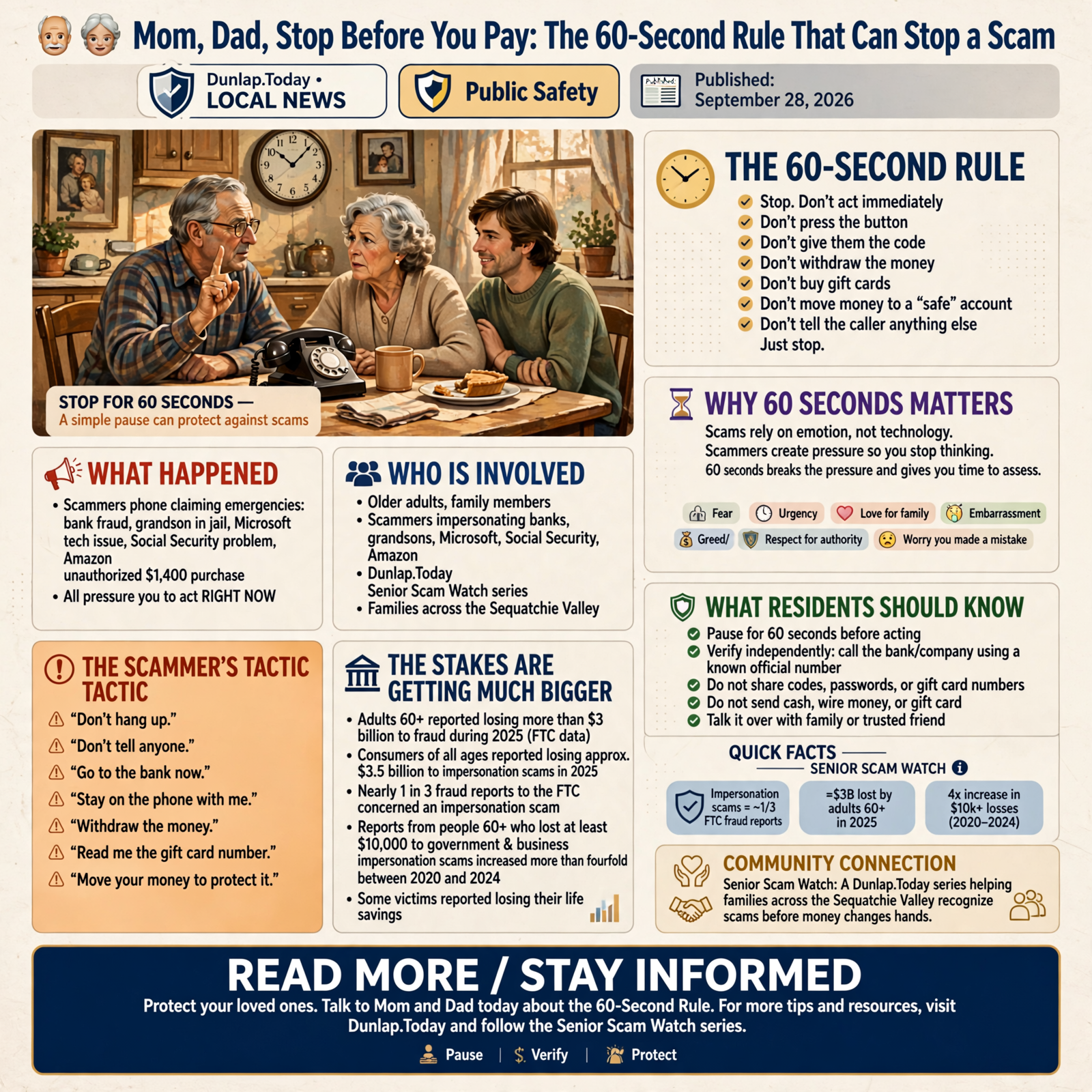
🛡️ Senior Scam Watch: A Dunlap.Today series helping families across the Sequatchie Valley recognize scams before money changes hands.
The phone rings.
Your bank says somebody is stealing your money.
Your grandson says he is in jail.
Microsoft says your computer has been hacked.
Social Security says there is a problem with your account.
Amazon says somebody just bought a $1,400 computer using your credit card.
And every one of them tells you essentially the same thing:
You need to do something RIGHT NOW.
That is the moment I want you to remember one simple rule.
Stop for 60 seconds.
Don’t press the button.
Don’t give them the code.
Don’t withdraw the money.
Don’t buy the gift cards.
Don’t move the money to a supposedly “safe” account.
Don’t tell the caller anything else.
Just stop.
Because in many modern scams, those 60 seconds are the one thing the scammer cannot afford to give you.
🚨 Why 60 Seconds Matters

Most successful scams aren’t really about technology.
They are about emotion.
The scammer wants you to feel something strongly enough that you stop analyzing what is happening.
Usually that feeling is one of these:
- 😨 Fear
- ⏰ Urgency
- ❤️ Love for a family member
- 😳 Embarrassment
- 💰 Greed or excitement
- 🫡 Respect for authority
- 😟 Worry that you’ve made a mistake
Once that emotion takes over, the scammer starts giving instructions.
And those instructions usually come quickly.
Don’t hang up.
Don’t tell anyone.
Go to the bank now.
Stay on the phone with me.
Withdraw the money.
Read me the number on the gift card.
Move your money so we can protect it.
The scammer isn’t merely asking you to act.
He is trying to keep you from having enough time to think.
💰 The Stakes Are Getting Much Bigger

Senior scams are not merely irritating telephone calls anymore.
Some are wiping out retirement accounts.
The Federal Trade Commission reported that adults age 60 and older reported losing more than $3 billion to fraud during 2025.
And one of the fastest-growing threats involves scammers pretending to represent trusted companies or government agencies.
Across all ages, consumers reported losing approximately $3.5 billion to impersonation scams in 2025. Nearly one in three fraud reports received by the FTC concerned an impersonation scam.
The numbers involving older victims can be especially painful.
FTC research found that reports from people 60 and older who lost at least $10,000 to government and business impersonation scams increased more than fourfold between 2020 and 2024.
Some victims reported losing their life savings.
That is why this conversation matters.
📊 Seniors Aren’t Necessarily Easier to Fool
There is an important point here that often gets lost.
Older adults are not necessarily falling for scams more frequently than everyone else.
FTC data has repeatedly shown that adults 60 and older may actually report losing money to fraud at a lower rate than younger adults.
The problem is that when older adults do lose money, the losses can be substantially larger.
That makes sense.
A 25-year-old may have $800 available.
A 75-year-old may have:
- decades of retirement savings,
- home equity,
- investment accounts,
- pensions,
- Social Security income,
- and access to established bank accounts and credit.
The scammer isn’t necessarily targeting weakness.
He may be targeting assets.
☎️ The Scam Often Starts With Something That Sounds Responsible

Imagine this phone call:
“Mrs. Johnson, I’m calling from your bank’s fraud department. We’ve detected suspicious activity on your account.”
That sounds helpful.
The caller isn’t threatening you.
He is protecting you.
Or so it appears.
Next:
“We need to secure your funds before the hackers transfer them.”
Still sounds reasonable.
Then:
“I’m going to walk you through moving the money into a protected account.”
And suddenly the person supposedly protecting your money is directing you to give it to the scammer.
FTC investigators describe exactly this type of false emergency: scammers impersonate trusted businesses and government agencies, convince victims that their money is in danger, and then persuade them to transfer it supposedly for safekeeping.
🧠 The Scam Isn’t the Story — The Scam Is the Instructions
This is one of the most important concepts we will discuss in Senior Scam Watch.
The story can change.
Today it is your bank.
Tomorrow it is Medicare.
Next week it is Amazon.
Next month it is the Sheriff’s Department.
After that it may be your grandson’s voice generated by artificial intelligence.
Don’t memorize every possible story.
Watch what the person is asking you to do.
🛑 The 60-Second Rule

Here is the rule I want families across the valley to remember:
If an unexpected phone call, email, text message or computer warning combines urgency with money, stop for 60 seconds before doing anything.
During those 60 seconds, ask five questions.
1️⃣ Did I Expect This Contact?
Did you initiate this call?
Did you already have an appointment with this person?
Were you expecting this message from your bank?
If the answer is no, slow down.
2️⃣ Are They Trying to Frighten Me?
Listen for:
- “Your account has been compromised.”
- “Your Social Security number has been suspended.”
- “There’s a warrant for your arrest.”
- “Your grandson is in trouble.”
- “Your computer is infected.”
- “Someone is stealing your money.”
Fear makes us cooperative.
Scammers know that.
3️⃣ Are They Creating a Deadline?
Listen carefully for words like:
- immediately,
- urgent,
- today,
- right now,
- before we disconnect,
- before the transaction clears.
A legitimate organization can usually survive while you hang up and independently verify what is happening.
4️⃣ Are They Telling Me to Keep It Secret?
This is an enormous warning sign.
A scammer may tell you:
“Don’t tell the bank teller why you’re withdrawing the money.”
Or:
“Don’t tell your family because the investigation is confidential.”
Or:
“Do not hang up or we’ll lose the ability to protect the account.”
Why?
Because the scammer knows that the first person you tell may say:
“Mom, hang up. That’s a scam.”
5️⃣ Are They Telling Me How to Move Money?
This is where the alarm bells should get loud.
Be especially cautious if somebody tells you to:
- 💳 buy gift cards,
- ₿ use a Bitcoin ATM,
- 🏦 wire money,
- 💵 withdraw large amounts of cash,
- 📦 put cash in a package,
- 🪙 buy gold,
- or transfer money to another account for “safekeeping.”
FTC data shows cryptocurrency, bank transfers and cash are among the important payment methods appearing in high-dollar impersonation scams involving older victims.
📞 Hang Up and Call Back — But Not the Number They Gave You

Here’s another rule worth putting on the refrigerator:
Never use the suspicious caller to verify the suspicious caller.
If someone says they are from your bank:
Hang up.
Get your debit or credit card.
Call the number printed on the card.
If someone says they are from Social Security:
Hang up and independently locate the official Social Security contact information.
If someone says they are from Amazon:
Open the Amazon app or website yourself and look at your orders.
If someone says your computer has a virus:
Do not call the telephone number displayed in the pop-up.
If someone claims to be your grandson:
Hang up and call your grandson directly using the number you already have.
🔄 Leave the Scammer’s World
This is the principle:
Change channels.
The scammer called you?
You make a different call.
The scammer emailed you?
You open the company’s website yourself.
The scammer sent a text?
You use the official app.
The scammer says a family member is involved?
You independently contact the family.
Do not let the person making the claim control the method used to verify the claim.
👨👩👧👦 Families Need a Scam Plan Before the Scam Happens

We make plans for fires.
We make plans for tornadoes.
We make plans for medical emergencies.
Families should also have a scam plan.
Pick Your “Call Before You Pay” Person
Every older adult should have one or two trusted people they can call before making an unusual financial transaction.
It might be:
- a son or daughter,
- a grandchild,
- a sibling,
- a trusted neighbor,
- a banker,
- or a longtime friend.
The agreement is simple:
“If somebody unexpectedly tells me I need to move money, send money, withdraw money or buy something in order to solve an emergency, I will call you first.”
No embarrassment.
No lectures.
No “How could you fall for that?”
Just:
“Call me before you pay.”
❤️ Shame Is One of the Scammer’s Best Weapons

This deserves special attention.
People sometimes hide scams because they are embarrassed.
Maybe they already gave the caller information.
Maybe they clicked the link.
Maybe they sent $500.
Maybe they suddenly realize the person they have been talking with online isn’t who they claimed to be.
That is precisely when families need to be approachable.
If somebody thinks admitting the problem will earn them a lecture, they may keep sending money instead.
The first family response should be:
“Let’s figure out what happened.”
Not:
“I can’t believe you did that.”
🤝 Give People Permission to Be Suspicious
Older generations were often raised to:
- answer the telephone,
- respect authority,
- be polite,
- help someone who asks for assistance,
- and take another person’s word seriously.
Those are good qualities.
Scammers exploit them.
So families may need to explicitly give one another permission to say:
“No.”
“I’m hanging up.”
“I’ll verify this myself.”
“I’m going to call my daughter.”
“I’m not giving you that information.”
Being polite does not require being financially defenseless.
🤖 Artificial Intelligence Changes the Equation
For years, families relied on little clues.
The scammer had bad grammar.
The email looked strange.
The caller didn’t sound quite right.
Those clues are becoming less reliable.
AI can help criminals produce:
- more professional emails,
- more convincing text messages,
- better-written scripts,
- realistic images,
- and increasingly convincing synthetic voices.
So our defenses need to move away from:
“Does this look fake?”
and toward:
“Can I independently prove this is real?”
🔐 Consider a Family Safe Word

Families can borrow an old idea and make it useful again.
Choose a word or phrase that isn’t obvious from Facebook, birthdays, pet names or family history.
If a caller says:
“Grandma, I’m in trouble.”
Grandma can ask:
“What’s our family word?”
No system is perfect, but requiring independent verification creates another obstacle for the scammer.
And just as important:
Hang up and call the family member yourself.
📋 Put This Beside the Telephone

You don’t need to memorize this entire article.
Write this down:
STOP BEFORE YOU PAY.
- Hang up.
- Wait 60 seconds.
- Call someone you trust.
- Verify the story independently.
- Never move money because an unexpected caller tells you to.
That’s it.
Five steps.
📣 Please Send This Article to Someone You Love

This Senior Scam Watch series only works if we get the information outside the people who already know it.
If you have:
- parents,
- grandparents,
- older neighbors,
- church members,
- retired coworkers,
- or friends who live alone,
please send them this article.
Better yet, talk about it.
Ask:
“If somebody called tomorrow and said your bank account was being hacked, what would you do?”
That conversation today may prevent a very painful conversation six months from now.
👨👩👧 Share It With the Whole Family
This isn’t just an article for seniors.
Children and grandchildren should read it too.
Because scam prevention works best when a family establishes the rules before the emergency phone call arrives.
🚨 Introducing Dunlap.Today Senior Scam Watch

This is the beginning of a continuing Dunlap.Today series.
In upcoming Senior Scam Watch articles, we’ll examine specific schemes including:
- 👦 The Grandchild Emergency Scam
- 🏦 Fake Bank Fraud Departments
- 💻 Microsoft and Computer Support Scams
- 🏛️ Social Security and Government Impersonation
- ❤️ Romance Scams
- 🎁 Sweepstakes and Lottery Scams
- 💳 Gift Card Scams
- ₿ Bitcoin ATM Scams
- 📦 Package Delivery Texts
- 🩺 Medicare and Health Insurance Scams
- 💰 Investment Scams
- 🤖 AI Voice-Cloning Scams
- 🏠 Contractor and Home Repair Scams
We’ll show what they look like, what the scammer wants, what warning signs appear, and what to do when one reaches your family.
🛡️ Remember One Thing

You do not have to become an expert in every scam.
You don’t have to understand cryptocurrency.
You don’t need to understand artificial intelligence.
You don’t need to recognize every fake email.
You need to remember this:
Unexpected urgency involving money deserves a pause.
Give yourself 60 seconds.
Leave the caller’s world.
Call somebody you trust.
Verify the story independently.
And never be embarrassed about asking:
“Does this sound right to you?”
That may be the most profitable 60 seconds you spend all year.
📚 Sources & Further Reading

- Federal Trade Commission — Top Scams Affecting Older Adults, May 2026: The FTC reported that adults age 60 and older reported more than $3 billion in fraud losses during 2025.
- Federal Trade Commission — June 2026: Consumers across all age groups reported approximately $3.5 billion in losses to impersonation scams during 2025, with business and government impersonation among the most costly categories.
- Federal Trade Commission — False Alarm, Real Scam: FTC analysis documents the growth of high-dollar business and government impersonation scams targeting older adults and describes common payment methods and contact channels.
- Federal Trade Commission — Protecting Older Consumers: FTC reporting shows that older adults may be less likely than younger consumers to report losing money when exposed to fraud, but their individual losses can be substantially higher when fraud succeeds.
📣 HELP PROTECT THE VALLEY: Please send this article to at least one parent, grandparent, older friend or neighbor.
Then ask them one question:
“Who will you call before you send money?”
If they already know the answer, you’ve accomplished something important.




0 Comments