

📧 An Email Saying Your “Held” Messages Will Be Deleted After the Microsoft Outage, a Real Government Phone Number on Your Caller ID That Isn’t Really Them and a “Delivery Fee” Text as Shipping Season Starts: Your Scam Watch for This Week

Or: Your Email Came Back on Its Own, Caller ID Can Fib, and the Post Office Doesn’t Text You a Bill
By Thomas Seest, Dunlap.Today · Sunday, November 15, 2026
Good morning, neighbors. It’s Sunday, the coffee’s hot and nothing on your phone needs an answer before breakfast. This week’s tricks all have one thing in common: they borrow something real. A real Microsoft outage. A real government phone number. A real holiday package you might actually be waiting on. The fix is the same for all three: a real-looking detail is not proof. Check it yourself, your own way.
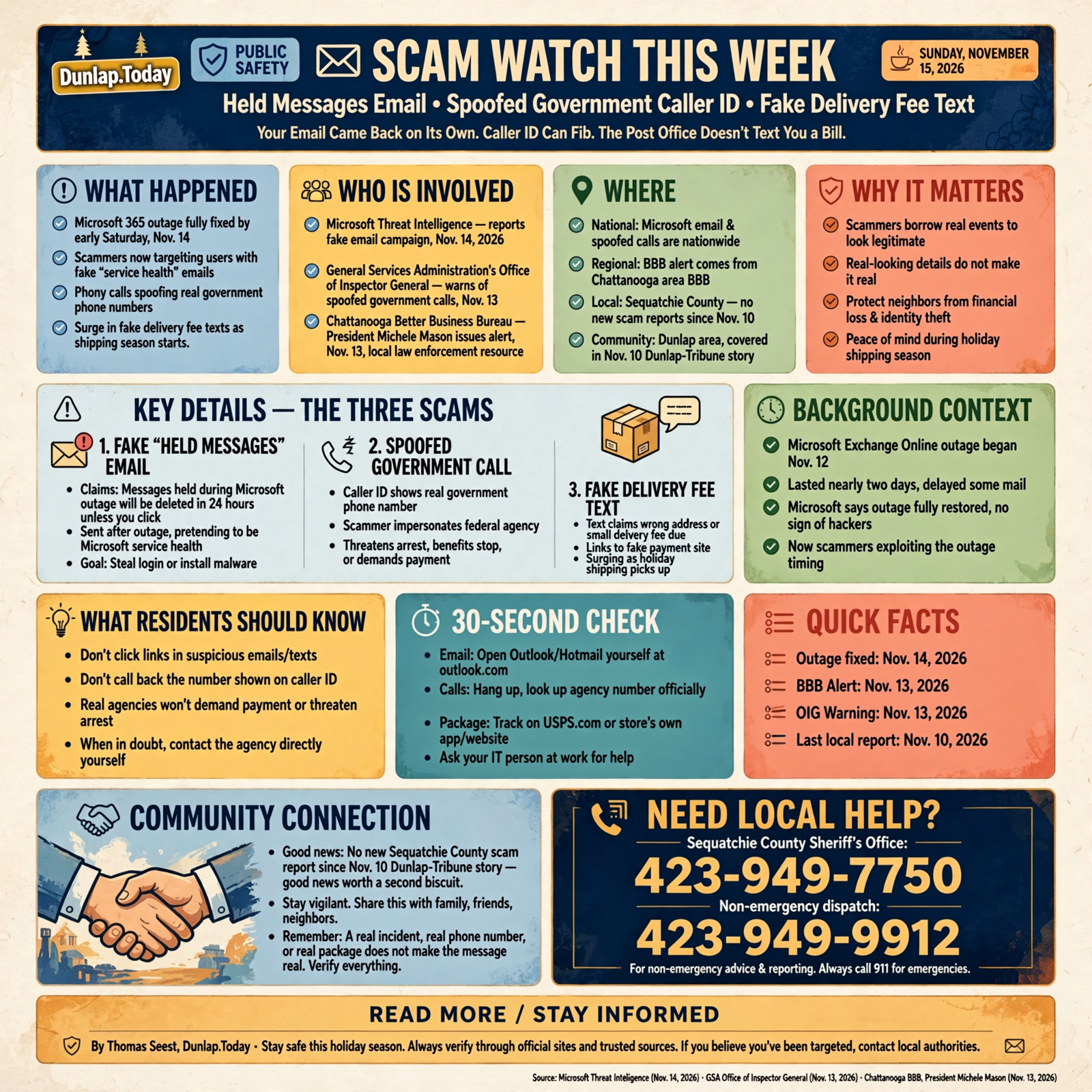
Here’s what’s on the porch: after this week’s long Microsoft 365 outage, which Microsoft said was fully fixed by early Saturday, Nov. 14, Microsoft’s own security team says scammers are sending fake “service health” emails claiming messages held during the outage will be deleted in 24 hours unless you click; the General Services Administration’s Office of Inspector General, a federal watchdog, warned on Friday, Nov. 13 that scammers have been making calls look like they come from its real government phone numbers; and Chattanooga Better Business Bureau President Michele Mason wrote on Nov. 13 that fake texts and emails about wrong addresses and delivery fees are surging as holiday shipping picks up. The Microsoft emails and the spoofed calls are national; the BBB reminder comes from our own regional BBB in Chattanooga. Closer to home, we haven’t seen a new Sequatchie County scam report since the Nov. 10 Dunlap-Tribune story, which we’ve already covered. That’s good news worth a second biscuit.
⏱️ What this means for you in 30 seconds
- An email says messages “held” during the Microsoft outage will be deleted unless you click? Don’t click. Microsoft says the outage is over, and those emails are fake.
- Want to check your email? Open your Outlook or Hotmail app the way you always do, or type outlook.com yourself. At work, ask your own IT person.
- Caller ID shows a real government number? That’s not proof. Real government agencies won’t call to threaten arrest, stop your benefits or demand payment. Hang up and call the agency back at a number you look up yourself.
- A text says your package has a wrong address or owes a small fee? Don’t tap the link. Track it on USPS.com or the store’s own app or website.
- Remember: A real-looking detail (a real incident number, a real phone number, a real package) doesn’t make the message real.
- Need local help? Sequatchie County Sheriff’s Office: 423-949-7750. Non-emergency dispatch: 423-949-9912.
📧 Your Email Came Back on Its Own: Ignore “Restore Your Held Messages” Notices

National: Microsoft Threat Intelligence, reported Nov. 14, 2026
If your Outlook email acted up late this week, you weren’t alone. Microsoft’s Exchange Online email service had a disruption that began Nov. 12 and delayed some mail, and The Verge reported it lasted nearly two days. Microsoft said Saturday that service was fully restored, and the company said there was no sign the outage was caused by hackers.
Scammers moved fast anyway. Microsoft Threat Intelligence says it found an active campaign of fake Microsoft 365 “service health” emails. Some claim that messages held during the outage will be deleted within 24 hours unless you click to restore them. The subject lines look like “Outage – ” followed by a six-letter code, the sender names say things like “Outage Notification” or “Service Health”, and some even quote Microsoft’s real incident number to look official. Microsoft described it as an attempt to steal passwords and said similar messages went to organizations across many U.S. industries.
It’s like a fellow knocking on your door after a storm, saying the power company sent him to “save” the food in your freezer for a small fee. The storm was real. He isn’t from the power company, and your freezer was fine all along.
What it means for you: Microsoft’s warning is mainly about workplace email accounts, and it hasn’t said personal Outlook.com or Hotmail users were targeted. But the lesson fits anybody with an inbox: your email doesn’t need you to click anything to come back. If you get one of these, don’t click its buttons or open its attachments. In Outlook you can often choose Report, then Report phishing. If you’re at work, tell your IT person or office manager. If you clicked and typed in your password, change it right away by going to your account yourself, not through the email. Clicking alone, without typing anything in, doesn’t by itself mean your account was taken over. Close the page and report it.
👉 Read more (iTnews: Phishers quick to exploit extended M365 outage) · AP: Microsoft says services fully restored
☎️ A Real Government Number on Caller ID Can Still Be a Fake Call
National: GSA Office of Inspector General, Nov. 13, 2026
Here’s one to tape on the fridge next to the phone. The Office of Inspector General for the General Services Administration, the federal agency that handles government buildings and supplies, says scammers may have recently spoofed its real phone numbers. That means the calls show up on caller ID as a real government agency number, but they aren’t real.
The watchdog says these callers may pressure people to give up Social Security numbers or bank details, or demand immediate payment by phone. Its plain rule: “GSA OIG and other U.S. government agencies will never call to threaten arrest, suspend benefits, or demand payment in any form.” Its advice: hang up immediately and don’t give out personal or financial information.
Think of caller ID like the name painted on the side of a pickup truck. Anybody with a can of paint can write “County Road Department” on a door. You’d still call the courthouse before you handed him a check.
What it means for you: We’ve talked before about fake “federal agent” calls. This week’s warning is a fresh reminder from a different agency that a familiar number on the screen is not proof. If a “government” caller wants money or personal details, hang up, look up the agency’s number yourself, and call back. You can report GSA impersonation calls at gsaig.gov/hotline, and for calls pretending to be any other agency, the government keeps a directory of every agency watchdog’s hotline at ignet.gov. You can always report at ReportFraud.ftc.gov, too.
👉 Read more (GSA OIG: Beware of Scammers That Are Spoofing Real Government Numbers) · Directory of Inspector General hotlines
📦 Shipping Season Is Here: The Post Office Doesn’t Text You a “Delivery Fee” Link
Regional: Chattanooga Better Business Bureau, Nov. 13, 2026
With Thanksgiving a week and a half off and the gift orders starting to roll, our own regional BBB has a reminder. In a Nov. 13 column in the Chattanooga Times Free Press, Chattanooga BBB President Michele Mason wrote that peak shopping season brings “a surge in fake texts and emails claiming delivery issues” along with porch pirates eyeing packages left on doorsteps. She warned that a convincing note about an incorrect address or an outstanding delivery fee may lead to a fake website built to steal your payment information or passwords.
The U.S. Postal Inspection Service backs that up: USPS won’t text or email you without you first asking for tracking with a tracking number, and those messages will NOT contain a link. It also says USPS doesn’t charge for its tracking service.
It’s a bit like somebody at the end of your gravel drive saying your mail-order package is stuck at the mailbox and you owe him a dollar to open the gate. The mail carrier never asked you for a dollar before, and she’s not starting now.
What it means for you: If you get a “package problem” text, don’t tap the link, even if you’re expecting something. Look it up on USPS.com, or in the store’s or shipper’s own app or website, using the tracking number from your order email or receipt. You can forward the text to 7726 (it spells SPAM) and report USPS look-alikes to spam@uspis.gov. If you already tapped and typed in card details, call your bank or card company using the number on the back of your card. And for the porch: if a big box is coming while you’re away, ask a neighbor to grab it or have it held, the same way you’d ask them to watch the dog.
👉 Read more (Times Free Press: Protect your packages and your information this holiday season) · USPIS: Package tracking text scams
✅ Your Front-Porch Scam Checklist

- ✅ “Restore your held email” message after the Microsoft outage? Don’t click. Your email came back on its own.
- ✅ Check email the usual way: your own app, or type outlook.com yourself.
- ✅ At work? Tell your IT person or office manager about any “outage” email.
- ✅ Typed your password into one of those pages? Change it right away, going to your account yourself.
- ✅ Caller ID shows a government number? Still hang up if they want money or personal details.
- ✅ Real agencies don’t call to threaten arrest, stop benefits or demand payment.
- ✅ Call the agency back at a number you looked up yourself.
- ✅ “Delivery fee” or “wrong address” text? Don’t tap. Track it on USPS.com or the store’s own site.
- ✅ Forward scam texts to 7726 (SPAM), then delete them.
- ✅ Already paid, clicked or shared? Call your bank first, then the sheriff’s office (423-949-7750) and ReportFraud.ftc.gov.
The practical rule: A real detail doesn’t make a fake message real. Hang up, close it, and check it yourself, your own way.
— Dunlap.Today
📚 Plain-English Glossary

- Outage: When a service like email stops working for a while. This week’s Microsoft outage delayed some email, and Microsoft says it’s fixed.
- Phishing email: An email dressed up to look official, meant to get you to click, type in a password, pay or share information.
- Service health notice: A real status message companies like Microsoft use to tell businesses about problems. Scammers are copying the look.
- Caller ID spoofing: When a scammer makes a fake phone number, even a real agency’s number, show up on your screen.
- Office of Inspector General (OIG): The watchdog inside a government agency that investigates fraud and warns the public about impersonators.
- Smishing: A scam sent by text message, usually with a link to a fake website.
- Porch pirate: Someone who takes delivered packages off a doorstep.
- 7726: A free number most phone companies use for reporting scam texts. It spells SPAM on the keypad.
❓ Frequently Asked Questions

Was my email lost in the Microsoft outage?
Microsoft said Saturday that service was fully restored, and reports said delayed messages were catching up. Microsoft also said there was no sign the outage was caused by hackers. If something still seems missing, check your own app or outlook.com, or ask your workplace IT person. Don’t use a link in an email to “restore” anything.
I clicked a link in one of those outage emails. Am I in trouble?
Take a breath. Clicking alone, without typing anything in or downloading anything, doesn’t by itself mean your account was taken over. Close the page and report the email. If you typed in your password, change it right away by going to your account yourself, and keep an eye out for sign-in alerts you don’t recognize. At work, tell your IT team.
I use Hotmail at home, not a work account. Should I worry?
Microsoft’s warning describes emails sent to organizations, and it hasn’t said personal Outlook.com or Hotmail users were targeted. But it’s a good habit for everyone: never “fix” your email by clicking a link in an email. Open your app or type outlook.com yourself.
How can a scammer show a real government phone number?
It’s called spoofing. Caller ID can be faked, so a real number on the screen doesn’t prove who is calling. If the caller wants money or personal details, hang up and call the agency back at a number you looked up yourself.
Where do I report a call pretending to be a government agency?
For calls pretending to be the GSA’s watchdog, use gsaig.gov/hotline. For other agencies, the government’s directory at ignet.gov lists every Inspector General hotline. You can also report any impersonation call at ReportFraud.ftc.gov.
Does the Post Office ever text me?
Only if you signed up for text tracking with a specific tracking number, and the Postal Inspection Service says those messages won’t contain a link. Tracking is free. If a text with a link says your package is stuck or owes a fee, don’t tap it. Check USPS.com yourself.
I already paid a “delivery fee” from a text. Is it too late?
No, and you’re not alone. Call your bank or card company right away using the number on your card and ask them to stop the charge and watch your account. Then report it to the Sequatchie County Sheriff’s Office at 423-949-7750 and at ReportFraud.ftc.gov. For USPS look-alike texts, you can also email spam@uspis.gov.
🔗 Other Resources

- iTnews: Phishers quick to exploit extended M365 outage (Nov. 14, 2026)
- Secritic: Scammers use a real Microsoft 365 outage to make fake emails look genuine (Nov. 14, 2026)
- AP: Microsoft says services fully restored after hourslong global outage
- GSA OIG: Beware of Scammers That Are Spoofing Real Government Numbers (Nov. 13, 2026) · GSA OIG hotline
- Directory of Inspector General hotlines (ignet.gov)
- Chattanooga Times Free Press: Protect your packages and your information this holiday season (Nov. 13, 2026)
- U.S. Postal Inspection Service: Package tracking text scams · Report USPS look-alike texts: spam@uspis.gov · Forward scam texts to 7726
- Sequatchie County Sheriff’s Office: 423-949-7750 · Non-emergency dispatch: 423-949-9912 · Dunlap Police: (423) 949-3319
- TN Attorney General: Scams, Schemes & Swindles
- IdentityTheft.gov · National Elder Fraud Hotline (U.S. Justice Department): 1-833-372-8311 · AARP Fraud Watch Network Helpline: 877-908-3360
- Report a scam: ReportFraud.ftc.gov · FBI IC3 · BBB Scam Tracker
🌄 Rest Easy: The Real Thing Will Still Be There When You Check

Here’s the calm takeaway for a quiet Sunday: you don’t have to out-think every crook. Your email came back without anybody’s help, the real government office will still answer when you call the number you looked up, and your package will still show up on USPS.com without a “fee.” When a message leans on a real-sounding detail to rush you, that’s your cue to slow down, set the phone face-down and finish your coffee. Pass this along to the neighbor who runs the office computer, the friend who still answers every call and anybody in the family who’s ordering gifts online. We’ll keep watch and bring you what’s new. Read Dunlap.Today and sign up for our newsletter for plain-English scam alerts and Valley news.

0 Comments