
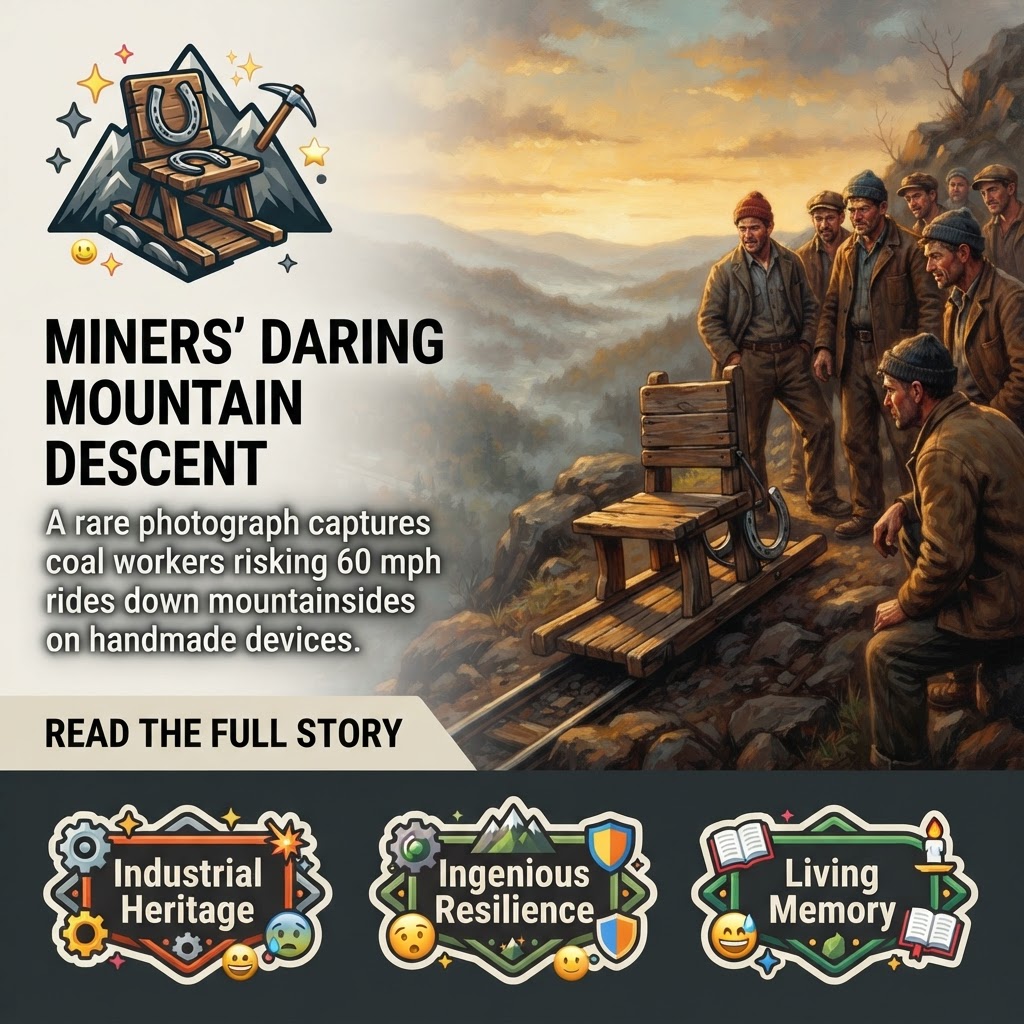
🏔️ Rare Historic Photo Reveals Coal Miners’ Daring Mountain Descent in Sequatchie Valley
A remarkable photograph preserved in the archives of the Sequatchie Valley Historical Association offers a glimpse into one of the region’s most ingenious-and dangerous-solutions to the daily challenge of getting home after a grueling shift underground. The image, believed to be the only known photo of its kind, captures coal miners preparing to use a handmade device called an “Incline Horse” to slide down the mountainside at speeds reaching 60 miles per hour.
📸 A Window Into Coal Mining Life Before 1916
The photograph, dated before 1916 and now housed at the Dunlap Coke Ovens Coal Mining Museum and Park, shows a group of miners and a child worker posed with the wooden seat device at the beginning of their evening descent. After ten hours of labor in the mines, these workers faced a choice: walk the nearly one-mile trek down the mountain to their homes in the valley, or risk a thrilling ride on a contraption made of wood, a steel horseshoe, and a metal roller. 🛠️
The “Incline Horse” was crude but effective-a handmade transportation device that speaks to the resourcefulness and desperation of workers seeking faster passage home. The presence of a child worker in the photograph also documents a darker chapter of industrial history: child labor in the coal mines of the Sequatchie Valley and surrounding regions.
💡 Why This Matters
This image is far more than a curiosity. It is a tangible record of how coal mining shaped daily life in the Sequatchie Valley, revealing the physical demands, the ingenuity, and the risks that miners accepted as routine. The photograph documents not just a transportation method, but an entire way of life-the exhaustion after a ten-hour shift, the urgency to get home, and the willingness to trust a handmade device hurtling down a mountainside at dangerous speeds. 📍
For residents of the valley today, this image connects modern life to the industrial heritage that built the region. The coal mining era transformed the Sequatchie Valley economically and socially, and artifacts like this photograph help explain why the valley developed as it did and what sacrifices earlier generations made.
🤝 Community Connections
The preservation and public sharing of this photograph reflects the work of local historians and community organizations dedicated to keeping the valley’s industrial past alive. The Dunlap Coke Ovens Coal Mining Museum and Park, which now holds the original photo in its archives, serves as a steward of these stories. By sharing this image, the museum invites residents and visitors to engage with the valley’s history and understand the human stories behind the coal industry that once dominated the region. ⭐
The photograph also connects to broader conversations about labor history, industrial heritage, and how communities remember and honor the contributions of working people. For families with roots in the coal mining era, images like this may trigger personal memories or family stories passed down through generations.
👥 Human Impact
The miners in this photograph were real people-workers who faced daily danger, exhaustion, and the need to find creative solutions to survive their circumstances. The child worker visible in the image represents a generation of young people who entered the mines instead of attending school, a reality that shaped their entire lives. 🏔️
For descendants of these miners, the photograph offers a tangible connection to ancestors and a visual record of their struggles. For the broader community, it humanizes the coal mining era-transforming abstract historical dates and statistics into the faces and choices of actual people.
📚 Local Perspective
The Sequatchie Valley’s identity is deeply rooted in coal mining history. From the late 1800s through much of the 20th century, coal extraction was the economic engine of the region, drawing workers from across the country and shaping the valley’s towns, families, and culture. The “Incline Horse” is one of countless innovations and adaptations that miners developed to cope with the demands of their work.
This photograph is particularly significant because it is believed to be the only known image of miners using this specific device. In an era before widespread photography, especially in remote mining communities, such images are rare and invaluable. The fact that it has been preserved and is now accessible through the Dunlap Coke Ovens Coal Mining Museum and Park means that future generations can learn directly from visual evidence rather than relying solely on written accounts or oral history.
🔍 What This Reveals About Community Heritage
The preservation of this photograph demonstrates the valley’s commitment to documenting and honoring its industrial past. Museums, historical associations, and community organizations work to ensure that stories like this one are not lost. For residents, this means that the valley’s history is actively being collected, preserved, and shared-creating opportunities to learn, reflect, and pass knowledge to younger generations. ✨
The image also raises important questions about how we remember labor history. The miners in this photograph took extraordinary risks to get home faster. Their willingness to slide down a mountainside at 60 miles per hour speaks to both their determination and the physical toll of their work. Understanding this context helps residents appreciate the valley’s heritage and the resilience of those who built it.
🎯 Opportunities for Connection
Residents interested in learning more about this photograph and the coal mining era can visit the Dunlap Coke Ovens Coal Mining Museum and Park, where the original image is archived. The museum offers opportunities to engage with local history, see artifacts, and connect with others who share an interest in the valley’s past. 🏛️
For families with mining heritage, this photograph may inspire conversations about family history and the stories of ancestors. Community members can also support the work of local historical organizations by volunteering, donating, or participating in oral history projects that capture and preserve the memories of those who lived through the coal mining era.
❓ Questions Worth Considering
As residents reflect on this remarkable image, several questions emerge:
- How many other photographs, documents, or artifacts from the coal mining era remain undiscovered or at risk of being lost?
- What other ingenious solutions did miners develop to cope with the demands of their work, and are those stories being preserved?
- How can the valley continue to honor and learn from its industrial heritage while also moving forward economically and culturally?
- What family stories or memories do residents have about coal mining in the Sequatchie Valley, and how can those be documented for future generations?
🌄 Long-Term Community Impact
Photographs and artifacts like this one serve as anchors for community identity and pride. They remind residents that the Sequatchie Valley has a deep, complex history shaped by the courage and ingenuity of working people. As the valley continues to evolve-with tourism, small business, and new economic opportunities-preserving and sharing this history helps maintain cultural continuity and ensures that the sacrifices of earlier generations are remembered and honored.
The photograph also has educational value for schools, researchers, and visitors interested in industrial history, labor studies, and Appalachian heritage. By making such images accessible, the valley positions itself as a destination for heritage tourism and cultural learning-opportunities that can benefit local businesses and strengthen community pride. 📖
🔗 Community Threads: Stewardship and Memory
The Museum-Community Relationship: The Dunlap Coke Ovens Coal Mining Museum and Park does not simply store artifacts-it actively shares them with the public, inviting residents and visitors to engage with local history. This relationship between the museum and the community creates a shared responsibility for remembering and interpreting the valley’s past. When residents visit, donate, or volunteer, they participate in the ongoing work of historical preservation.
Family Heritage and Collective Memory: For many valley residents, coal mining is not abstract history-it is family history. Photographs like this one connect individuals to their ancestors and create opportunities for intergenerational conversations about work, sacrifice, and resilience. These personal connections strengthen community bonds and ensure that history remains alive and relevant rather than confined to textbooks.
Labor and Innovation: The “Incline Horse” represents the ingenuity of working people who solved problems with limited resources. This thread connects the coal mining era to the valley’s contemporary culture of self-reliance, craftsmanship, and problem-solving. Understanding this heritage can inspire residents to value and support local innovation and entrepreneurship today.

0 Comments