

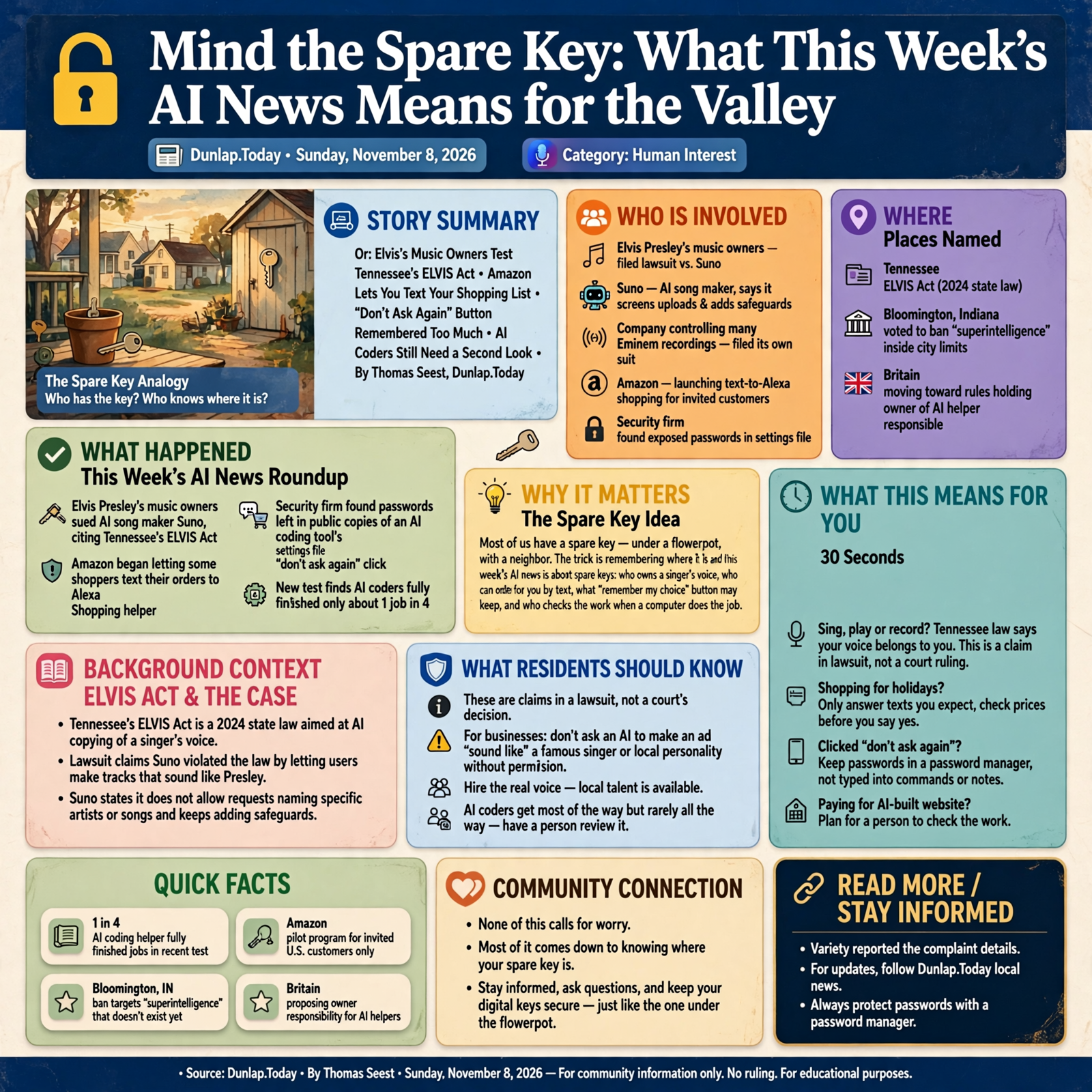
🗝️ Mind the Spare Key: What This Week's AI News Means for the Valley

Or: Elvis’s Music Owners Test Tennessee’s ELVIS Act, Amazon Lets You Text Your Shopping List, a “Don’t Ask Again” Button Remembered Too Much and AI Coders Still Need a Second Look
By Thomas Seest, Dunlap.Today · Sunday, November 8, 2026
Most of us have a spare key somewhere — under a flowerpot, on a nail in the shed, with a trusted neighbor. Nothing wrong with that. The trick is remembering where it is and who else knows.
This week’s AI news is about spare keys: who owns a singer’s voice, who can order things for you by text, what a “remember my choice” button might quietly keep, and who checks the work when a computer does the job.
Here’s the roundup: Elvis Presley’s music owners sued AI song maker Suno, partly under Tennessee’s own ELVIS Act, Amazon began letting some shoppers text their orders to its Alexa shopping helper, a security firm found passwords left in public copies of an AI coding tool’s settings file after people clicked “don’t ask again”, a new research test found the best AI coding helper fully finished only about one job in four, Bloomington, Indiana, voted to ban “superintelligence” inside city limits and Britain moved toward rules that hold the owner of an AI helper responsible when it runs off. None of this calls for worry. Most of it comes down to knowing where your spare key is.
⏱️ What this means for you in 30 seconds
- Sing, play or record? Tennessee law says your voice belongs to you. Elvis’s music owners are now testing that law in court. These are claims, not a ruling.
- Shopping for the holidays? Amazon is starting to let invited customers text an AI helper to shop. Only answer texts you expect, and check prices before you say yes.
- Clicked “don’t ask again” lately? Handy buttons can remember more than you meant. Keep passwords in a password manager, not typed into commands or notes.
- Paying for an “AI-built” website? A new test says AI coders get most of the way but rarely all the way. Plan for a person to check it.
- Hearing about towns banning AI? One Indiana city banned a kind of AI that doesn’t exist yet. Your phone and chatbots aren’t affected, and nothing like it has come up here.
🎤 Elvis’s Music Owners Lean on a Tennessee Law

A group that owns rights to Elvis Presley’s music filed a federal lawsuit against Suno, a company whose AI makes songs from typed requests. Variety reported the complaint claims copyright violations and says Suno broke Tennessee’s ELVIS Act — a 2024 state law aimed at AI copying of a singer’s voice — by letting users make tracks that sound like Presley. A company that controls many Eminem recordings filed its own suit.
Suno says it doesn’t allow requests naming specific artists or songs, screens uploads and keeps adding safeguards. These are claims in a lawsuit, not a court’s decision.
It’s a little like a brand on a calf. Somebody can copy the pattern, but the brand still says whose it is.
What it means for you: If you sing at church, pick at the jam on Saturday night or record radio spots, Tennessee law already recognizes your voice as yours. For businesses, the easy rule is: don’t ask an AI to make an ad “sound like” a famous singer or a local personality without permission. Hire the real voice — there’s plenty of talent right here.
📱 Amazon Wants You to Text Your Shopping List

Amazon started inviting a small group of U.S. customers to text Alexa for Shopping, an AI helper that can search, compare, fill a cart, buy, watch for price drops, reorder and check on deliveries. Amazon says millions more customers will get the option in the coming weeks. GeekWire reports purchases go through with the customer’s approval, and customers can turn on automatic buying when a price hits a target.
It works on phones with modern text chats (called RCS), including most Android phones with Google Messages and iPhones on iOS 18 or later, if your carrier supports it. Adweek reports Amazon is testing sponsored product ads inside the chats.
It’s like leaving your list with the clerk at the old general store — except the clerk also has a few products he’d like to mention.
What it means for you: Convenient, if you want it. But new features are a scammer’s favorite costume, so only reply to an “Alexa Shopping” text you were expecting, and when in doubt open the Amazon app yourself instead of tapping a link. If you run a shop here, tell folks if they can text or call in an order — local can be just as easy.
🔑 A “Don’t Ask Again” Button Remembered Too Much

Security firm Apiiro said it found 1,122 public copies of a settings file from Claude Code, an AI tool that helps programmers, holding at least one password or digital key. The Hacker News reported that when a user approves a command and clicks “Yes, and don’t ask again,” the tool can save that exact command — including any password typed into it — and some people then posted the file publicly on GitHub, a site where programmers share code.
Apiiro did not test whether most of those keys still work. Its advice to programmers: change every password the file ever held first, then remove the file and keep secrets out of typed commands.
It’s the spare key under the mat — perfectly handy until somebody else learns which mat.
What it means for you: Most folks will never touch this tool. But the lesson fits every phone and computer: a “remember my choice” box can remember more than you intended. Keep passwords in a password manager, don’t type them into notes or messages, and if you hire a web developer or IT shop, ask how they store your passwords.
🔨 AI Can Build Most of the Fence — Somebody Still Walks the Line

Researchers led by Alibaba built a new test from real requests people made to change existing websites, choosing many that had already given AI helpers trouble. The Decoder reported the best of ten AI models met about 70% of each job’s requirements on average, but got the whole job completely right only about 26% of the time — roughly one in four.
The research hasn’t been formally reviewed yet, and AI programs did the grading, so treat the numbers as a careful estimate rather than a final score.
Think of a new hand who strings wire faster than anybody, then leaves a corner post loose. You’d still hire him. You’d also walk the line before turning the cattle out.
What it means for you: If you’re paying for an “AI-built” website or app, that’s fine — just ask who checks the finished work, and test the pieces that matter (prices, phone numbers, hours, the order button) yourself.
🏛️ An Indiana Town Banned “Super-Smart” AI

The city council in Bloomington, Indiana, voted unanimously on Nov. 4 to ban “superintelligence” in the city, the Indiana Daily Student reported. The ordinance describes an AI that outperforms people at nearly all mental tasks and acts on its own — something that doesn’t exist today. The rule is meant to be temporary and would end 91 days after Indiana writes its own safety rules. An advocacy group says the mayor still has to approve it, so treat the final step as pending. A local news site raised questions about how a city could enforce it.
It’s a bit like a church posting “No Hunting” on its property line: a clear message, with a limited reach.
What it means for you: Your phone, chatbots and everyday apps aren’t touched by a rule like this, and we found nothing similar proposed in the Sequatchie Valley. The bigger lesson is that local boards are where neighbors’ voices land first. Agendas are public — it’s worth a glance now and then.
👉 Read more (Indiana Daily Student)
🐕 If the AI Helper Runs Off, Who Answers for It?

Britain’s government added a section to a cybersecurity bill that would let ministers write rules for when an AI agent — a helper that can take actions on its own — gets out of control at places like power suppliers and cloud computing companies. The Register reported the rules could cover safeguards, telling affected businesses, saving evidence and official reviews. Nothing takes effect until it goes through public consultation and Parliament approves.
It’s like a dog ordinance: the owner answers for the dog, not the breeder.
What it means for you: This is overseas and still a proposal. But the idea is worth borrowing: if your business uses an AI helper, write down what it’s allowed to touch and who to call if it does something odd. The person who turns it on is the one who’ll be asked what happened.
✅ Your Front-Porch AI Checklist

- ✅ Your voice is yours under Tennessee law. Don’t let an ad copy somebody else’s without permission.
- ✅ Holiday shopping by text? Only answer texts you expected, and open the store’s app yourself when unsure.
- ✅ Before you click “remember me” or “don’t ask again,” ask what exactly it’s remembering.
- ✅ Keep passwords in a password manager — not in notes, texts or typed commands.
- ✅ If someone builds your website with AI, test the prices, hours, phone numbers and order button yourself.
- ✅ Write down what any AI helper at work may read, send or buy, and who to call if it goes sideways.
- ✅ Mark Tuesday, Nov. 10, 2:30 p.m. CT if you want to catch UTC’s public talk on the economic impact of AI.
Practical rule: Know where every spare key is — and never hand one to a helper, human or AI, without knowing who checks the door behind them.
— Dunlap.Today
📚 Plain-English AI Glossary
- ELVIS Act: Tennessee’s 2024 law protecting a person’s voice and likeness from unauthorized AI copying.
- AI song generator: A program that makes music and lyrics from a typed request.
- AI agent: A helper that can take actions — shop, send, change files — not just answer questions.
- RCS: The newer kind of phone texting that supports pictures, typing bubbles and business chats.
- Auto-buy: A setting that lets a helper purchase automatically when a price hits your target.
- Secret (in computing): A password, token or digital key that unlocks an account or database.
- GitHub: A website where programmers store and share code — sometimes publicly.
- Benchmark: A standard test used to compare how well AI programs do a job.
- Superintelligence: A hypothetical AI smarter than people at nearly everything. It doesn’t exist today.
- Ordinance: A local law passed by a city or county.
❓ Frequently Asked Questions

Did a court rule that Suno broke Tennessee law?
No. Elvis Presley’s music owners filed a lawsuit making that claim. Suno disputes misuse and says it blocks requests for specific artists. A court will decide later.
Does the ELVIS Act protect regular people, or just stars?
It’s a Tennessee law about a person’s voice and likeness, and it’s being tested here by a famous estate. If you have a specific worry about your own voice or image, a Tennessee attorney can explain how it applies to you.
Should I sign up to text Amazon’s shopping helper?
That’s up to you. Right now it’s invitation-only. If you try it, keep approvals on, check prices before saying yes and be careful with automatic buying.
How do I know a shopping text is real?
If you didn’t expect it, don’t tap links. Open the store’s app or website yourself, or call the store. Scammers often copy brand-new features.
I don’t write code. Does the Claude Code password problem affect me?
Directly, probably not. The lesson does: “remember this” buttons can store more than you think. If you hire a developer or IT shop, ask how they keep your passwords safe.
Is AI-built software bad?
Not at all. The new test says AI gets most of a job done but often misses a piece. A person checking the finished work closes that gap.
Could Sequatchie County ban AI like Bloomington did?
Local governments can set rules for their own offices and land use, but their reach over nationwide technology is limited — and even Bloomington’s rule raised enforcement questions. We found nothing like it proposed here.
Is a data center coming to the Sequatchie Valley?
We haven’t found any data-center proposal in Sequatchie, Bledsoe or Marion counties. If that changes, we’ll tell you.
Does Dunlap.Today use AI?
Yes, to help gather information and draft. A person reviews what’s published and is responsible for every story. If you spot a mistake, tell us and we’ll fix it.
🔗 Other Resources

- Variety: Elvis music owners and Eminem publisher sue Suno
- The Verge: Elvis and Eminem rights holders are suing Suno
- Amazon: Alexa for Shopping can now help you shop over text
- GeekWire: Amazon’s AI shopping agent moves into text messages
- The Hacker News: Claude Code’s “Don’t Ask Again” file exposes passwords
- The Decoder: AI coding agents still need human cleanup
- Indiana Daily Student: Bloomington council bars superintelligent AI
- B Square Bulletin: Questions about authority and enforcement
- The Register: UK seeks powers over AI agents
- Pulitzer Center: Tennessee has bet big on data centers
🌄 Keep Learning, and Mind the Spare Key

Nothing in this week’s news calls for fear. A Tennessee law about singers’ voices is getting its day in court. Shopping by text is coming for the holidays. A handy button turned out to remember too much, and the fix is straightforward. AI helpers are fast but still need a person to check the work, and governments near and far are starting to ask who answers when a helper runs off.
Pick one small thing this week — maybe moving a few passwords into a password manager, or checking which apps you’ve told to “remember me” — and save the rest for another morning. The more you learn, the more comfortable all of this becomes. We’ll keep watching what matters for the Sequatchie Valley so you don’t have to. Read Dunlap.Today and sign up for our newsletter for plain-English news from right here at home.
Sources
Know about an upcoming event or story in the Dunlap, TN area? Submit it here.


0 Comments