
✍️ Whose Words Are These? Courts Start Asking Who, or What, Wrote It

Or: An AI-Written Police Report Sets a Suspect Free, a Polish Narrator Wins Over His Cloned Voice, a Chatbot Company's User Chats Go Up for Sale, a Judge Shields a Lawyer's Phone, and Baker McKenzie Rethinks the Billable Hour: This Week's eDiscovery AI News in Plain English
By Thomas Seest, Dunlap.Today · Sunday, November 15, 2026
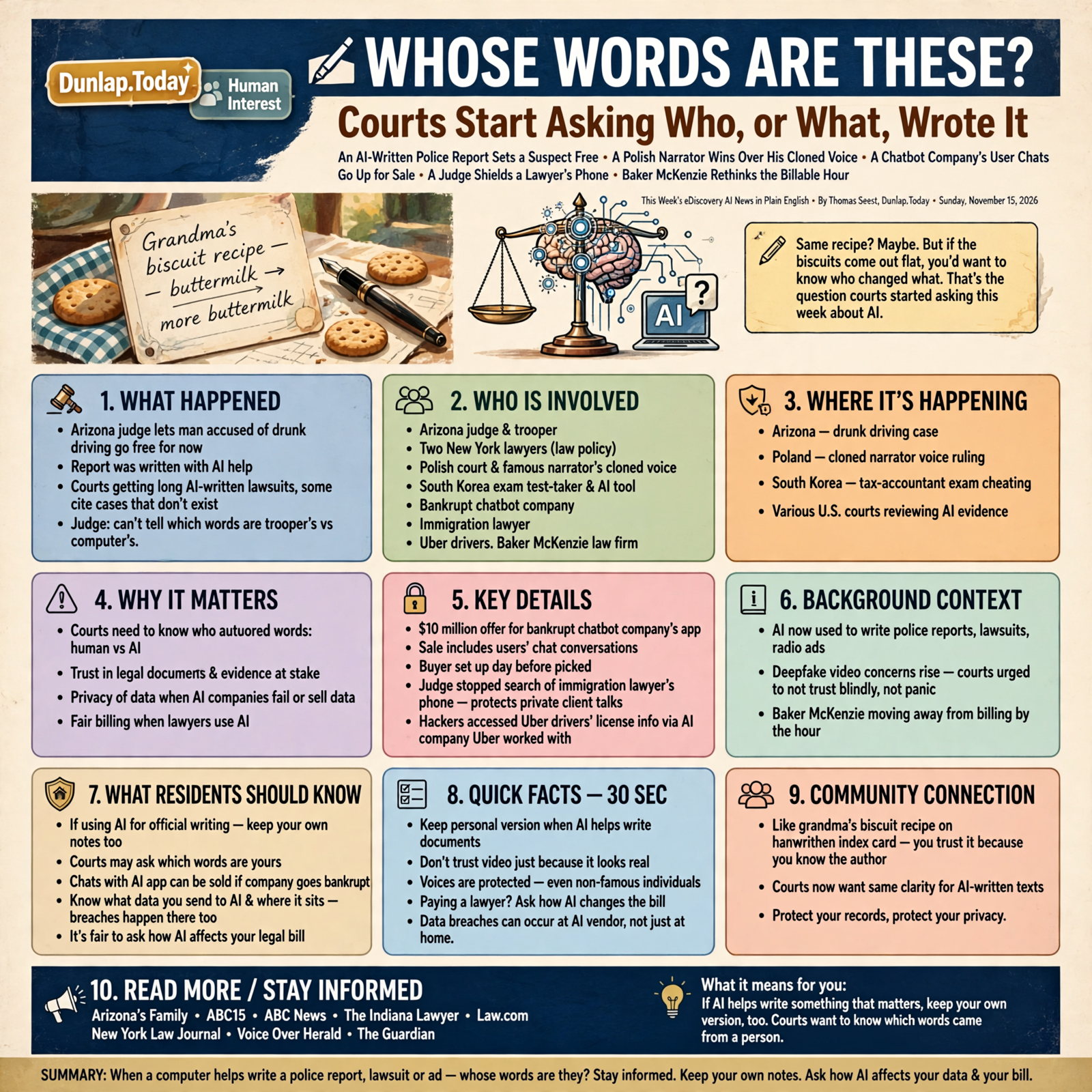
Grandma’s biscuit recipe is on a stained index card in her own handwriting. You trust it because you know who wrote it, and you can tell where she crossed out ‘buttermilk’ and wrote ‘more buttermilk.’
Now picture a typed copy with no name on it. Same recipe? Maybe. But if the biscuits come out flat, you’d want to know who changed what.
That’s the question courts started asking this week about AI. When a computer helps write a police report, a lawsuit or a radio ad, whose words are they? Here’s the rundown: who wrote this, who holds your data, new rules for labels, what AI is good at, and billing, jobs and judgment.
⏱️ What this means for you in 30 seconds
- Using AI to help write something official? Keep your own notes too. A judge may want to see what you actually said.
- Worried about fake videos or voices? Courts are looking for a middle path: don’t trust blindly, don’t panic either.
- Chatting with an AI app? Your conversations can be sold if the company goes bankrupt.
- Handing data to an AI company? Know what you sent and where it sits. Breaches can happen there, not just at home.
- Paying a lawyer? Some big firms are moving away from billing by the hour. It’s fair to ask how AI affects your bill.
⚖️ Who Wrote This? Courts Are Asking

An Arizona judge let a man accused of drunk driving go free for now because the trooper's report said it was written with help from AI. The judge couldn't tell which words were the trooper's and which were the computer's.
Courts are getting buried in very long lawsuits that people without lawyers wrote with AI, some citing cases that don't exist.
Two New York lawyers wrote that judges shouldn't trust a video just because it looks real, but also shouldn't order expensive testing every time someone yells 'deepfake.'
A Polish court ruled a company broke the law by using an AI copy of a famous narrator's voice in its ads. The judge said everyone's voice is protected, not just famous ones.
In South Korea, the top scorer on a national tax-accountant exam admitted he cheated with a tiny hidden camera and an AI tool.
It's like a note from school signed 'Mom' in handwriting that looks a little too much like your teenager's. The note might be true. But the principal is going to call home and check.
What it means for you: If AI helps you write something that matters, keep your own version, too. Courts want to know which words came from a person.
👉 Read more (Arizona's Family) · ABC15 · ABC News · Read more (The Indiana Lawyer) · Read more (Law.com New York Law Journal) · Read more (Voice Over Herald) · Read more (The Guardian)
🔐 Who Holds Your Data

A bankrupt chatbot company has a $10 million offer for its app, and the sale includes users' chat conversations. The buyer was set up the day before it was picked.
A judge stopped federal agents from searching a copy of an immigration lawyer's phone, which holds private talks with his clients.
Hackers got Uber drivers' license information through an AI company Uber worked with. Uber's own systems weren't the way in.
A trial lawyer built his own AI computer in his office so client files never go to an outside company.
When you lend your truck to a neighbor, you know where it is. When he lends it to his cousin Billy, and Billy lends it to a buddy, you've lost track. Data works the same way once it leaves home.
What it means for you: Know which companies hold your information and your chats. A lawyer's phone, a chatbot's logs and an AI vendor's files can all end up somewhere you didn't expect.
👉 Read more (PPC Land) · Read more (Newsweek) · Read more (Startup Fortune) · Read more (Tom's Hardware)
📜 New Rules for Labels and Logs

Europe published guidance on how AI-made pictures, audio and video must be labeled so people can tell they aren't real.
A Canadian law commission says police and courts in Ontario need clear rules and a public list of the AI tools they use.
In Pakistan, court guidelines now say anyone using AI in court work must mark which parts AI wrote and explain how they checked them.
The feed store puts a tag on every sack so you know what's inside. Regulators want the same for AI: a tag that says a machine made it, and a record of who checked it.
What it means for you: Expect more labels on AI-made pictures and audio, and more rules asking people to say which parts AI wrote and how they checked them.
👉 Read more (JournalArta) · Read more (CBA National Magazine) · Read more (Business Recorder)
🧰 What AI Is Good At, and What to Test

At a conference in Dubai, lawyers said AI can read huge piles of documents in a day, but one AI translation flipped what a person meant.
Lawyers in India say the real test of AI isn't how fast it writes. It's how long a person has to spend checking it.
HR departments are using AI to sort worker complaints, but experts say a person should make the final call on discipline.
A new test found AI tools often answer legal questions without asking for important facts they're missing.
A new hay baler can do a day's work before lunch. You still walk the field to see what it missed, and you check the first few bales by hand.
What it means for you: AI can read mountains of documents fast. The real question is how long a person needs to check its work, and whether it knows when it's missing something.
👉 Read more (SCC Online) · Read more (ETLegalWorld) · Read more (SHRM) · Read more (Scale AI) · Unite.AI
💼 Billing, Jobs and Judgment

One of the world's biggest law firms says it's moving away from charging mainly by the hour, because AI makes the work faster.
A study of 60,000 smaller law firms found most still bill by the hour, even as big firms talk about changing.
A Korean lawyer wrote that AI can read thousands of emails overnight, but it can't stop a nervous worker from deleting evidence.
On X, people are discussing a tech CEO's warning that AI could replace many beginner office jobs, like summarizing documents.
When the combine replaced the threshing crew, nobody missed the blisters. But somebody still had to decide when the wheat was ready.
What it means for you: AI may change how lawyers charge and which beginner jobs exist. Judgment, the part where somebody takes responsibility, is still the part you're paying for.
👉 Read more (LawFuel) · LinkedIn News · Read more (Legal Reader) · Read more (Seoul Economic Daily) · Read more (X trending story)
✅ Checklist for this week

- ✅ When anyone uses AI to draft a report or declaration, keep their original notes or dictation
- ✅ In discovery, ask which parts of a key document were written with AI, and by which tool
- ✅ Collect metadata and chain of custody for videos, screenshots and recordings at the start
- ✅ Ask for a real reason before paying for forensic testing on every ‘deepfake’ claim
- ✅ List which AI vendors hold your company’s or clients’ data, and in which accounts
- ✅ Read a chatbot app’s privacy terms. Your chats can be sold if the company is
- ✅ Lawyers: travel with as little client data on your phone as you can
- ✅ Measure how long it takes to check AI work, not just how fast it writes
Practical rule: If a computer helped write it, keep the human’s version too.
— Dunlap.Today
📚 Plain-English AI Glossary

- Probable cause: Enough real evidence for police to arrest someone or get a warrant.
- Generative AI: AI that writes text, makes pictures or creates voices on request.
- Deepfake: A fake video, picture or recording made with AI to look or sound like a real person.
- Voice clone: An AI copy of someone’s voice that can say things they never said.
- Authentication: Showing a court that a piece of evidence is what you say it is.
- Pro se: Representing yourself in court without a lawyer.
- Taint team: A separate group that screens seized files so investigators don’t see private lawyer-client material.
- Stalking-horse bidder: The first buyer in a bankruptcy sale, whose offer sets the price others must beat.
- Machine-readable label: A hidden digital tag that tells computers a picture or file was made by AI.
- Value-based pricing: Charging for the result or the job, not for the hours spent.
❓ Frequently Asked Questions

Can a police report written with AI be used in court?
It depends. One Arizona judge said he couldn’t find probable cause because he couldn’t tell which parts the AI wrote. Other courts may see it differently. Keeping the officer’s own notes helps.
Can someone use AI to copy my voice?
They can, and a Polish court just said that’s not allowed without permission, for famous and ordinary voices alike. Laws differ by country and state, and that ruling can still be appealed.
What happens to my chatbot conversations if the company goes bankrupt?
They can be sold with the company’s other assets. In the Character.ai case, users’ chat content is on the list. State officials have pushed to protect that data.
Can the government search a lawyer’s phone?
Sometimes, but there are limits. A federal judge in Boston blocked a search of an immigration lawyer’s phone for now, partly because it holds private client conversations.
Will AI make legal bills cheaper?
Maybe. Some big firms are moving away from billing by the hour. Most small firms still bill hourly. It’s fair to ask your lawyer how they use AI and how that shows up on your bill.
Other Resources

- Arizona’s Family: Judge cites AI in releasing a DUI suspect
- Voice Over Herald: Poland’s first AI voice deepfake ruling
- Newsweek: Judge blocks search of an immigration lawyer’s phone
- Scale AI: SG-LegalClarify legal reasoning benchmark
- CBA National: Why Canada needs AI regulation in criminal justice
Got an eDiscovery or legal AI question from the porch? Send it our way. We’ll keep translating the jargon into plain English.
Know about an upcoming event or story in the Dunlap, TN area? Submit it here.


0 Comments