
🎁 A "You Won Because You Donated" Call, a Gift Card That's Empty Before You Give It, TreasuryDirect's Login Change Day and a Stranger Who Offers to Get Your Money Back: Your Scam Watch for This Week

Or: Nobody Honest Charges You to Get Something That’s Already Yours
By Thomas Seest, Dunlap.Today · Wednesday, October 28, 2026
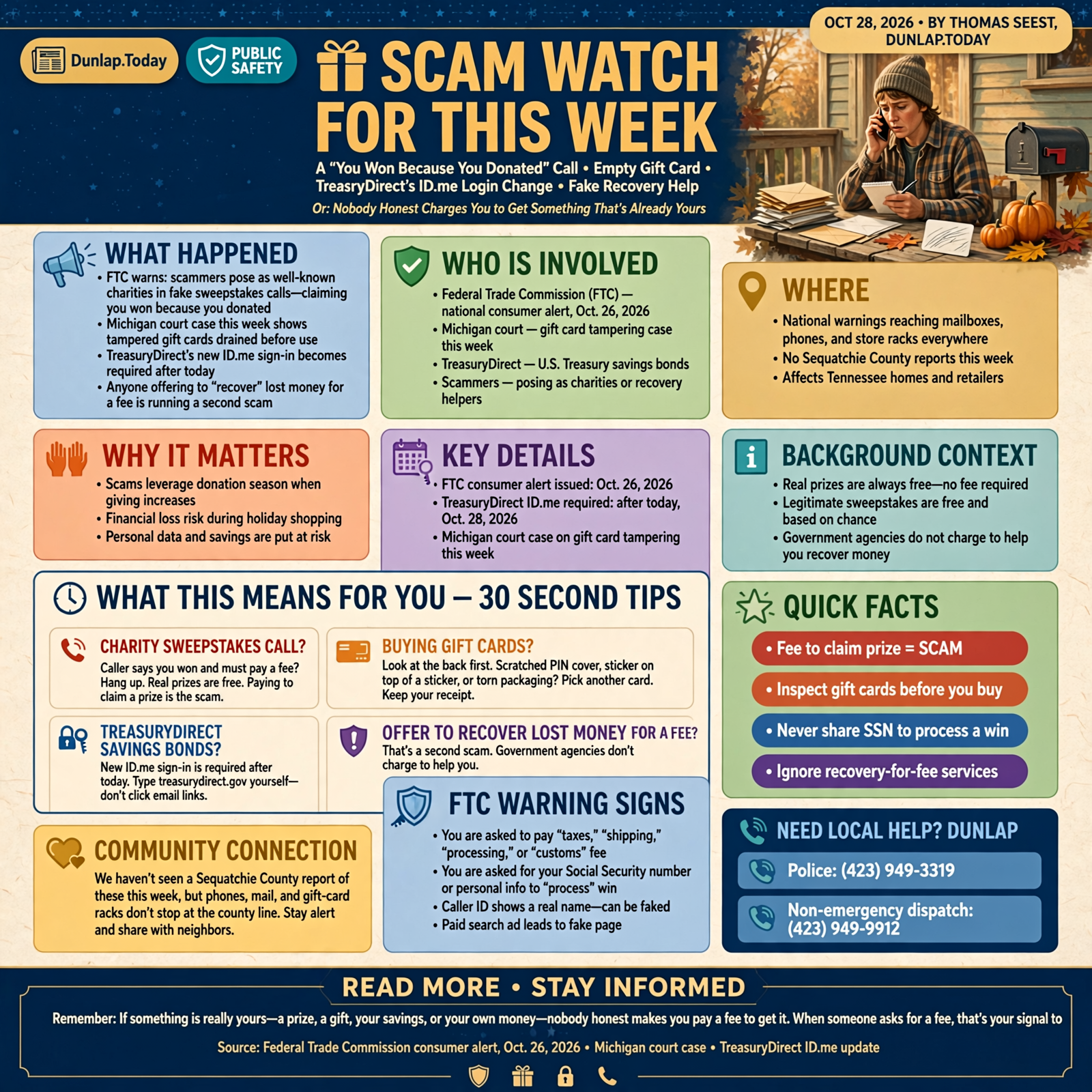
Good Wednesday morning, neighbors. Payday for a lot of folks, cool air on the porch, and a short list this week. Every item on it comes back to one simple idea: if something is really yours, a prize, a gift, your savings or your own money, nobody honest makes you pay a fee to get it. When someone does ask for a fee, that’s your signal to set the phone down.
Here’s what’s on the porch: the Federal Trade Commission says scammers are posing as well-known charities and telling people they won a sweepstakes because they donated; a Michigan court case this week shows how tampered gift cards get drained, just in time for holiday shopping; TreasuryDirect’s new ID.me sign-in becomes required after today, so look-alike emails may follow; and a reminder that anyone who offers to “recover” money you lost for a fee is running a second scam. All four are national warnings that reach right into Tennessee mailboxes, phones and store racks. We haven’t seen a Sequatchie County report of these this week, but phones, mail and gift-card racks don’t stop at the county line.
⏱️ What this means for you in 30 seconds
- A caller says you won a charity’s sweepstakes and must pay a fee? Hang up. Real prizes are free. Paying to claim a prize is the scam.
- Buying gift cards for Christmas? Look at the back first. Scratched PIN cover, a sticker on top of a sticker, or torn packaging? Pick another card. Keep your receipt.
- Have savings bonds on TreasuryDirect? The new ID.me sign-in is required after today. Type treasurydirect.gov yourself instead of clicking email links.
- Lost money to a scam and now someone offers to get it back for a fee? That’s a second scam. Government agencies don’t charge to help you.
- Need local help? In Dunlap, call police at (423) 949-3319 or non-emergency dispatch at (423) 949-9912.
🎗️ “You Won Our Charity Sweepstakes Because You Gave!” Real Prizes Are Free, So Any Fee Means Scam

National: Federal Trade Commission consumer alert (Oct. 26)
We covered fake prize calls a few days ago, but the FTC flagged a new twist on Oct. 26: scammers are borrowing the names of well-known charities, or names that only sound like them, and telling people they won a charity-sponsored sweepstakes because they donated. It’s a clever hook this time of year, when lots of us give.
The FTC’s warning signs are short and easy to remember:
- You’re asked to pay to claim a prize. The FTC says that’s the moment you know it’s a scam. Real prizes are free.
- You’re asked for your Social Security number or other personal information to “process” the win.
- You’re told you won because you gave. That’s the charity hook.
- Caller ID shows a real name. The FTC says caller ID can be faked, so the name on the screen proves nothing.
- A paid search ad leads you to a fake page. The FTC says impersonators buy ads on Google Search and Bing, so scroll past the ads.
The FTC also says legitimate sweepstakes are free and based on chance, and it’s illegal to make you pay or buy something to enter or to improve your odds. FTC guidance adds that the fee is often called “taxes,” “shipping,” “processing” or “customs.”
What it means for you: It’s like the church raffle calling to say you won the quilt, but you have to mail them $200 for “shipping” first. No church raffle in the Valley works that way, and no real charity does either. If a “win” costs money, it’s not a win. If you want to check on a charity, look up its name with words like “complaint,” “review” or “scam,” and call it using a number you find yourself.
👉 Read more (FTC: Spot scammers impersonating well-known charities and sweepstakes) · Morning Overview: The FTC says anyone asking you to pay for a prize is a scammer
💳 Before You Buy That Christmas Gift Card, Flip It Over. A Tampered Card Can Be Empty Before It’s Opened
National: Michigan Attorney General case (Oct. 27) and consumer tips from the D.C. Attorney General and the FTC
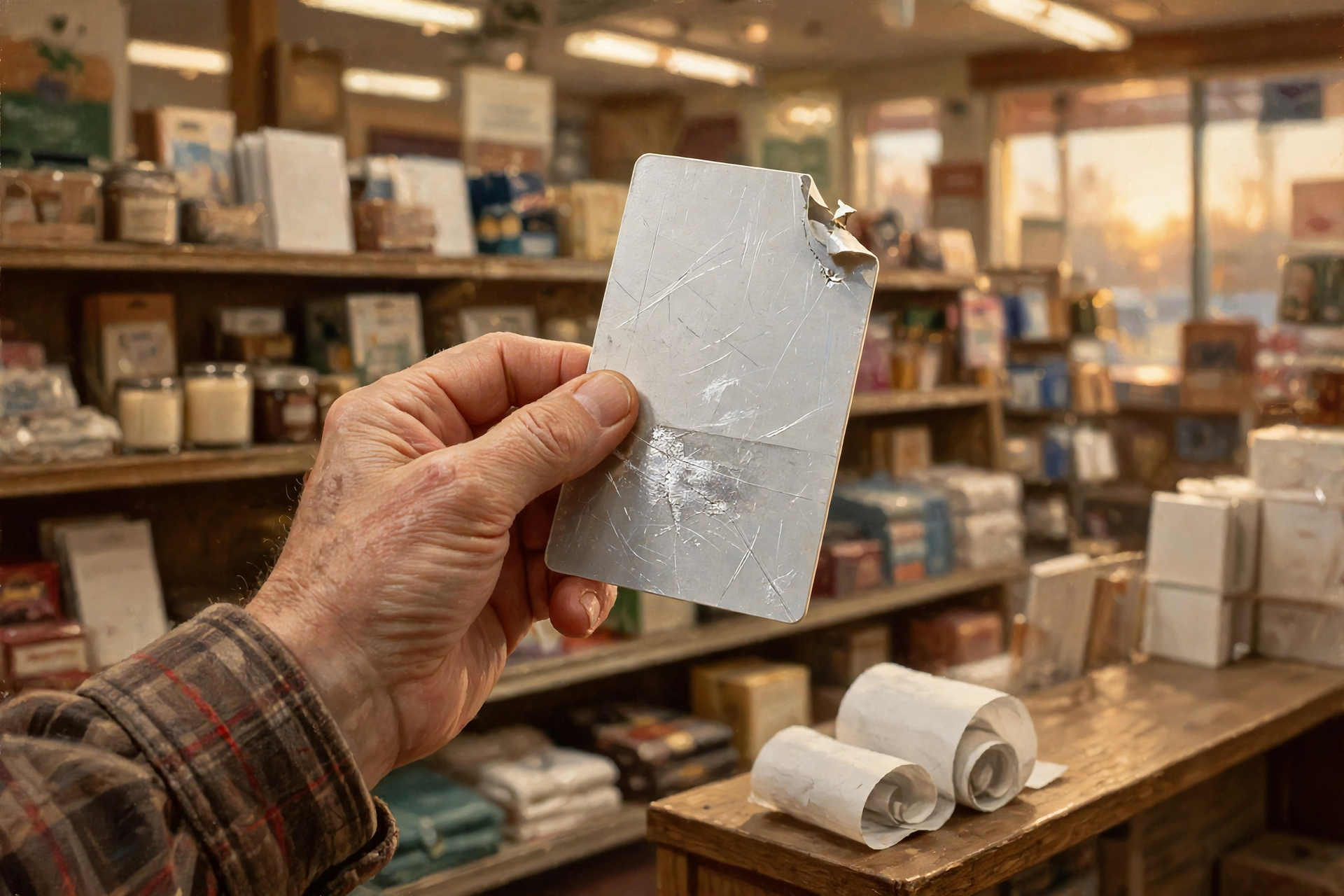
Gift cards are about the easiest present there is, and that’s why thieves like them too. On Oct. 27, Michigan Attorney General Dana Nessel announced that a California man pleaded no contest in a case tied to altered gift cards placed on racks at Meijer stores around Detroit in 2025. Here’s how the Michigan AG’s office says these schemes usually work:
- Thieves take empty, unsold gift cards from a store.
- They uncover the card number, write it down, and reseal the card so it looks untouched.
- They put the card back on the rack and use computer programs to watch for it to be loaded.
- When a shopper puts money on it, the balance is moved out right away. The person who gets the gift finds it empty.
Attorney General Nessel’s advice: “Shoppers should carefully inspect gift cards they intend to purchase, checking for any signs the card has been tampered with, before loading them with funds.” The D.C. Attorney General’s office adds a few more tips: look closely at the barcode and PIN area for scratches or extra stickers, buy from stores that keep cards behind the counter or locked up, pay with a credit card if you can, and keep your receipt. It also warns that even a card that looks fine could still be unsafe.
What it means for you: It’s like checking the seal on a jar of jam at the store before you put it in the buggy. If the seal’s been popped, you pick another jar. Do the same with gift cards. If anything looks scratched, peeled or re-stuck, put it back. Hold on to the receipt and give it with the card, so the person you give it to can get help if the balance is gone. And remember the other half of the gift-card rule: nobody legitimate ever asks to be paid in gift cards.
👉 Read more (Michigan Attorney General: Gift card fraud case) · D.C. Attorney General: Gift card draining tips
🏦 Update: TreasuryDirect’s ID.me Sign-In Is Required After Today. Type the Website Yourself

National: U.S. Treasury’s TreasuryDirect (savings bonds and Treasury securities)
Two days ago we told you this change was coming, and today’s the day. TreasuryDirect, the government website where many folks keep savings bonds, says ID.me will replace the old TreasuryDirect login and will be required after October 28, 2026. To set it up, TreasuryDirect says you’ll need your Social Security number and a government photo ID.
Any time a big change like this happens, scammers may send look-alike emails. TreasuryDirect gives a few things to remember:
- Its real emails come from subscriptions@subscriptions.treas.gov.
- “The Treasury Department does not send unsolicited e-mails asking for personal or financial information, or demand fees to release funds.”
- Before you sign in, check that the web address says treasurydirect.gov.
What it means for you: Think of it like the bank changing the locks on the safe-deposit boxes. The bank will give you a new key at the counter. It won’t send a stranger to your house to “help” you with it. Go to the site yourself by typing treasurydirect.gov, and if you get stuck, ask a family member you trust to sit with you. Nobody needs to call you about it, and nobody should charge you a fee.
👉 Read more (TreasuryDirect: ID.me sign-in information)
🔁 Lost Money to a Scam? Watch Out for the “We Can Get It Back for You” Call. That’s Scam Number Two

National: Federal Trade Commission guidance on refund and recovery scams
Over the past few weeks we’ve shared stories of neighbors around the region who lost money to fake deputies, fake prizes and fake jobs. Here’s something the FTC warns about that often comes after: a call, email or social media message from someone who says they can get your lost money back, for a fee. They may say they’re a lawyer, a “recovery” company, or even a government agency.
The FTC’s guidance boils down to a few points worth writing on the fridge:
- Anyone who asks for a fee upfront to get your money back is a scammer.
- Government agencies don’t charge to help you, and they won’t call asking for payment or your bank details to “release” a refund.
- Scammers sometimes know details about what you lost, because the same crooks or their partners share lists. That doesn’t make them real.
- Check any agency or firm yourself, using a number you look up, not the one they give you.
What it means for you: It’s like a fellow showing up after your hog got loose, saying he knows right where it is and he’ll bring it home for $300 cash, up front. If he really knew, he’d tell the sheriff. Real help, like your bank, the police, or the FTC’s free report site, doesn’t send you a bill to get started. If you’ve already lost money, call your bank first and file a free report at ReportFraud.ftc.gov. Being fooled once is nothing to be ashamed of. Just don’t pay twice.
👉 Read more (FTC: Refund and recovery scams) · FTC: What to do if you were scammed
✅ Your Front-Porch Scam Checklist
- ✅ Real prizes are free. If a “win” costs money, it’s a scam.
- ✅ Never give your Social Security number to claim a prize.
- ✅ Caller ID can be faked. A real charity’s name on the screen proves nothing.
- ✅ Searching online? Scroll past the paid ads before you click.
- ✅ Flip a gift card over before you buy it. Scratched or re-stuck? Pick another.
- ✅ Keep the gift-card receipt and give it along with the card.
- ✅ Anyone who wants to be paid in gift cards is a scammer. Every time.
- ✅ TreasuryDirect: type treasurydirect.gov yourself. Treasury doesn’t email asking for personal info or fees.
- ✅ Nobody honest charges a fee to get back money you lost.
- ✅ Already clicked, called or paid? Call your bank first, change passwords, then report it.
The practical rule: If it’s already yours, a prize, a gift, your savings or your own money, nobody honest makes you pay to get it.
— Dunlap.Today
📚 Plain-English Glossary
- Sweepstakes: A contest where winners are picked by chance. Real ones are free to enter and free to win.
- Charity impersonation: When a scammer uses a real charity’s name, or one that sounds like it, to seem trustworthy.
- Spoofing: Faking caller ID so a call looks like it’s coming from a real charity, company or agency.
- Paid search ad: A result at the top of Google or Bing that someone paid to put there. Scammers buy them too.
- Gift card draining: When thieves copy a gift card’s number before it’s sold, then take the money as soon as it’s loaded.
- Gift-card PIN: The number on the back of a gift card. Whoever has it can spend the money, so never read it to anyone.
- TreasuryDirect: The U.S. Treasury’s website for buying and keeping savings bonds and other Treasury securities.
- ID.me: A sign-in service that checks who you are using your ID. TreasuryDirect now requires it.
- Recovery scam: When someone promises to get back money you lost to a scam, but charges you a fee and disappears.
- Phishing: A fake email, text or website made to look real so you’ll hand over passwords or personal information.
❓ Frequently Asked Questions

I really did give to that charity. Couldn’t the sweepstakes be real?
Even if you gave, the rule doesn’t change: the FTC says real prizes are free, and it’s illegal to make you pay to enter or to improve your odds. If you’re curious, hang up and contact the charity using a phone number or website you look up yourself, not one the caller gave you.
I paid a “fee” to claim a prize. What now?
Act fast. If you paid by bank transfer or Zelle, call your bank or credit union right away and ask them to reverse it. If you used a payment app, contact the app. If you paid with a gift card, call the card company at the number on the back, tell them a scammer got the card number and PIN, and keep the card and receipt. Then report it at ReportFraud.ftc.gov.
I gave someone a gift card and it was empty. What should I do?
Find the receipt and the card. Contact the store where it was bought and the gift-card company, using the number on the card or the company’s real website. If you paid with a credit card, call your card company too. You can also report it to local police and at ReportFraud.ftc.gov.
I have savings bonds but never use TreasuryDirect online. Do I need to do anything?
TreasuryDirect says ID.me is required after Oct. 28, 2026, to sign in to an online TreasuryDirect account. If you have one, sign in by typing treasurydirect.gov yourself, and have your Social Security number and photo ID ready. If you only have paper bonds in a drawer, this sign-in change is about the website account. When in doubt, check TreasuryDirect’s website yourself rather than trusting an email or call.
Someone called saying they’re with a government office and can return my lost money. Is that possible?
Government agencies don’t charge fees to help you get money back and won’t call asking for payment or bank details to release a refund. Hang up and look up the agency’s real number yourself. If someone wants money first, it’s a recovery scam.
I already clicked a link or paid someone. Is it too late?
Act quickly, but don’t panic. Call your bank, card company or payment app using the number on your card or statement and ask what can be done. Change any password you gave out and turn on two-step login. Then report it at ReportFraud.ftc.gov, to the Tennessee Attorney General at tn.gov/consumer and to local police (Dunlap Police: (423) 949-3319). If your Social Security number was taken, IdentityTheft.gov has a step-by-step plan.
🔗 Other Resources

- FTC: Spot scammers impersonating well-known charities and sweepstakes · Morning Overview: Paying for a prize means scam
- Michigan Attorney General: Gift card fraud case · D.C. Attorney General: Gift card draining tips
- FTC: Avoiding and reporting gift card scams
- TreasuryDirect: ID.me sign-in information
- FTC: Refund and recovery scams · FTC: What to do if you were scammed
- BBB Scam Tracker · National Elder Fraud Hotline (U.S. Justice Department): 1-833-372-8311 · AARP Fraud Watch Network Helpline: 877-908-3360
- TN Attorney General: Scams, Schemes & Swindles
- Report a scam: ReportFraud.ftc.gov · IdentityTheft.gov
🌄 Rest Easy: What’s Yours Doesn’t Come With a Fee

Here’s the calm takeaway: a real prize is free, a good gift card has a clean back and a receipt, your savings bonds are reached by typing treasurydirect.gov yourself, and real help getting lost money back doesn’t send you a bill. Every trick on this week’s list wants you to pay to get something that’s already yours. So don’t. Set it down, pour another cup, and call somebody you already trust.
Share this with the neighbor who gives to every good cause, the friend doing her Christmas shopping early, the uncle with savings bonds, or anybody who’s been through a scam and is still hurting over it. We’ll keep watch and bring you what’s new. Read Dunlap.Today and sign up for our newsletter for plain-English scam alerts and Valley news.
Know about an upcoming event or story in the Sequatchie Valley? Submit it here.



0 Comments