
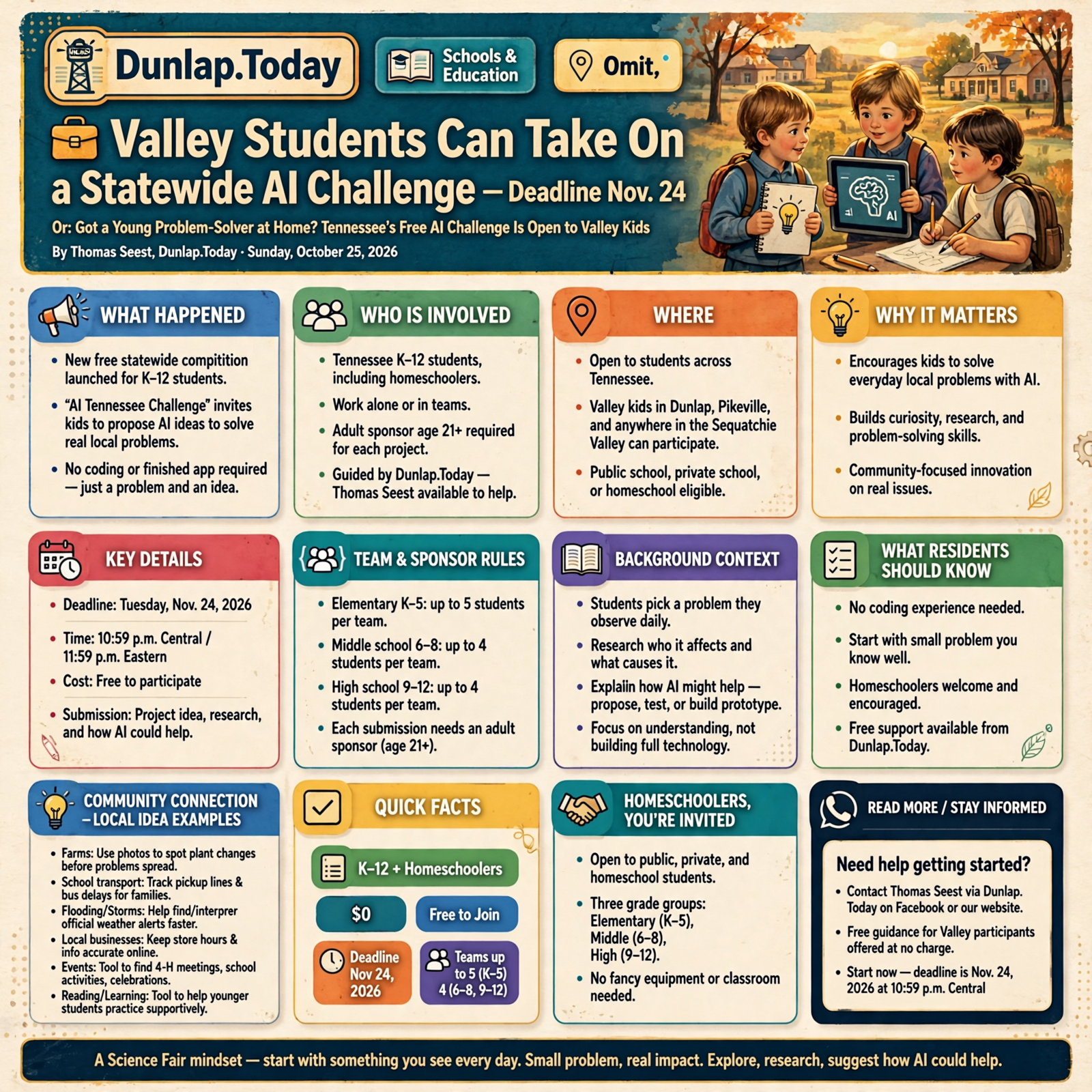
🎒 Valley Students Can Take On a Statewide AI Challenge — Deadline Nov. 24

Or: Got a Young Problem-Solver at Home? Tennessee’s Free AI Challenge Is Open to Valley Kids
By Thomas Seest, Dunlap.Today · Sunday, October 25, 2026
Have you ever heard a child look at something that isn’t working and ask, “Why don’t they just fix that?” Maybe it’s a school pickup line, a muddy spot on a farm road, or a website that says a store is open when the lights are off and the door is locked.
Well, Tennessee has a challenge for kids like that: pick a real problem and see whether artificial intelligence could help solve it.
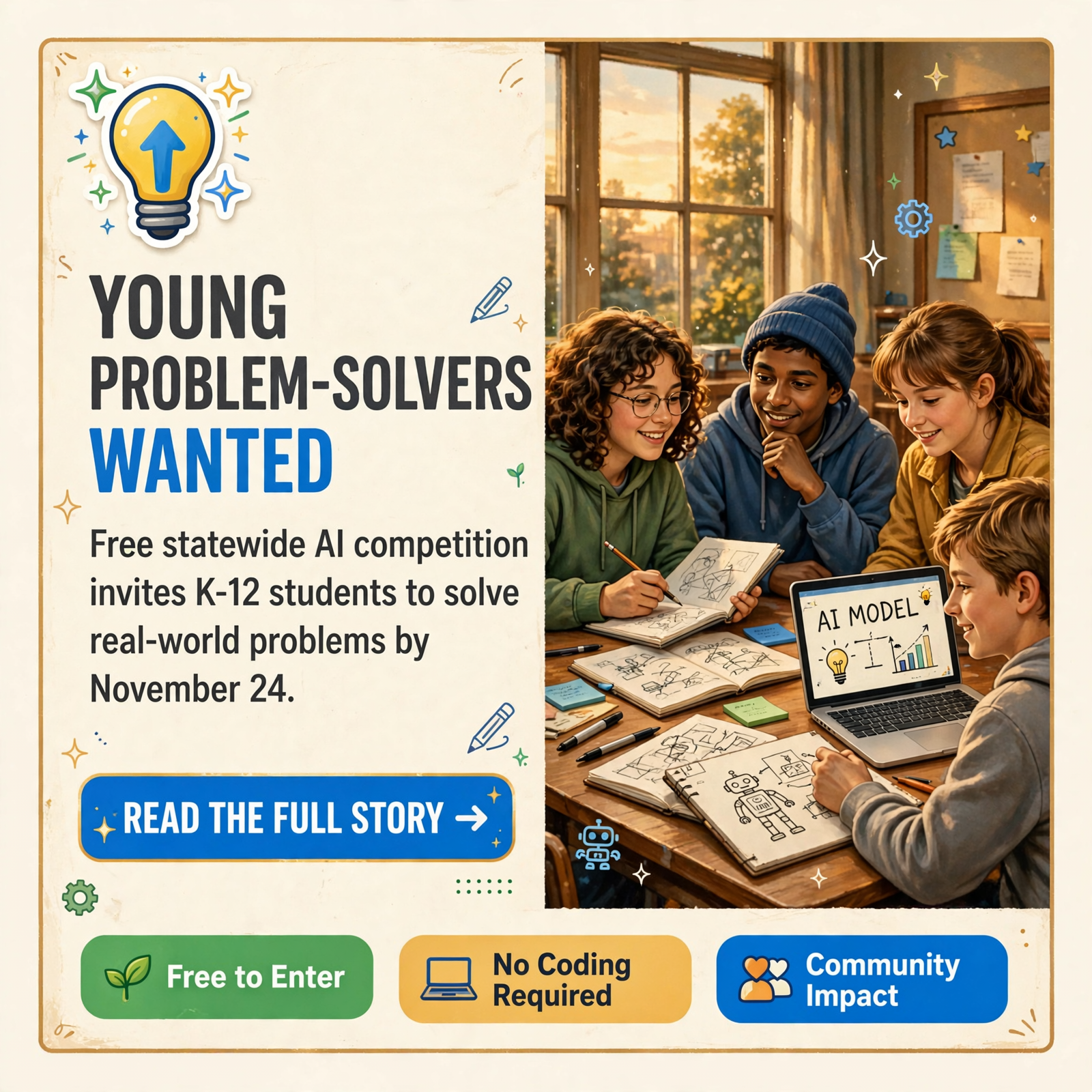
The AI Tennessee Challenge is a new, free statewide competition for students in kindergarten through 12th grade. Homeschool students are welcome. Children may work alone or in teams, and they don’t have to know how to code or build a finished app to participate. The deadline is Tuesday, Nov. 24, 2026, at 10:59 p.m. Central (11:59 p.m. Eastern).
That means a curious student in Dunlap, Pikeville, or anywhere else in the Sequatchie Valley has a chance to develop an idea and have it considered alongside projects from across Tennessee.
⏱️ What Valley families need to know in 30 seconds
- Who: Tennessee K–12 students, including homeschoolers.
- Cost: Free to participate.
- Experience: No coding or prior AI experience required.
- Team size: Up to five students in K–5; up to four in grades 6–8 and 9–12.
- Adult help: Every project needs a sponsor age 21 or older.
- Deadline: Tuesday, Nov. 24, at 10:59 p.m. Central.
- Need help? Contact me through Dunlap.Today on Facebook or our website; I’m happy to guide Valley participants at no charge.
💡 Think of a Science Fair, but Start With Something You See Every Day

Here’s the simple version: students choose a problem, learn who it affects, research what causes it, and explain how AI might help. They can propose an idea, test a model, or build a working prototype. The organizers aren’t asking every fourth-grader to become a professional programmer by Thanksgiving.
In the Sequatchie Valley, we don’t have to look far for ideas. What if students explored:
- Farms: Could photographs help a farmer spot changes in plants before a problem spreads?
- School transportation: Could better information help explain long pickup lines or bus delays?
- Flooding and storms: Could a system help families find and understand official weather alerts more quickly?
- Local businesses: Could technology help shops keep their hours, phone numbers, and event information accurate online?
- Community events: Could an easy-to-use tool help families find school activities, 4-H meetings, and local celebrations?
- Reading and learning: Could a thoughtful tool help younger students practice without simply handing them answers?
Those are local examples, not official project topics. Students are free to find a problem that matters to them. A small problem you understand well can make a better project than a grand idea that nobody has had time to investigate.
🏡 Homeschoolers, You’re Invited Too
This isn’t limited to a school’s computer club or a classroom with fancy equipment. The competition is open to Tennessee students attending public school, private school, or homeschool.
There are three grade groups:
- Elementary (K–5): Students may enter alone or in teams of up to five.
- Middle school (6–8): Students may enter alone or in teams of up to four.
- High school (9–12): Students may enter alone or in teams of up to four.
Each submission requires an adult sponsor who is at least 21. Teachers, homeschool educators, librarians, instructional coaches, and community leaders may serve. An adult sponsor does not need to be an AI expert. Homeschool educators acting as sponsors do need to provide one of the verification documents listed in the official rules.
Teachers, homeschool groups, 4-H leaders, and other youth mentors could make a difference simply by telling an interested student, “That sounds like a good question. Let’s find out.”
🧰 No Coding Experience? No Problem.

The challenge specifically says students do not have to use ChatGPT or any other generative AI tool. A project can begin with pencil and paper, observation, conversations, research, sketches, or a simple prototype.
What matters is explaining the problem, showing what students learned, making a thoughtful case for using AI, and being clear about where AI might get things wrong. Students must do the real thinking and creative work themselves. Adults can help them learn, organize, and test ideas, but should not do the assignment for them.
It’s a little like showing your work in math class. The answer matters, but so does the path you took to get there.
📋 What Does a Student Actually Turn In?
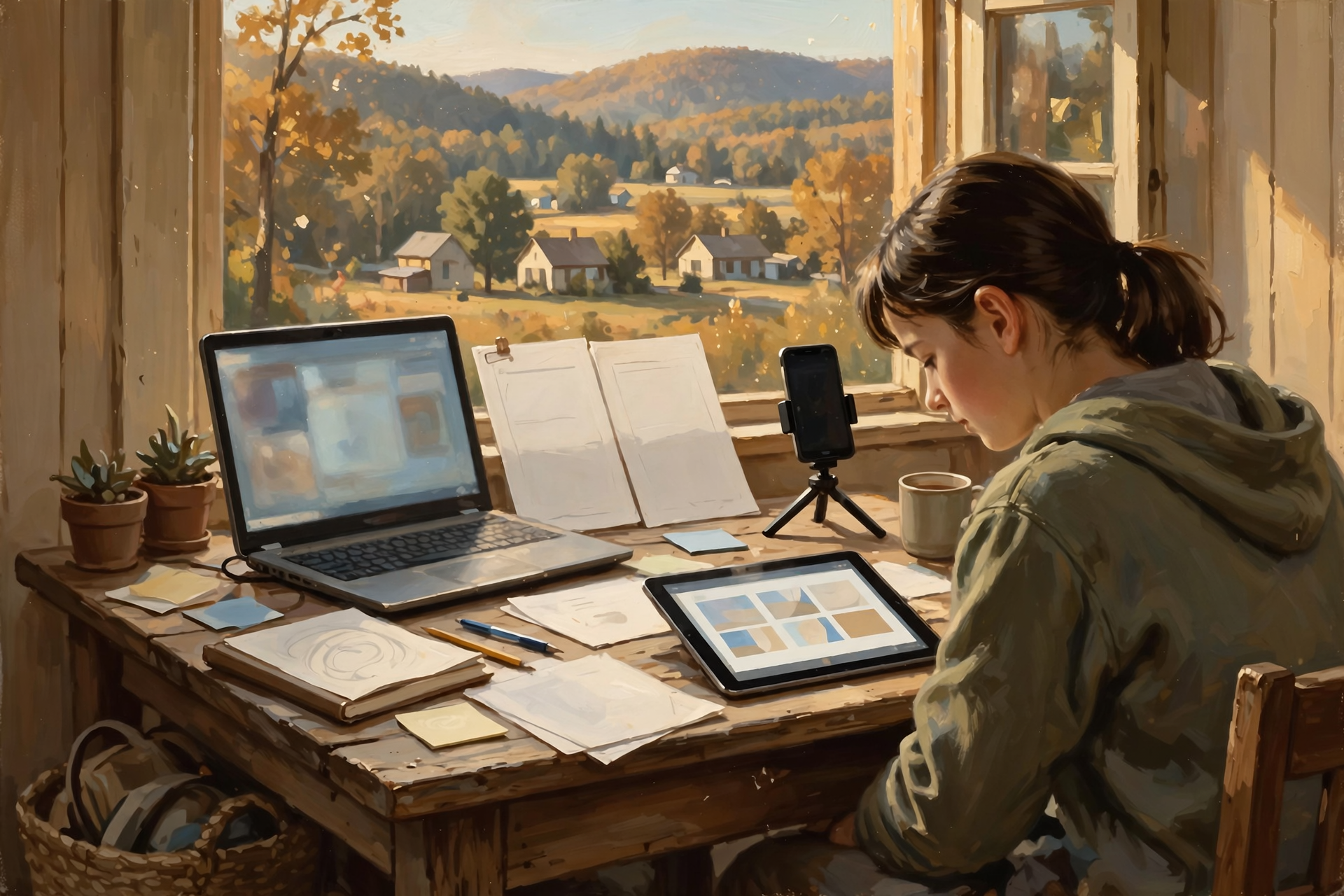
Every submission has three parts. They don’t need expensive equipment or a professional video crew:
- A project narrative: A recommended two-page explanation of the problem, research, proposed AI solution, testing, responsible use, and lessons learned.
- A visual presentation: Five to eight slides showing the idea and the evidence behind it.
- A short video: Four minutes or less, explaining the project in the students’ own voices.
The rules ask students to identify any AI tools they used and explain how they checked the results. Judges look for community relevance, useful thinking, research, testing, responsible AI use, and clear communication—not just technical flash.
That ought to sound familiar to anyone who has ever helped a child prepare a good science fair exhibit.
🏆 Our Valley Students Would Compete in East Tennessee
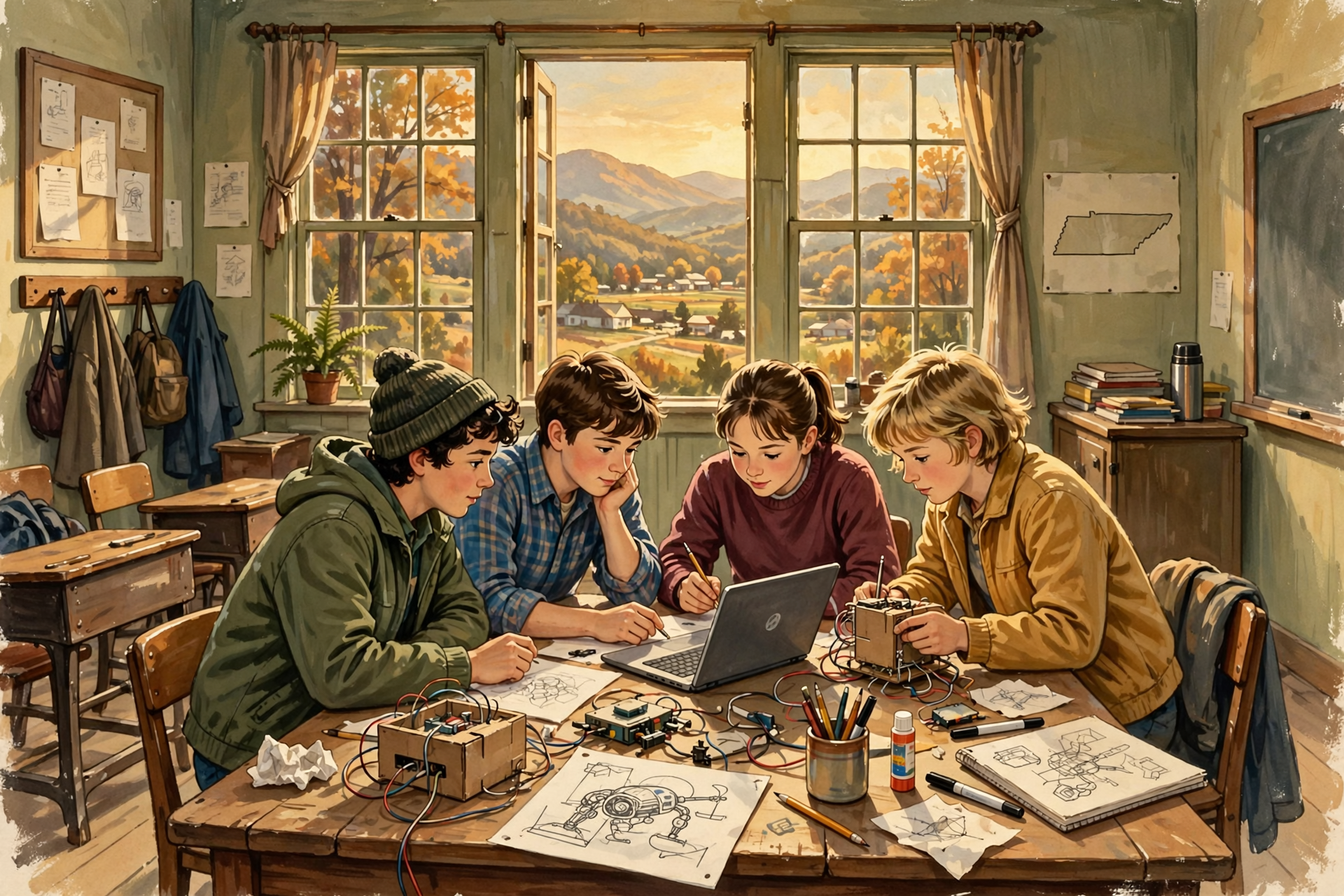
The AI Tennessee Challenge is organized by AI Tennessee and the University of Tennessee’s ADEPT Center with statewide education and university partners. It follows the success of elementary school students from Alcoa, Tennessee, who won their age category in a national AI competition with an idea called Homework Helper.
For this new statewide challenge, entries are considered in the East, Middle, and West Tennessee regions. Sequatchie Valley students would be in East Tennessee.
Organizers plan to name 27 finalists statewide, including nine regional winners across the three regions and grade bands, plus three statewide grand-prize winners—one for each grade band. Winning teams will be recognized at a virtual celebration on Friday, Dec. 11. Eligible completed entries receive digital participation certificates; other winner prizes have not yet been announced.
Of course, the biggest reward may be learning that an idea from a small community deserves to be heard.
🗓️ Mark These Dates

- Oct. 19: Challenge opened.
- Oct. 21–Nov. 23: Project development period and optional support opportunities.
- Tuesday, Nov. 24: Projects due by 10:59 p.m. Central (11:59 p.m. Eastern).
- Friday, Dec. 11: Winners announced and virtual celebration.
Official requirements, resources, updates, and submission information are available at AI Tennessee’s challenge website. Because the deadline is firm, families should review the official submission instructions early rather than leaving all three pieces until the last evening.
🤝 Need Help Getting Started? I’d Be Happy to Help.
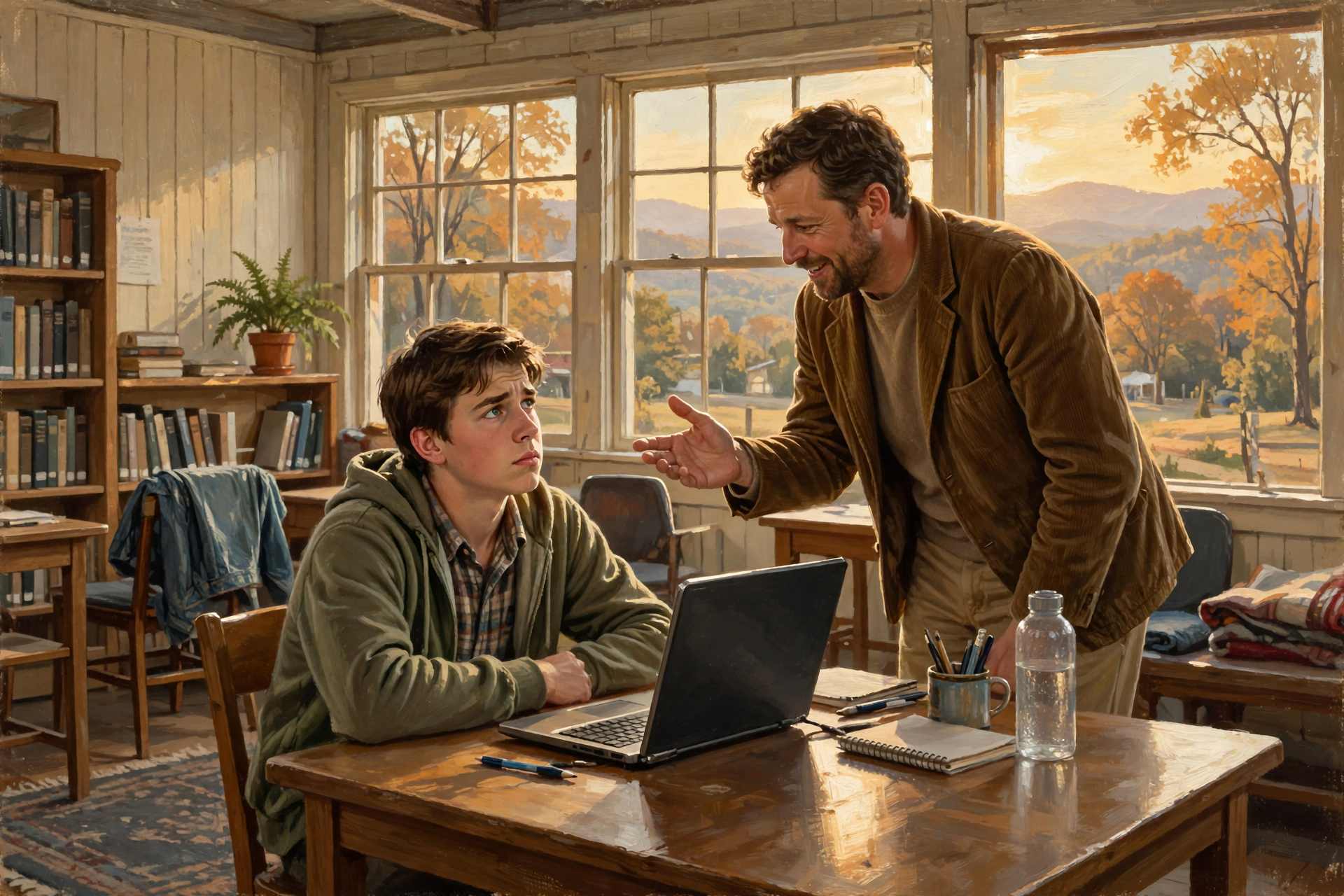
If you’re a student, parent, homeschool family, teacher, or community leader anywhere in the Sequatchie Valley and you’d like some help with the AI Tennessee Challenge, I’m offering my time and guidance at no charge.
Maybe you have a good idea but don’t know whether AI fits. Maybe you’ve never used an AI tool, need help thinking through the project requirements, or want somebody to help you get organized. I’m happy to talk through ideas, point you toward useful resources, explain the technology in plain English, and help you understand the steps.
The idea and the work remain the student’s. I’m offering guidance and encouragement, not to take over the project or do it for them.
To reach me, use the contact information on the Dunlap.Today website or send a message to Dunlap.Today on Facebook. Tell me you’re interested in the AI Tennessee Challenge, and we’ll take it from there.
I would love to see students from Dunlap, Pikeville, and across the Valley give this a try. Sometimes the best ideas come from young people who haven’t yet been told something is impossible.
❓ Frequently Asked Questions
Is the AI Tennessee Challenge really free?
Yes. There is no entry fee.
Can homeschool students enter?
Yes. Homeschool students are expressly eligible. Homeschool educators who act as adult sponsors must provide the verification required in the official rules.
Does my child have to know computer programming?
No. Students can submit a researched concept or prototype without writing code. They don’t have to use generative AI tools.
Can students work together?
Yes. K–5 teams can have up to five students. Grades 6–8 and 9–12 can have up to four students per team.
Does an adult have to be involved?
Yes. Every entry needs a sponsor who is at least 21 years old. Adults guide and support students, but students must do the substantive work.
When is the deadline in Dunlap and Pikeville?
Tuesday, Nov. 24, 2026, at 10:59 p.m. Central Time. The official 11:59 p.m. deadline is listed in Eastern Time.
Does the project have to be a working AI app?
No. A clear proposal, investigation, or carefully tested idea is eligible. The judges evaluate the reasoning, research, purposeful role for AI, and responsible use.
Can Dunlap.Today help my student?
Yes. I’m happy to offer free guidance to families and youth leaders in the Sequatchie Valley. Reach out through Dunlap.Today’s Facebook page or the contact information on our website.
🔗 Other Resources
- AI Tennessee: Official Challenge Rules, Deadlines, and Resources
- AI Tennessee: October 21 Announcement of the Statewide Challenge
- Dunlap.Today: Contact Us and Follow Local Coverage
🌄 A Good Idea Doesn’t Need a Big-City Address
There’s plenty of talent in the Sequatchie Valley. There’s also plenty of common sense, curiosity, and firsthand experience with problems worth solving. That’s a fine place to start.
Share this story with a teacher, homeschool parent, 4-H leader, or family with a curious student. And if they could use a hand, send them my way through Dunlap.Today. I’d be glad to help.
Let’s see what our Valley kids can come up with.
— Dunlap.Today


0 Comments