
🌾 Farm Payments on the Way, a Blackberry Cleanup Date, Leaves Worth Keeping and a Steady Pasture Report — Your Farm & Garden Report
Or: A Sunny Friday in Dunlap — Watch for FSA Payments, Mark Tuesday for the Blackberry Canes, Mow the Leaves Into the Lawn and Look Over the Hay List Before You Need It
By Thomas Seest, Dunlap.Today · Friday, October 23, 2026
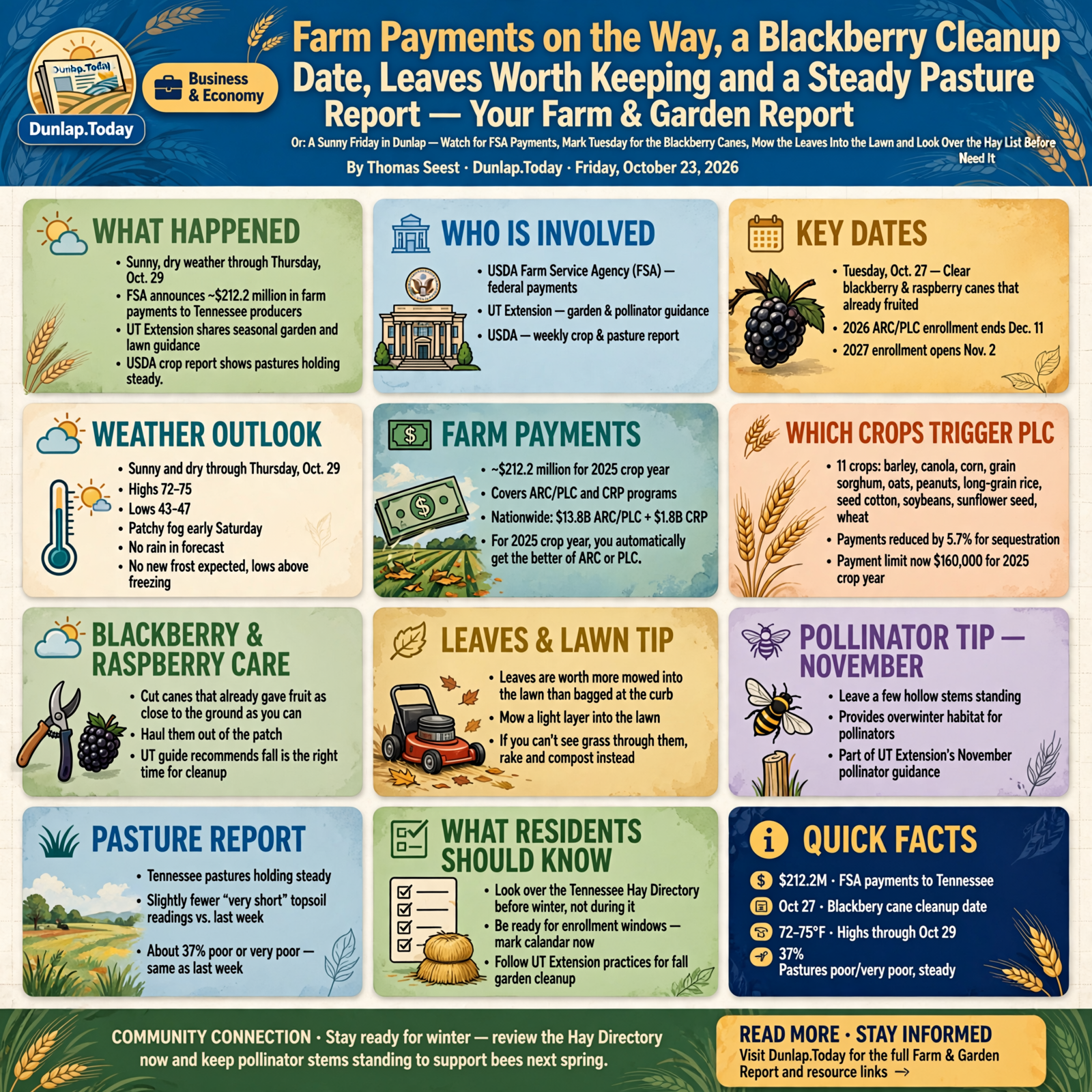
Good Friday morning. The weather is still behaving like a polite houseguest. National Weather Service Dunlap calls for sunny skies today with a high near 75 and calm wind. After that, expect highs of 72 to 75 and lows of 43 to 47 through next Thursday, Oct. 29, with patchy fog early Saturday. There’s no rain in the forecast, and those lows sit well above freezing, so no new frost is expected this week.
Here’s the roundup. USDA’s Farm Service Agency says about $212.2 million in farm program payments are headed to Tennessee producers, and it has posted the dates for the next two signup windows. UT Extension’s garden calendar marks Tuesday, Oct. 27 as the day to clear out blackberry and raspberry canes that already fruited, and a new UT guide explains why fall is the right time. UT also says fallen leaves are worth more mowed into the lawn than bagged at the curb, and its November pollinator tip says to leave a few hollow stems standing. And USDA’s weekly crop report shows Tennessee pastures holding steady, with slightly fewer “very short” topsoil readings than the week before. A short checklist is at the end.
⏱️ What this means for you in 30 seconds
- Weather: Sunny and dry through Thursday, Oct. 29. Highs 72–75, lows 43–47. No frost in the forecast.
- Farm payments: About $212.2 million in ARC/PLC and CRP payments are going to Tennessee. For the 2025 crop year, you automatically get the better of ARC or PLC.
- Signup dates: 2026 ARC/PLC enrollment ends Dec. 11. 2027 enrollment opens Nov. 2.
- Blackberries: Cut the canes that already gave fruit as close to the ground as you can, and haul them out of the patch.
- Leaves: Mow a light layer into the lawn. If you can’t see grass through them, rake and compost instead.
- Remember: Pastures statewide are about 37% poor or very poor, the same as last week. Look over the Tennessee Hay Directory before winter, not during it.
💵 About $212 Million in Farm Program Payments Heads to Tennessee, and Two Signup Dates to Write Down

On Monday, Oct. 19, USDA’s Farm Service Agency (FSA) in Tennessee announced about $212.2 million in payments to Tennessee producers. The money comes through two programs: Agriculture Risk Coverage and Price Loss Coverage (ARC/PLC) for the 2025 crop year, and the Conservation Reserve Program (CRP). Nationwide, FSA says the payments total about $13.8 billion for ARC/PLC and $1.8 billion for CRP.
Here are the parts that matter most at the kitchen table, all from FSA’s release:
- The better of the two, automatically. Under a new federal law, for the 2025 crop year only, producers get whichever of ARC or PLC pays more, no matter which one they picked.
- Which crops. FSA lists 11 crops that triggered PLC payments in Tennessee: barley, canola, corn, grain sorghum, oats, peanuts, long-grain rice, seed cotton, soybeans, sunflower seed and wheat.
- A small trim. FSA says payments are reduced by 5.7% for sequestration, a required federal budget cut.
- Higher payment limit. FSA says the ARC and PLC payment limit rose from $125,000 to $155,000, with yearly inflation adjustments. The limit for the 2025 crop year is $160,000.
- More base acres. FSA reports Tennessee gained 637,674 additional base acres under the new law. Those count starting with the 2026 crop year.
- Conservation land. CRP payments cover about 77,552 acres in Tennessee, including 5,269 acres of Grassland CRP.
FSA says it will issue payments to eligible producers as calculations are completed. Two signup windows are open or about to open. 2026 ARC/PLC enrollment runs through Friday, Dec. 11, 2026. 2027 enrollment runs from Monday, Nov. 2, 2026, to March 15, 2027. FSA says to contact your local county office with questions.
What it means for you: Think of it like a co-op dividend check. You don’t have to do anything special to get the 2025 payment, and you get the better deal either way. If you farm land with base acres, call the FSA county office this fall to check that your contracts are in order before Dec. 11. Then put Nov. 2 on the calendar for next year’s signup. If you rent out farmland, ask your tenant how this shakes out for your place.
👉 Read more (USDA FSA Tennessee: $212.2 million in safety net payments, Oct. 19, 2026) · FSA: ARC/PLC program page
🫐 Tuesday Is Blackberry Cleanup Day: Out With the Old Canes
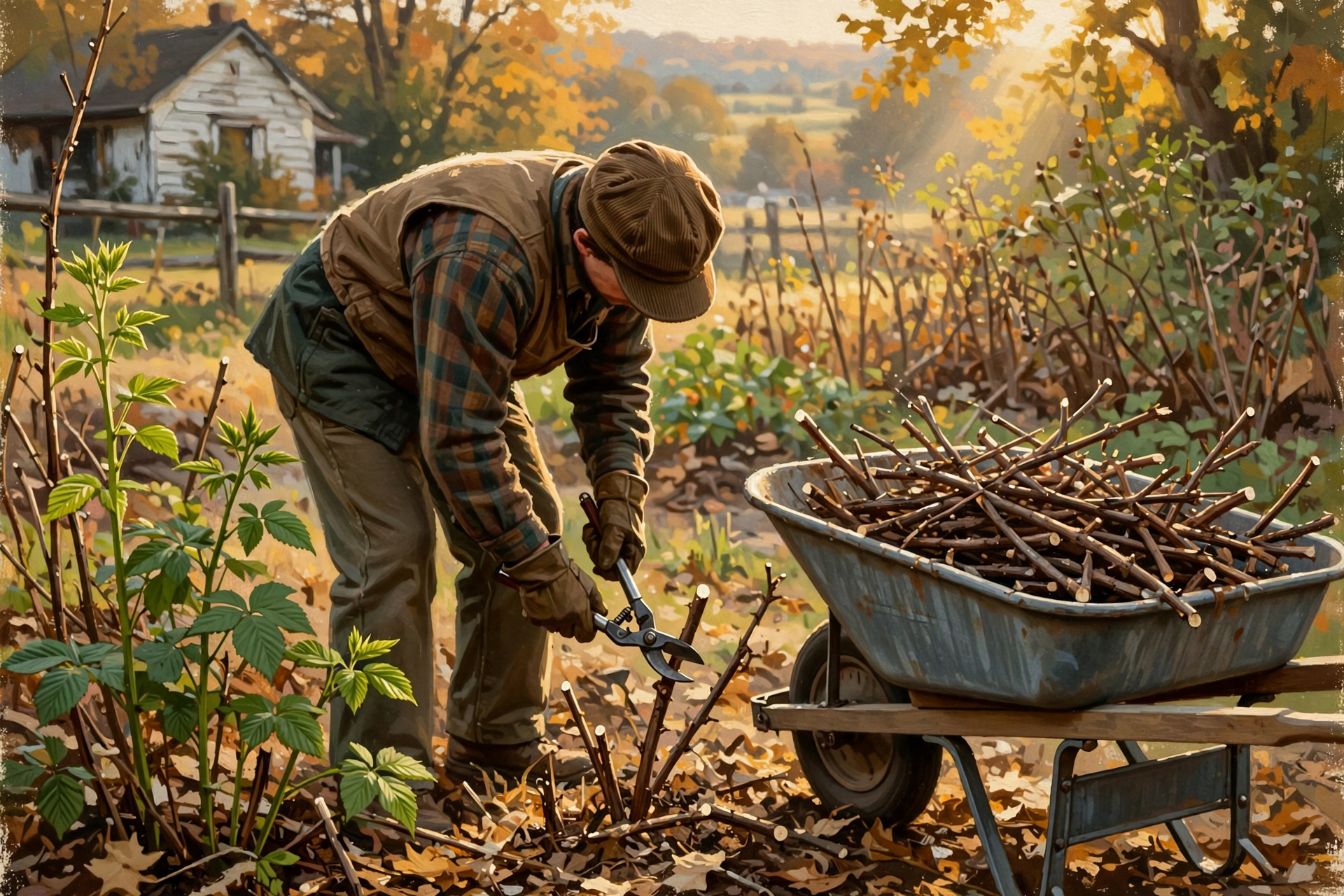
UT’s 2026 home garden calendar has a simple note for Tuesday, Oct. 27: “Remove and dispose of floricanes that already fruited on caneberries.” Caneberries are blackberries and raspberries. A newer UT Extension guide, Planting and Managing Caneberries for Residential Production in Tennessee (W1297B), explains why.
UT says the roots of these plants live for years, but each cane lives only two growing seasons. In year one it’s a primocane that just grows leaves. In year two it becomes a floricane, flowers, fruits and then dies. Here’s what UT recommends:
- Cut early, in our climate. UT says the lower disease risk in “warm and humid Tennessee climates” supports removing old canes in late summer or fall, instead of waiting until winter.
- Cut low and carry it off. Cut the spent canes as close to the ground as possible and take them out of the planting.
- Look for swollen spots. UT says cane borer beetles leave swelling, galls or wilted tips on young canes. Pruning out galled canes is an important cleanup step in fall and winter.
- Save the shaping for winter. In the dormant season, UT says to cut the side branches on this year’s new canes back to 8 to 12 inches and thin to about 4 to 6 canes per foot of row.
- No fertilizer now. UT’s caneberry timetable says don’t fertilize after early August. Fall is for a soil test and any pH fixes.
One exception: if you grow a fall-bearing (primocane) type, UT describes a method where all canes are cut or mowed just above the ground each winter. Check your variety’s tag before you cut.
What it means for you: It’s like clearing last season’s empty jars off the pantry shelf to make room. Old canes are finished, and leaving them just gives disease a place to spend the winter. The new green canes are next summer’s cobbler, so leave those standing. A sharp pair of loppers, gloves and a wheelbarrow will do it.
👉 Read more (UT Extension: Planting and Managing Caneberries, W1297B) · UT 2026 garden calendar
🍂 Don’t Bag the Leaves: Mow Them In, and Leave a Few Stems for the Bees
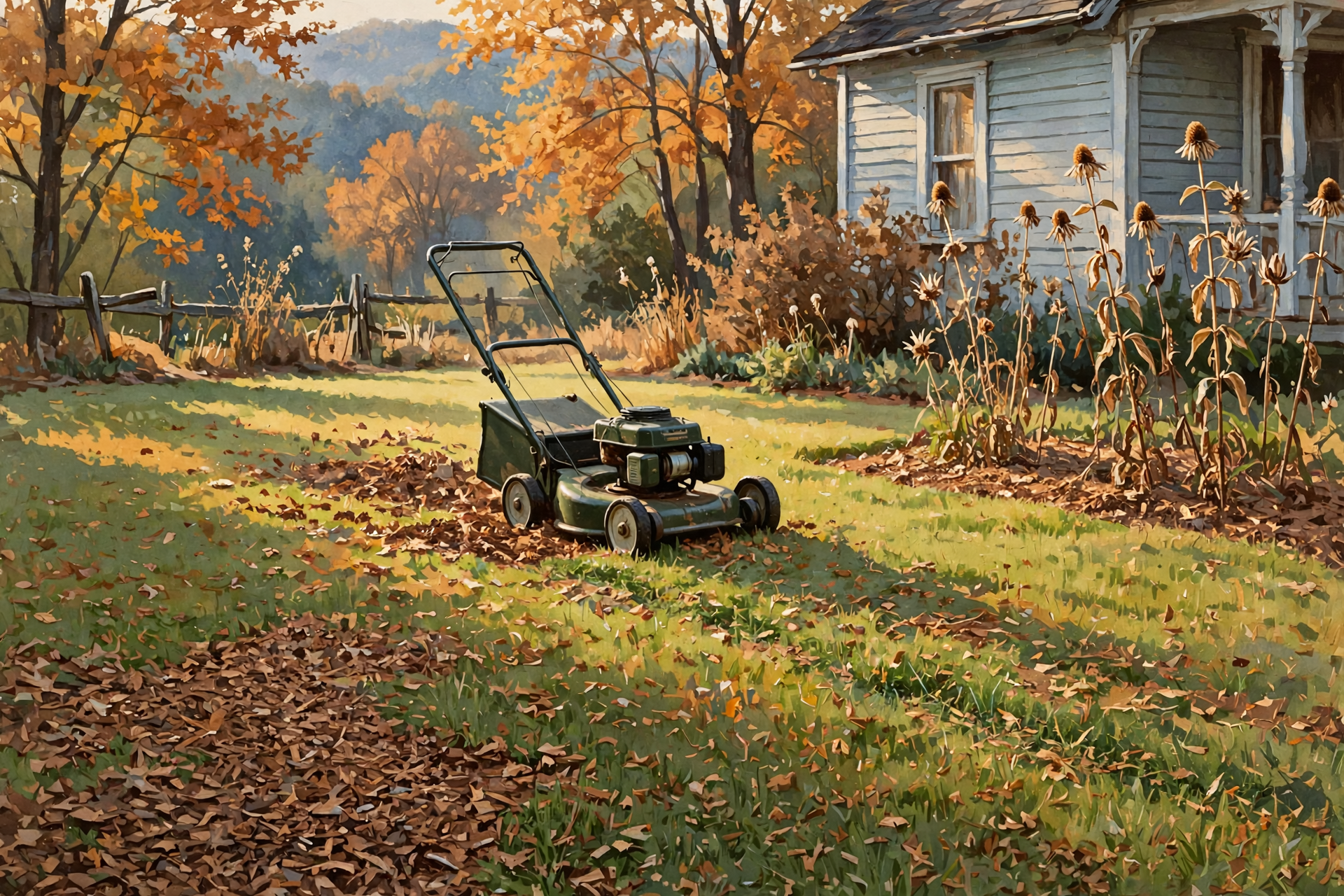
The oaks and maples are about to drop a free load of fertilizer on your yard. UT Gardens’ advice is short: rake heavy layers of leaves off the lawn and compost them, or mow over a light layer to turn it into mulch “that adds important nutrients back to the lawn.”
A UT Extension county director, Chris Hicks of Smith County, gave a handy test in a column for his county paper: when you mow leaves, make sure you can still see grass beneath the chopped pieces. If the layer is too thick, it can smother and kill the grass. He wrote that the chopped bits settle into the turf, feed the soil as they break down, and can help keep weed seeds from sprouting. He also cited Michigan State University research showing that up to 6 inches of leaves can be mulched at one time, depending on your mower.
UT’s 2026 garden calendar adds a November pollinator tip. Clear out weedy and diseased plant debris, since it can harbor pests and disease. But leave the hollow stems of your good flowering plants standing over winter. Pollinators use them as winter shelter. UT also names witch hazel as a good late-fall and early-winter pollinator tree.
What it means for you: It’s like making stock from the turkey bones instead of throwing them out. The leaves already have the goodness in them. A couple of passes with the mower saves your back, and you don’t need a burn pile. Just keep the mower deck high, go when the leaves are dry, and stop when the grass disappears. Then leave a few coneflower or bee balm stalks standing by the porch.
👉 Read more (UT Gardens: Mow a light layer of leaves into the lawn) · UT Extension Smith County: Don’t Let Leaves Go to Waste · UT 2026 garden calendar (November pollinator tip)
🐄 Pasture Check: Tennessee Holding Steady, and Where to Look If You Need Hay
USDA’s weekly Crop Progress report, released Monday for the week ending Oct. 18, gives a statewide check on Tennessee’s grass and dirt. These are statewide numbers, not Sequatchie County alone:
- Pasture condition: 15% very poor, 22% poor, 34% fair, 26% good and 3% excellent. That’s 37% poor or very poor, the same share as the week before.
- Topsoil moisture: 25% very short, 46% short, 27% adequate and 2% surplus. The “very short” share eased from 30% to 25% over the week.
- Subsoil moisture: 29% very short, 44% short, 26% adequate and 1% surplus.
- Fieldwork: 6.3 days were suitable for fieldwork, and Tennessee’s corn harvest reached 96%, ahead of the five-year average of 85%.
If you’re figuring out whether you’ll have enough hay this winter, the Tennessee Department of Agriculture and Tennessee Farm Bureau keep a free Tennessee Hay Directory. It lists sellers by county, with bale type, bale count, average weight, crop year and how the hay is stored. The current list includes sellers in some nearby counties, like Bledsoe, Grundy and Rhea. Listings change, and some are older crop years, so call first. TDA’s page also links to hay directories for neighboring states such as Alabama, Georgia and Kentucky.
What it means for you: It’s like checking the woodpile in October instead of January. Pastures aren’t getting worse statewide this week, which is a good thing. But with no rain in the 7-day forecast, it’s smart to count your bales now and know who to call. If a seller lists a forage test, that tells you what you’re really buying. The Sequatchie County Extension office can help you read it: 423-949-2611.
👉 Read more (USDA NASS: Crop Progress, Oct. 19, 2026) · TDA: Hay Directory · Tennessee Farm Bureau: Tennessee Hay Directory
📌 Sticky Notes for the Fridge
- This week: Sunny and dry in Dunlap through Thursday, Oct. 29. Highs 72–75, lows 43–47. Patchy fog early Saturday. No frost expected.
- Saturdays, Oct. 24 and 31, 9 a.m.–1 p.m. Central: Last two Dunlap Farmers Market Saturdays of the season, at the Jeff Johnson Pavilion, Harris Park (confirm before you go).
- Saturday, Oct. 24, 3 p.m. Central: Great Pumpkin Festival, 1958 Main Street, Dunlap (listed on the Dunlap–Sequatchie County Chamber calendar).
- Sunday, Oct. 25, 1–5 p.m. Central: Fall in the Foothills, Little River Dairy, Walland. Free.
- Tuesday, Oct. 27: UT’s calendar day to cut out blackberry and raspberry canes that already fruited.
- Thursday, Oct. 29: Next U.S. Drought Monitor map.
- Saturday, Oct. 31: Halloween.
- Sunday, Nov. 1: Clocks fall back one hour.
- Monday, Nov. 2: 2027 ARC/PLC enrollment opens. UT’s calendar adds that even a mid-November cover crop like rye can still help.
- Tuesday, Nov. 3: UT’s calendar: “Did you get your garlic planted? It isn’t too late!”
- Friday, Nov. 6, 8 a.m. Central: Tennessee Forage & Grassland Council annual meeting, Crossville.
- Saturdays, Nov. 7 and 14, 10 a.m.: Pony Pumpkin Patch, 1050 Ray Hixson Road, Dunlap (Chamber calendar).
- Monday, Nov. 9: Last day to apply for winter-storm emergency loans with FSA.
- Wednesday, Nov. 11: UT Live.Stock broadcast (details at UTBEEF.COM).
- Friday, Nov. 20: Apply-by date for 2027 NRCS conservation funding in Tennessee.
- Monday, Dec. 7: FSA county committee ballots due.
- Friday, Dec. 11: 2026 ARC/PLC enrollment deadline.
- Friday, Dec. 18: Dairy Margin Coverage signup ends.
- Thursday, Dec. 31: Organic Certification Cost Share applications due.
👉 Dunlap–Sequatchie County Chamber events · Dunlap Farmers Market · UT Extension Sequatchie County
✅ Your Farm & Garden Checklist for This Sunny Week
- ✅ If you farm base acres, call the FSA county office to check your 2026 ARC/PLC contract before Dec. 11.
- ✅ Write “Nov. 2: 2027 signup opens” on the barn calendar.
- ✅ On Tuesday or soon after, cut the brown, fruited blackberry and raspberry canes at ground level and haul them out.
- ✅ While you’re there, cut out any canes with swollen galls.
- ✅ Leave the green new canes alone until the dormant season.
- ✅ Mow a light layer of dry leaves into the lawn with the deck set high. Rake the thick piles into the compost.
- ✅ Leave a few hollow flower stalks standing for overwintering pollinators.
- ✅ Count your hay bales, and save the Tennessee Hay Directory link in case you come up short.
Practical rule: Check your FSA dates, clear out the spent canes, mow the leaves instead of bagging them, and count the hay while the weather’s easy.
— Dunlap.Today
📚 Plain-English Farm & Garden Glossary

- FSA: USDA’s Farm Service Agency. It runs farm loans and programs like ARC, PLC and CRP through local county offices.
- ARC (Agriculture Risk Coverage): A USDA program that pays when a crop’s revenue falls below a benchmark.
- PLC (Price Loss Coverage): A USDA program that pays when a crop’s national price falls below a set reference price.
- CRP (Conservation Reserve Program): A USDA program that pays landowners yearly rent to keep sensitive land in grass or trees instead of crops.
- Base acres: The acres on a farm that ARC and PLC payments are figured on. They’re based on the farm’s history, not what’s planted this year.
- Sequestration: An automatic federal budget cut that trims some program payments by a set percentage.
- Caneberry: A blackberry or raspberry plant.
- Primocane: A first-year cane that grows leaves. Most types don’t fruit until the cane’s second year.
- Floricane: A second-year cane that flowers, fruits and then dies.
- Gall: A swollen lump on a stem, often caused by an insect feeding inside.
- Topsoil and subsoil moisture: USDA’s weekly ratings of how wet the top few inches of soil are, and how wet the soil is deeper down.
- Forage test: A lab test of hay that shows its protein and energy, so you know how well it will feed your animals.
❓ Frequently Asked Questions

Do I need to sign up to get the 2025 ARC/PLC payment?
FSA says that for the 2025 crop year only, producers automatically receive the higher payment rate of ARC or PLC, regardless of which one they elected, and that it will issue payments to eligible producers as calculations are completed. If you’re not sure whether your farm is enrolled, call your local FSA county office.
Why is my payment a little smaller than I figured?
FSA says ARC/PLC payments are reduced by 5.7% for sequestration, a required federal budget cut. Payment limits also apply. The county office can walk you through your own numbers.
What’s the difference between the Dec. 11 and Nov. 2 dates?
Dec. 11, 2026, is the last day to enroll for the 2026 program year. Nov. 2, 2026, is when enrollment opens for 2027, and that window stays open until March 15, 2027.
How do I tell old blackberry canes from new ones?
The canes that gave fruit this summer are the floricanes. By now they’re usually brown, dry or dying back. This year’s new canes are the primocanes, and they’re usually still green and leafy. Cut the old ones and keep the new ones. Fall-bearing types work differently, so check the variety first.
Can I burn the old canes?
UT’s guide says to remove them from the planting. Hauling them off or bagging them is the simple choice. If you do plan an outdoor burn, check whether you need a permit from the Tennessee Division of Forestry first. Dry weather raises the fire risk.
Will mowing leaves hurt my lawn?
Not if the layer is light. UT says to mow over a light layer and rake heavy layers off for compost. A good test is whether you can still see grass after you mow. If you can’t, there’s too much.
Are the pasture numbers for Sequatchie County?
No. The Crop Progress numbers are statewide estimates for Tennessee. They’re a good general sign, but your own fields may be better or worse. Your county Extension office can help you judge your own pasture.
🔗 Other Resources

- National Weather Service: Dunlap forecast
- USDA FSA Tennessee: $212.2 million in safety net payments (Oct. 19, 2026)
- USDA FSA: ARC/PLC program
- UT Extension: Planting and Managing Caneberries for Residential Production in Tennessee (W1297B)
- UT Extension: Tennessee Home Fruit and Vegetable Garden 2026 calendar
- UT Gardens: Leaves and the lawn
- UT Extension Smith County: Don’t Let Leaves Go to Waste
- USDA NASS: Crop Progress (Oct. 19, 2026)
- Tennessee Department of Agriculture: Hay Directory
- Tennessee Farm Bureau: Tennessee Hay Directory
- Dunlap–Sequatchie County Chamber of Commerce: Events
- Dunlap Farmers Market
- UT Extension Sequatchie County (170 Church Street, Dunlap · 423-949-2611)
- Dunlap.Today
🏡 Keep Learning, Stay Calm and Come Back to the Porch
This is the easy-going part of the farm year. The payments are coming, the signup dates are posted, and the jobs left are the gentle kind: a few blackberry canes, a lawn full of leaves, a count of the hay in the barn. None of it has to happen all at once. Pick one this weekend, enjoy the sunshine, and save the rest for next week.
When you want the next calm, practical update for Sequatchie Valley readers, pull up a chair at Dunlap.Today.
Know about an upcoming event or story in the Sequatchie Valley? Submit it here.



0 Comments