
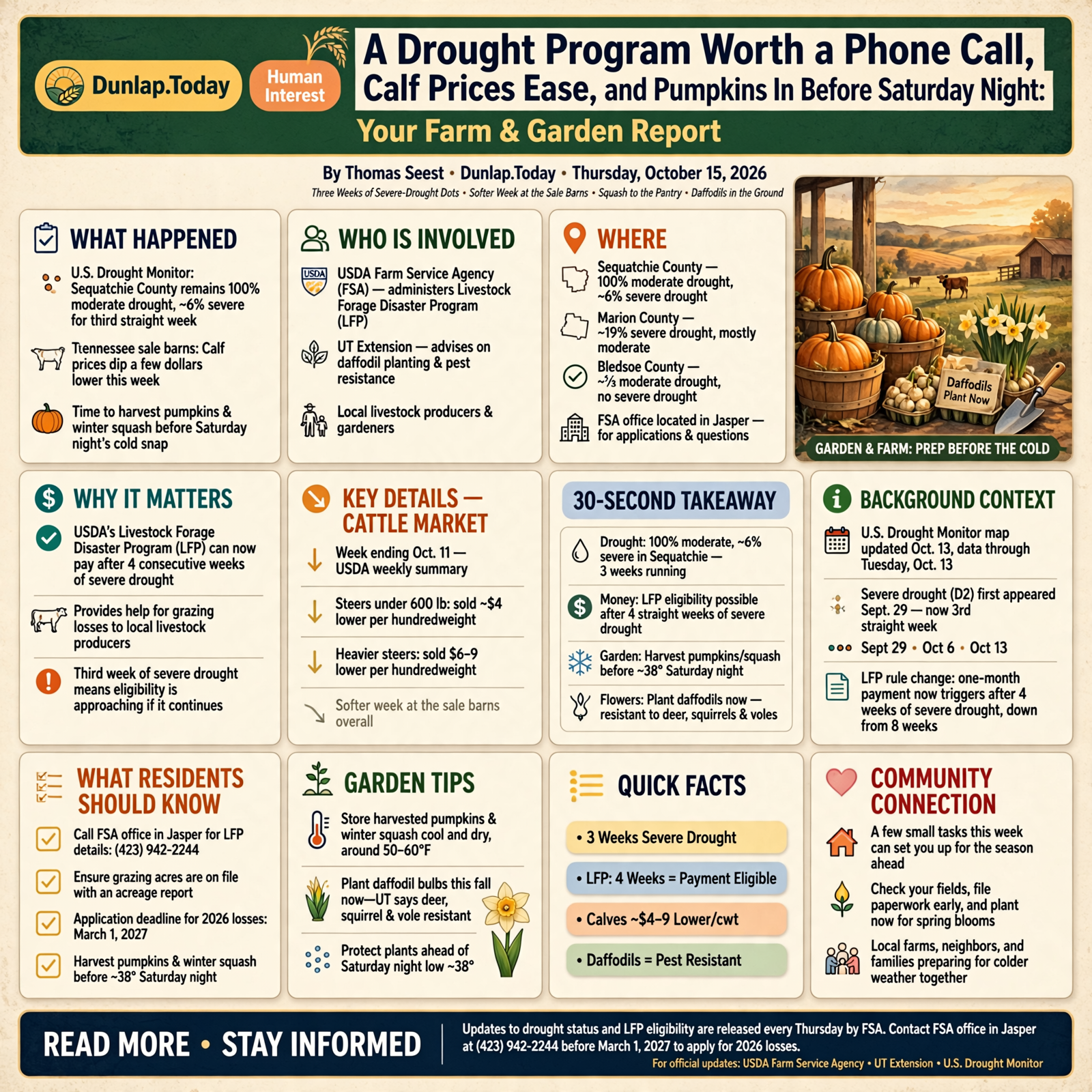
🌾 A Drought Program Worth a Phone Call, Calf Prices Ease, and Pumpkins In Before Saturday Night: Your Farm & Garden Report

Or: Three Weeks of Severe-Drought Dots on the Map, a Softer Week at the Sale Barns, Squash to the Pantry and Daffodils in the Ground
By Thomas Seest, Dunlap.Today · Thursday, October 15, 2026
Some weeks on the farm are about big jobs. This one is more like cleaning out the truck’s glove box: a few small papers worth reading, a couple of things to put away before the weather turns, and one bag of bulbs you’ll thank yourself for come March.
Here’s where things stand Thursday morning. Today’s U.S. Drought Monitor map still shows all of Sequatchie County in moderate drought, with a small slice (about 6 percent) in severe drought for the third straight week. That matters because a USDA program called the Livestock Forage Disaster Program now pays after just four straight weeks of severe drought, so it’s worth a call to the Farm Service Agency office in Jasper. At Tennessee sale barns, USDA’s latest weekly summary shows calf prices a few dollars lower. With Dunlap’s forecast still calling for a low near 38 Saturday night, it’s time to bring in pumpkins and winter squash. And UT Extension says daffodils are the bulb deer, squirrels and voles leave alone. A short checklist is at the end.
⏱️ What this means for you in 30 seconds
- Drought: Sequatchie is 100% moderate drought, about 6% severe, three weeks running. Marion is about 19% severe. Bledsoe has no severe drought.
- Money: USDA’s drought payment for grazing losses (called LFP) can start after 4 straight weeks of severe drought. Ask the FSA office in Jasper, (423) 942-2244. Application deadline is March 1, 2027.
- Cattle: For the week ending Oct. 11, Tennessee steers under 600 lbs sold about $4 lower per hundredweight. Heavier steers sold $6–9 lower.
- Garden: Pick ripe pumpkins and winter squash before Saturday night’s ~38°. Store them cool and dry, around 50–60°F.
- Flowers: Plant daffodils this fall. UT calls them deer, squirrel and vole resistant.
💧 Three Weeks of Severe-Drought Dots: Why a Call to the FSA Office Makes Sense
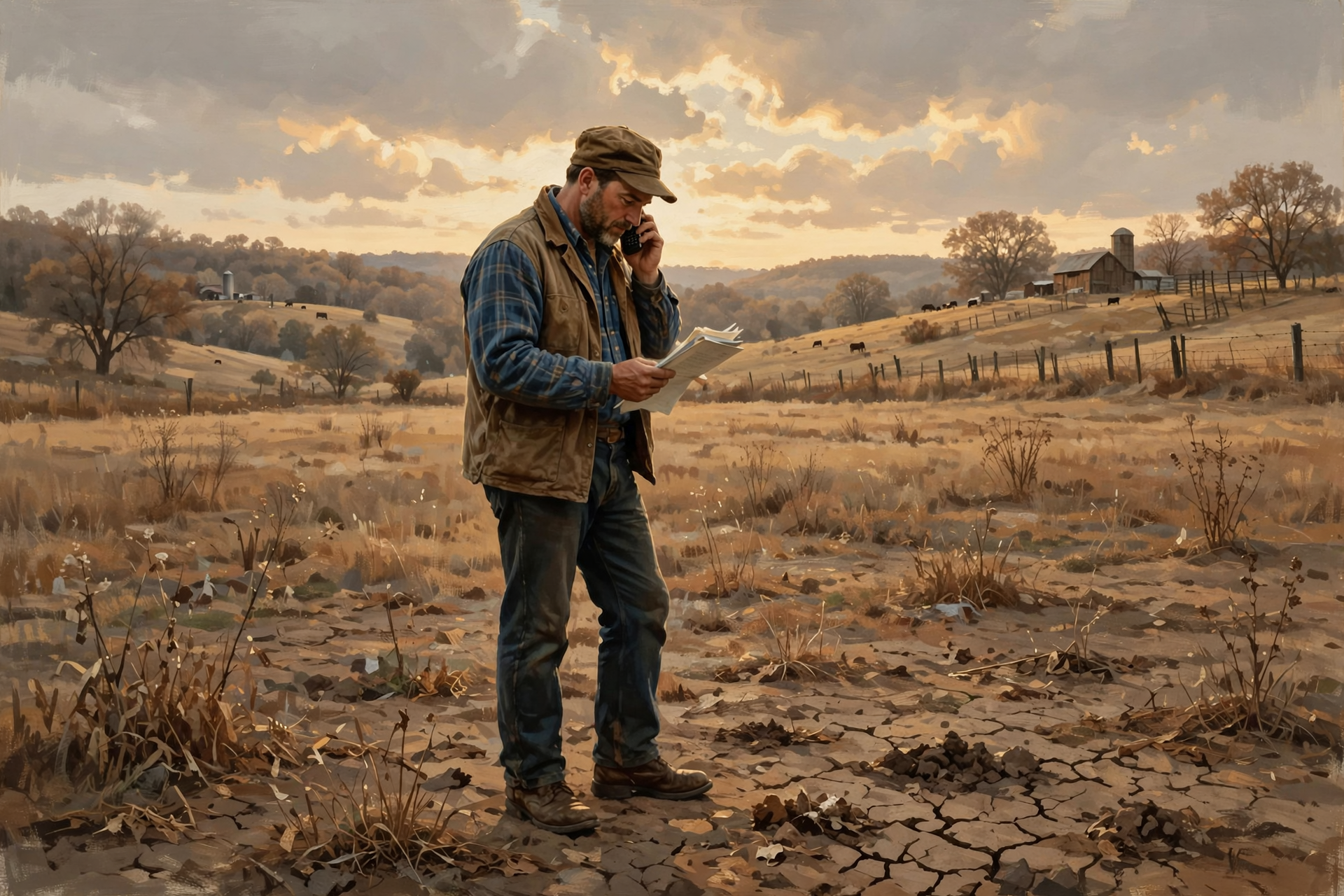
The U.S. Drought Monitor released its new map this morning, using data through Tuesday, Oct. 13. For Sequatchie County, it reads 100 percent moderate drought (D1), with about 5.8 percent in severe drought (D2). That’s the same as last week. The severe-drought slice first showed up on the Sept. 29 map, so this is the third straight week some part of the county has carried a D2 rating. Marion County is nearly all moderate drought, with about 19 percent severe, also for the third straight week. Bledsoe County is about one-third moderate drought, with no severe drought.
Here’s why those little patches matter. USDA’s Farm Service Agency runs the Livestock Forage Disaster Program (LFP), which pays eligible livestock producers for grazing lost to drought. Under the Working Families Tax Cuts Act, FSA says a one-month payment now triggers after four consecutive weeks of severe (D2) drought during the normal grazing season, instead of the old eight weeks. Seven out of eight weeks at D2 can mean two monthly payments. FSA updates its list of eligible counties every Thursday, and the deadline to apply for 2026 losses is March 1, 2027. FSA also says your grazing acres need to be on file with an acreage report.
What it means for you: Nobody can promise our counties will qualify. That depends on next week’s map and on FSA’s own review. But it’s like checking the gas gauge before a long drive: a two-minute look now saves a surprise later. If you run cattle, sheep or goats on pasture, call the FSA office at the Jasper Service Center, 3709 Main St., (423) 942-2244, which serves Sequatchie County. Ask whether your county is on the LFP list yet and what papers they’ll want. Start a folder with your grazing lease or deed, your livestock count, and the dates you started feeding hay.
👉 Read more (U.S. Drought Monitor: Tennessee) · USDA FSA: Livestock Forage Disaster Program
🐄 A Softer Week at the Sale Barns, With Lighter Calves Still Holding Up
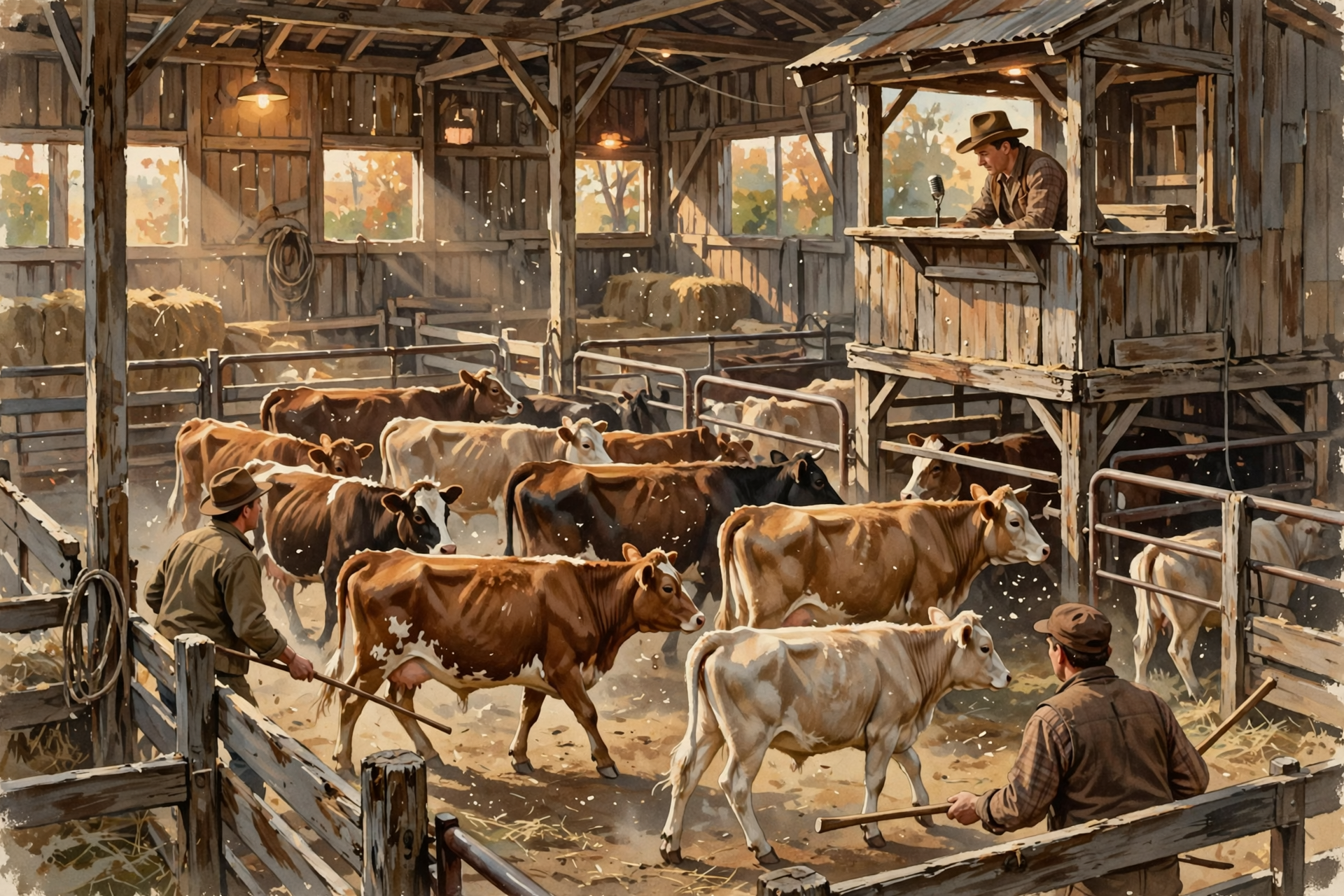
USDA Market News in Nashville put out its Weekly Tennessee Cattle and Grain Summary on Monday, for the week ending Sunday, Oct. 11. Compared with the week before, feeder steers under 600 pounds sold $4 lower per hundredweight, and steers over 600 pounds sold $6 to $9 lower. Heifers under 600 pounds sold $6 to $8 lower, and heavier heifers about $6 lower. Slaughter cows were $4 to $8 lower. USDA called demand moderate on a moderate supply of average-quality cattle. Tennessee barns sold 7,852 head, down from 10,439 the week before and close to last year’s 7,973.
A few state averages for medium and large No. 1 steers, per hundredweight:
- 450–500 lbs: $415.79 (prior week $413.32; a year ago $399.48)
- 500–550 lbs: $373.55 (prior week $377.32; a year ago $391.09)
- 550–600 lbs: $358.61 (prior week $362.84; a year ago $378.88)
- 600–650 lbs: $341.39 (prior week $347.87; a year ago $358.67)
Heifers weighing 450 to 500 pounds averaged $360.56, compared with $362.43 the week before. These are statewide averages, not a single Valley barn.
What it means for you: One soft week is like one cloudy day in a sunny month. It isn’t a new season. As a quick example of the math, a 525-pound steer at that week’s $373.55 average comes to roughly $1,960. That’s not a small check. If you’re selling this fall, call your barn ahead of time, ask how this week’s run looks, and sell on your own schedule instead of the market’s mood. USDA’s next weekly summary is due Monday.
👉 Read more (USDA Weekly Tennessee Cattle and Grain Summary)
🎃 Pumpkins and Winter Squash to the Pantry Before Saturday Night
Dunlap’s National Weather Service forecast calls for one more warm day today, with a high near 89. Friday turns breezy with a high near 80 and gusts up to 25 mph. Saturday reaches only about 60, then Saturday night drops to around 38 under mostly clear skies, and Sunday night stays near 40. Yesterday’s report covered tomatoes and peppers. This week, UT Extension’s harvest and storage guide has a word for the big fruit still sitting in the patch.
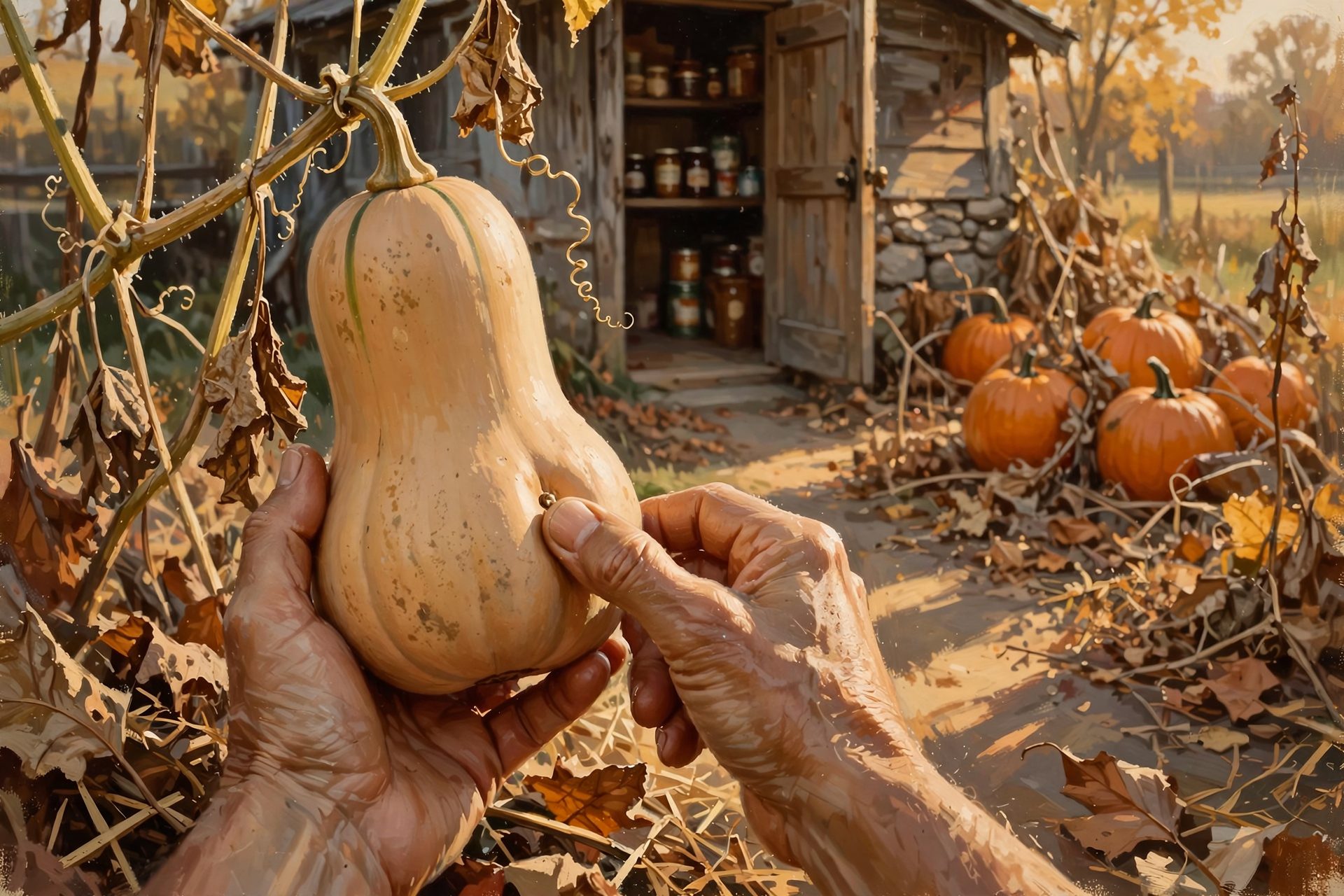
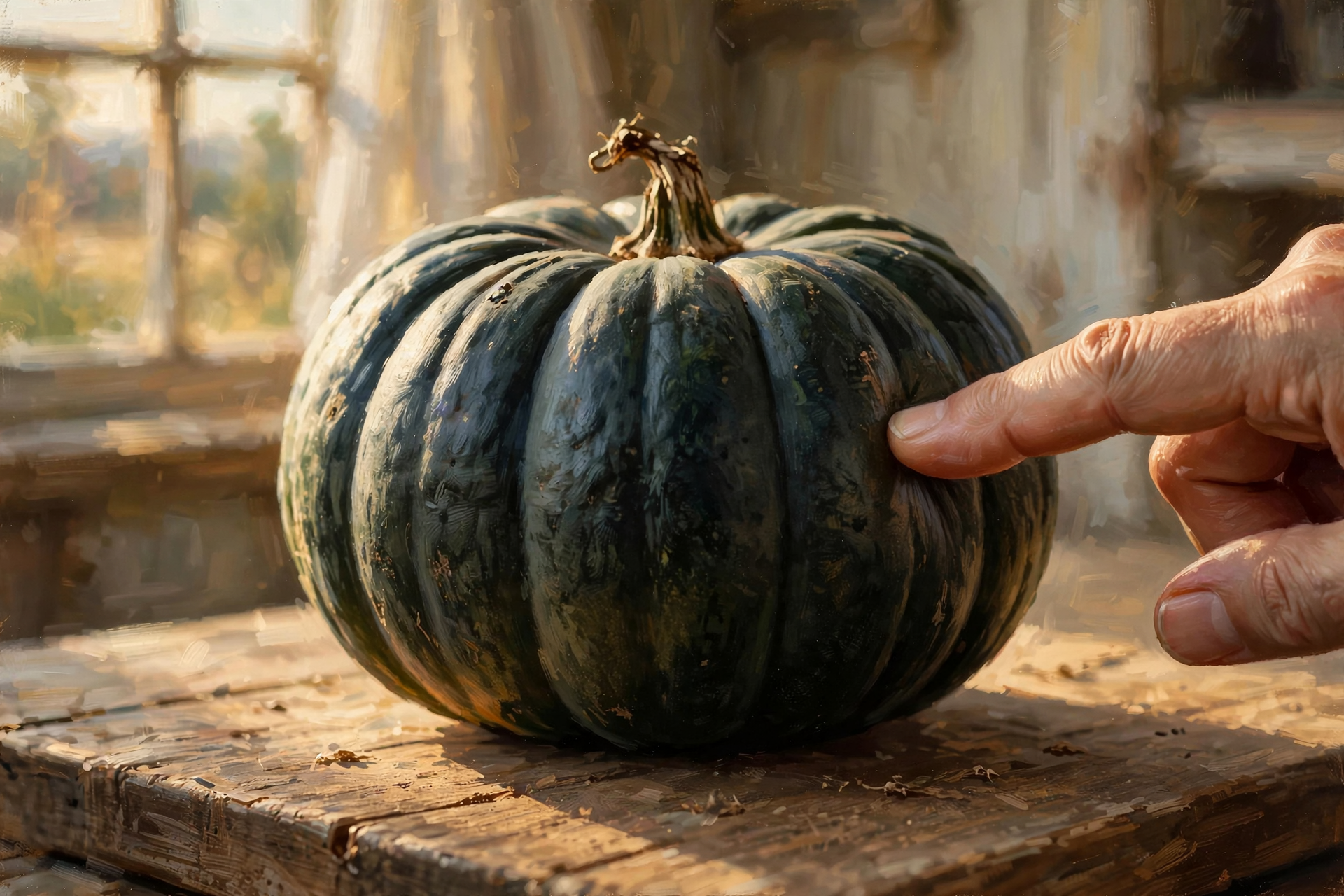
UT says to pick pumpkins once they’re fully grown and colored, but before frost. Winter squash (butternut, acorn, spaghetti and the like) is ready when the rind has hardened and you can’t easily scratch it with a fingernail. UT adds that winter squash needs to ripen on the vine for long storage. Both belong in what UT calls moderate storage: about 50 to 60 degrees. For most households, that means a pantry, basement or insulated garage, not the fridge. UT says stored that way, pumpkins keep up to two to three months, and winter squash can keep several months, depending on the type.
What it means for you: Think of it like putting up canned goods. A little work on a warm afternoon, then good eating all winter. Give the pumpkins and squash a fingernail test today or Friday, carry the ready ones in, and keep them out of direct sun. Any that are still green and soft can stay on the vine under a sheet Saturday night if you’d like to give them a few more days.
👉 Read more (UT: Harvest, Handling and Storage of Vegetables, W346-I) · NWS Dunlap forecast
🌼 Mail a Letter to Spring: Plant Daffodils the Critters Leave Alone
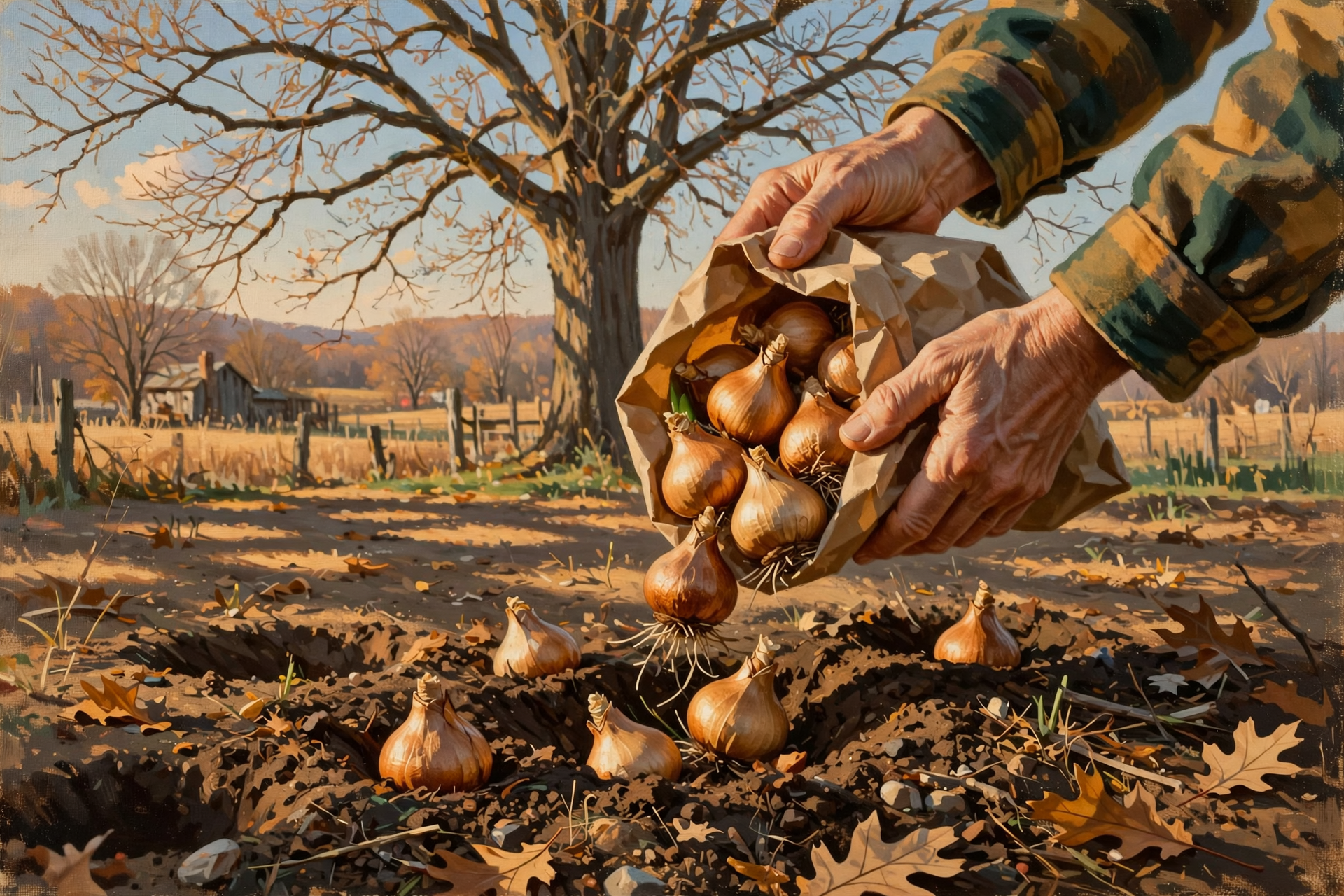
Fall is bulb season. UT Extension’s Bulbs for the Garden guide says most spring-blooming bulbs need fall planting. Its pick for a no-fuss Tennessee yard is the daffodil. UT lists daffodils as deer, squirrel and vole resistant, says many naturalize (spread and come back year after year), and notes they bloom from February to May, depending on the variety. Plant early, middle and late types together, and UT says you can stretch the show across most of spring. One caution from UT: the popular old ‘King Alfred’ type isn’t well suited to the South, so check the label.
Tulips are a different story. UT calls hybrid tulips a deer, squirrel and vole favorite. It says most of them don’t come back here and are best treated like annuals, or grown in pots. Crocus is also a favorite of voles. And after your daffodils bloom next spring, UT says to leave the leaves alone until they turn yellow, because they’re feeding next year’s flowers.
What it means for you: A bag of daffodils is like a letter you mail to yourself in March. Pick a spot with at least a few hours of sun. A bed under a big shade tree can work, since UT notes those spots get plenty of winter sun once the leaves drop. Plant them in loose clusters instead of straight rows, at the depth printed on the bag, and water them in. This dry fall makes that last step count.
👉 Read more (UT: Bulbs for the Garden, D140)
📌 Sticky Notes for the Fridge

- Starting today, Thursday, Oct. 15: A free burn permit is required for leaf and brush piles. Get it the day you burn at BurnSafeTN.org or in the MyTN app, or call 1-877-350-BURN on weekdays. Today’s light wind (0–5 mph) is a good burning day. Friday and Saturday’s gusts are not.
- Saturday, Oct. 17, 9 a.m.–1 p.m.: Dunlap Farmers Market Young Entrepreneurs Day at the Jeff Johnson Pavilion in Harris Park.
- Saturday night, Oct. 17: Low near 38 in Dunlap. Cover or bring in tender plants, and carry in porch pots.
- Monday, Oct. 19: USDA’s next weekly Tennessee cattle summary, and the next Crop Progress report.
- Thursday, Oct. 22: The next Drought Monitor map, plus FSA’s weekly update of LFP-eligible counties.
- Dec. 1, 2026: Deadline for Tennessee Department of Agriculture water-quality grant proposals.
- March 1, 2027: Deadline to apply for 2026 Livestock Forage Disaster Program payments.
👉 BurnSafeTN · Dunlap Farmers Market · TDA Newsroom
✅ Your Farm & Garden Checklist for Paperwork-and-Pantry Week
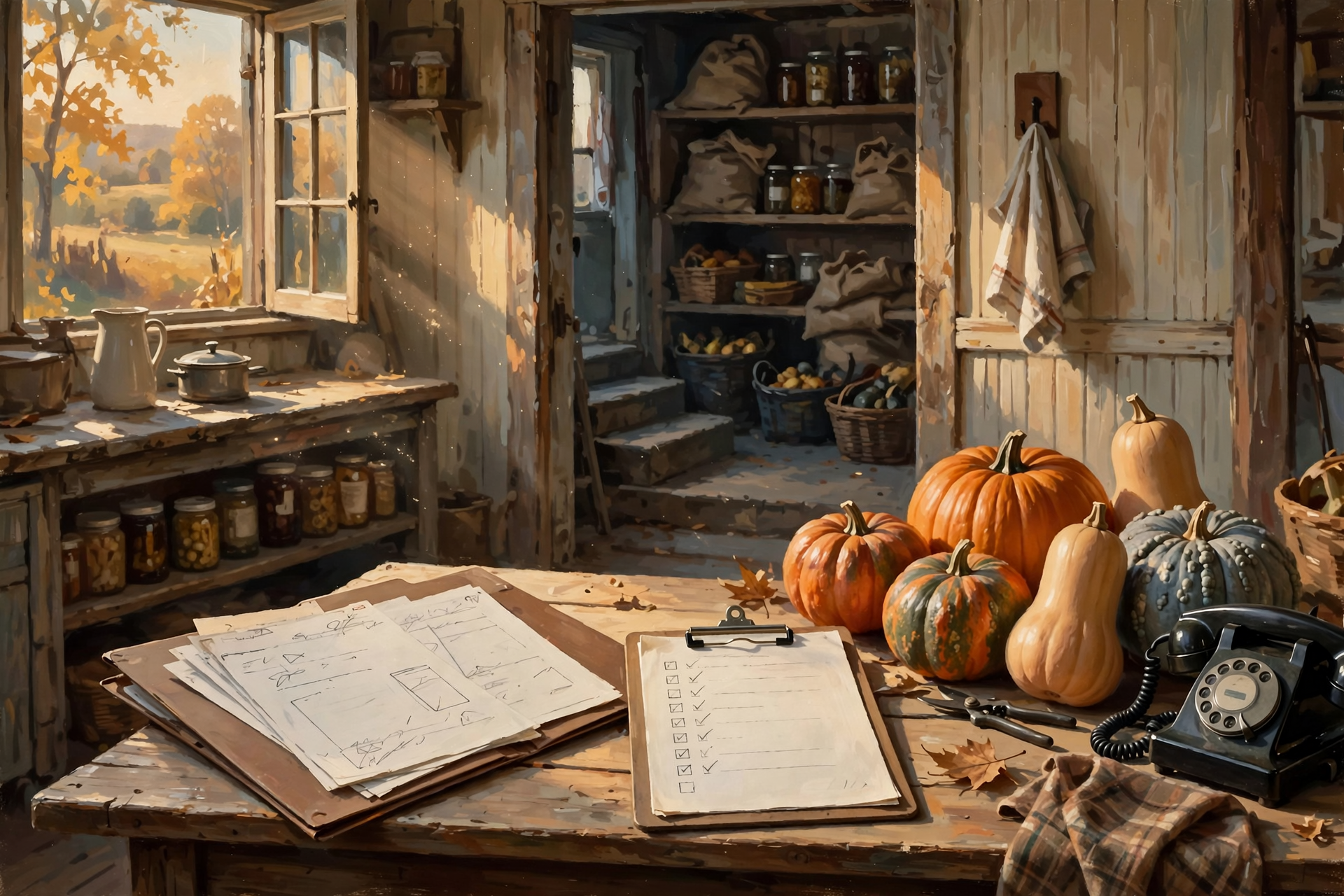
- ✅ Call FSA in Jasper, (423) 942-2244: Ask whether Sequatchie or Marion is on the LFP list, and what records they need.
- ✅ Start a drought folder with your grazing lease or deed, livestock count, and the date you started feeding hay.
- ✅ If you’re selling calves, call your sale barn before you haul. Check Monday’s USDA summary.
- ✅ Today or Friday: Fingernail-test your winter squash, and bring in pumpkins that are fully colored.
- ✅ Store them in a pantry, basement or insulated garage at about 50–60°F, out of the sun.
- ✅ Buy a bag of daffodils, skipping ‘King Alfred,’ and plant them in clusters this fall. Water them in.
- ✅ Today: If you’re burning brush, get the free permit and keep a hose close by.
- ✅ Saturday afternoon: Covers on and porch pots in before the near-38 night.
- ✅ Saturday 9–1: Visit the young vendors at the Dunlap Farmers Market.
Practical rule: Make the FSA call while it’s easy, put the pumpkins up before the cold, and plant the bulbs critters won’t eat.
— Dunlap.Today
📚 Plain-English Farm & Garden Glossary

- Moderate drought (D1): The Drought Monitor’s first drought level. Some damage to pastures and crops, and water levels running low.
- Severe drought (D2): The next level up. This is the level that can start LFP payments after four straight weeks.
- LFP (Livestock Forage Disaster Program): A USDA Farm Service Agency program that pays eligible livestock producers for grazing lost to drought.
- FSA (Farm Service Agency): The USDA office that handles farm program sign-ups, disaster help and farm loans. Sequatchie County’s office is at the Jasper Service Center.
- Hundredweight (cwt): 100 pounds. Cattle prices are quoted per hundredweight, so $373 per cwt is about $3.73 a pound.
- Medium and Large No. 1: USDA’s grade for well-muscled feeder cattle with a medium-to-large frame. It’s the grade used for the state averages in USDA’s weekly Tennessee report.
- Naturalize: When bulbs spread and come back on their own, year after year.
- Moderate storage: UT’s term for a cool, dry spot around 50–60°F, like a pantry or basement.
❓ Frequently Asked Questions
Does Sequatchie County qualify for drought payments right now?
That’s FSA’s call, not ours. Under the current rules, a one-month LFP payment can trigger after four consecutive weeks of severe drought. Today’s map is the third straight week with a severe-drought slice in Sequatchie. FSA updates its eligible-county list each Thursday, so call the Jasper office at (423) 942-2244 to get the current answer.
Who can apply for LFP?
FSA says eligible producers own, lease or contract-grow eligible livestock, provide pasture for them when the qualifying drought begins, and can certify a grazing loss. Leased land needs a written lease or FSA’s lease certification form. Ask the FSA office about your situation.
When is the LFP deadline?
For 2026 grazing losses, the application and supporting paperwork are due by March 1, 2027.
Were calf prices way down last week?
They were a few dollars lower per hundredweight. Lighter steers, 450 to 500 pounds, averaged $415.79, which is above a year ago. Steers from 500 to 650 pounds were below a year ago. These are statewide averages, so your barn and your cattle may differ.
How do I know a winter squash is ready?
UT says the rind should be hard enough that you can’t easily scratch it with a fingernail. For long storage, it needs to ripen on the vine.
Can I keep pumpkins in the refrigerator?
UT puts pumpkins and winter squash in its moderate-storage group, about 50 to 60 degrees, so a pantry, basement or insulated garage works better than the fridge.
Why daffodils instead of tulips?
UT lists daffodils as deer, squirrel and vole resistant, and many come back every year. UT says hybrid tulips are a critter favorite and usually don’t return in Tennessee.
🔗 Other Resources

- U.S. Drought Monitor: Tennessee
- USDA FSA: Livestock Forage Disaster Program (LFP)
- USDA Service Center Locator (Sequatchie FSA: Jasper Service Center, 3709 Main St. · 423-942-2244)
- USDA Weekly Tennessee Cattle and Grain Summary
- UT: Harvest, Handling and Storage of Vegetable Produce (W346-I)
- UT: Bulbs for the Garden (D140)
- National Weather Service: Dunlap forecast
- BurnSafeTN (free burn permits)
- Dunlap Farmers Market
- UT Extension Sequatchie County (170 Church Street, Dunlap · 423-949-2611)
- Dunlap.Today
🏡 Keep Learning, Stay Calm and Come Back to the Porch
A dry map, a soft week at the sale barn and a chilly Saturday night aren’t reasons to fret. They’re reasons to make one phone call, carry a few pumpkins inside, and plant a bag of bulbs. Do those three things and you’ve done right by the farm, the pantry and next spring.
When you want the next calm, practical update for Sequatchie Valley readers, pull up a chair at Dunlap.Today.
Sources
Know about an upcoming event or story in the Sequatchie Valley? Submit it here.



0 Comments