
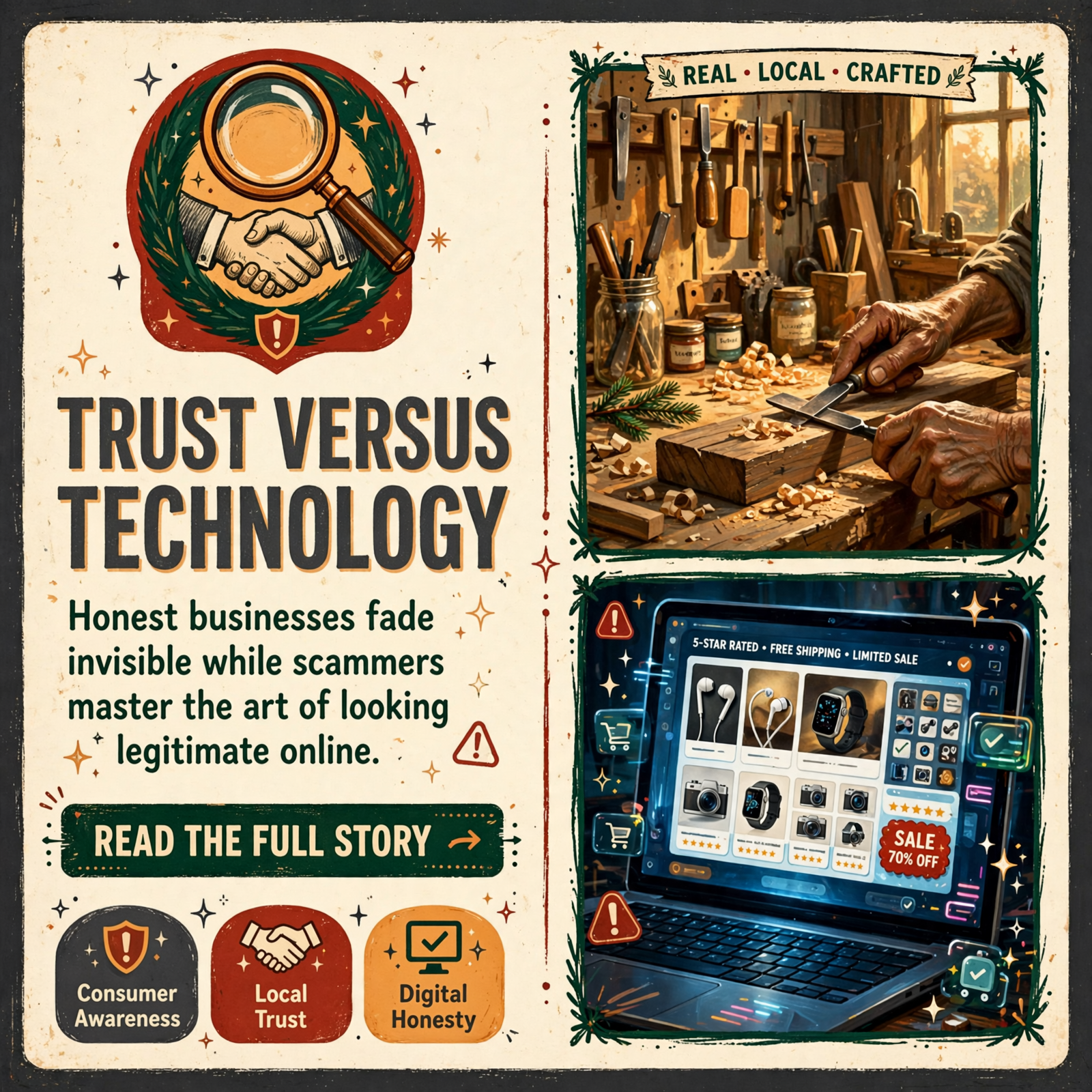
The Honest Business Nobody Can Find — and the Scammer Everybody Can

A reader caught something I missed. That experience raises an uncomfortable question about the future of small businesses in the Sequatchie Valley: What happens when the people who deserve our trust are nearly invisible, while the people who want to deceive us have mastered the art of looking legitimate?
First, I Have a Confession to Make

Recently, a reader contacted me about something we had published on Dunlap.Today.
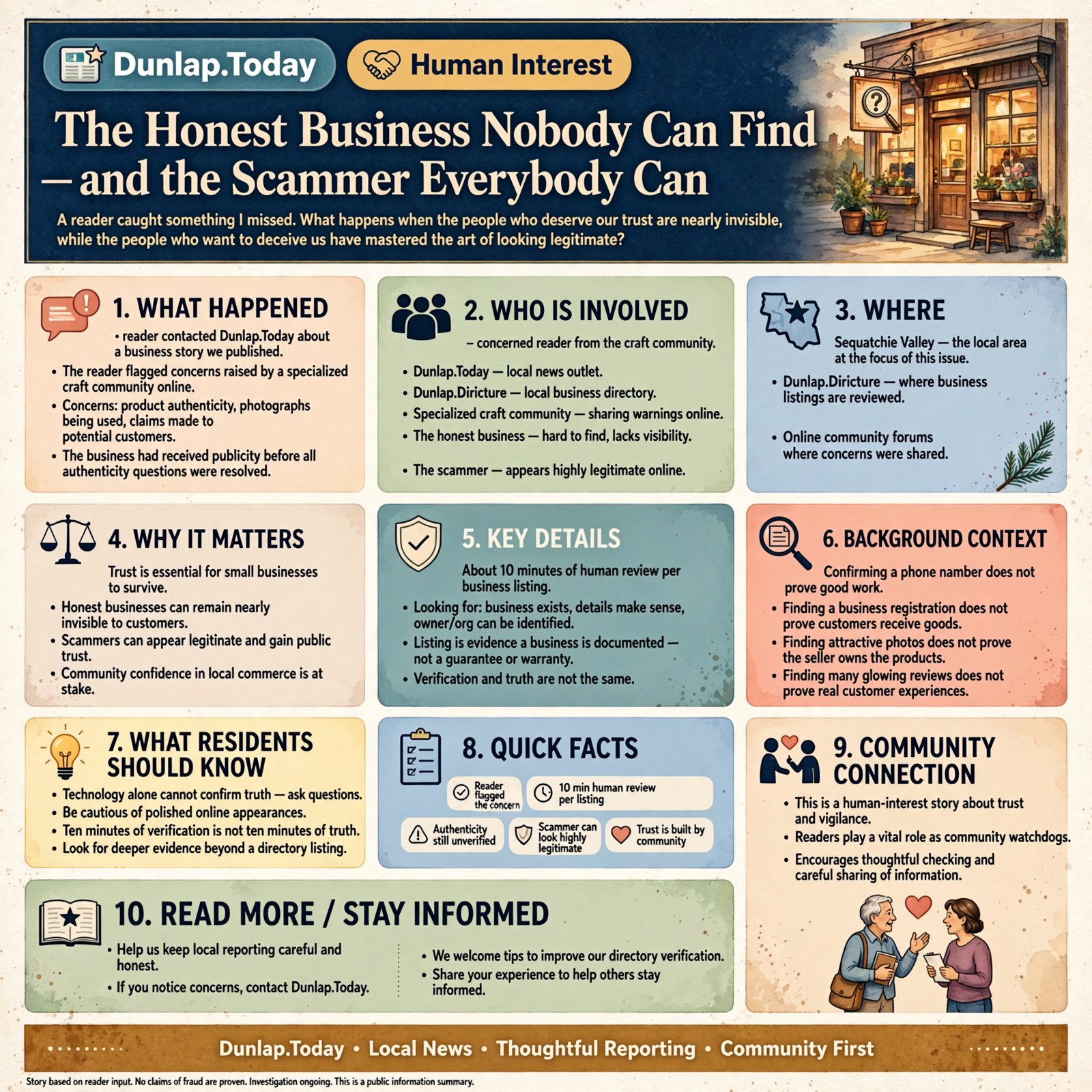
The reader had noticed stories featuring an online business that members of a specialized craft community were warning others about. The concerns involved the authenticity of the seller’s products, the photographs being used, and the representations being made to potential customers.
These are serious concerns. They deserve investigation rather than automatic acceptance as proven facts. An accusation posted online is not, by itself, proof that someone has committed fraud.
But the reader had identified something equally important: a business had received publicity without all the questions about its authenticity having been resolved.
And that bothered me.
Not because someone questioned our work. I appreciate that.
It bothered me because I spend an extraordinary amount of time thinking about local businesses, information, technology, artificial intelligence, and the increasingly complicated question of whom we can trust.
Yet here was a reader reminding me that all the technology in the world cannot replace the simple act of asking whether something is actually true.
That is a lesson worth sharing.
Particularly because I suspect this problem is going to become much worse.
Ten Minutes of Verification Is Not Ten Minutes of Truth

As part of operating Dunlap.Directory, I generally spend about ten minutes of actual human time reviewing each business listing.
That may not sound like much, but multiply it across a large directory and it represents a substantial investment of time.
I look for indications that the business exists, that the information makes sense, and that the people or organization behind it can reasonably be identified.
Sometimes the information is easy to find.
Sometimes it is practically impossible.
And sometimes a business has created such a convincing appearance of legitimacy that it can fool someone who is actively looking for problems.
There is an important distinction here.
Verifying that a business appears to exist is not the same as verifying that every claim it makes is true.
Confirming a telephone number does not establish that a contractor does good work.
Finding a business registration does not prove that customers receive what they purchase.
Finding attractive photographs does not prove that the seller owns the products in those photographs.
And finding fifty glowing reviews does not establish that fifty actual customers had fifty wonderful experiences.
There are different levels of verification, and they should not be confused.
A directory listing is useful evidence that someone has identified or documented a business. It is not an insurance policy, a product warranty, or a guarantee of honesty.
I wish ten minutes could settle all those questions.
Unfortunately, ten minutes barely gives you enough time to discover how many questions you should have asked.
The Strange Business Culture of the Sequatchie Valley
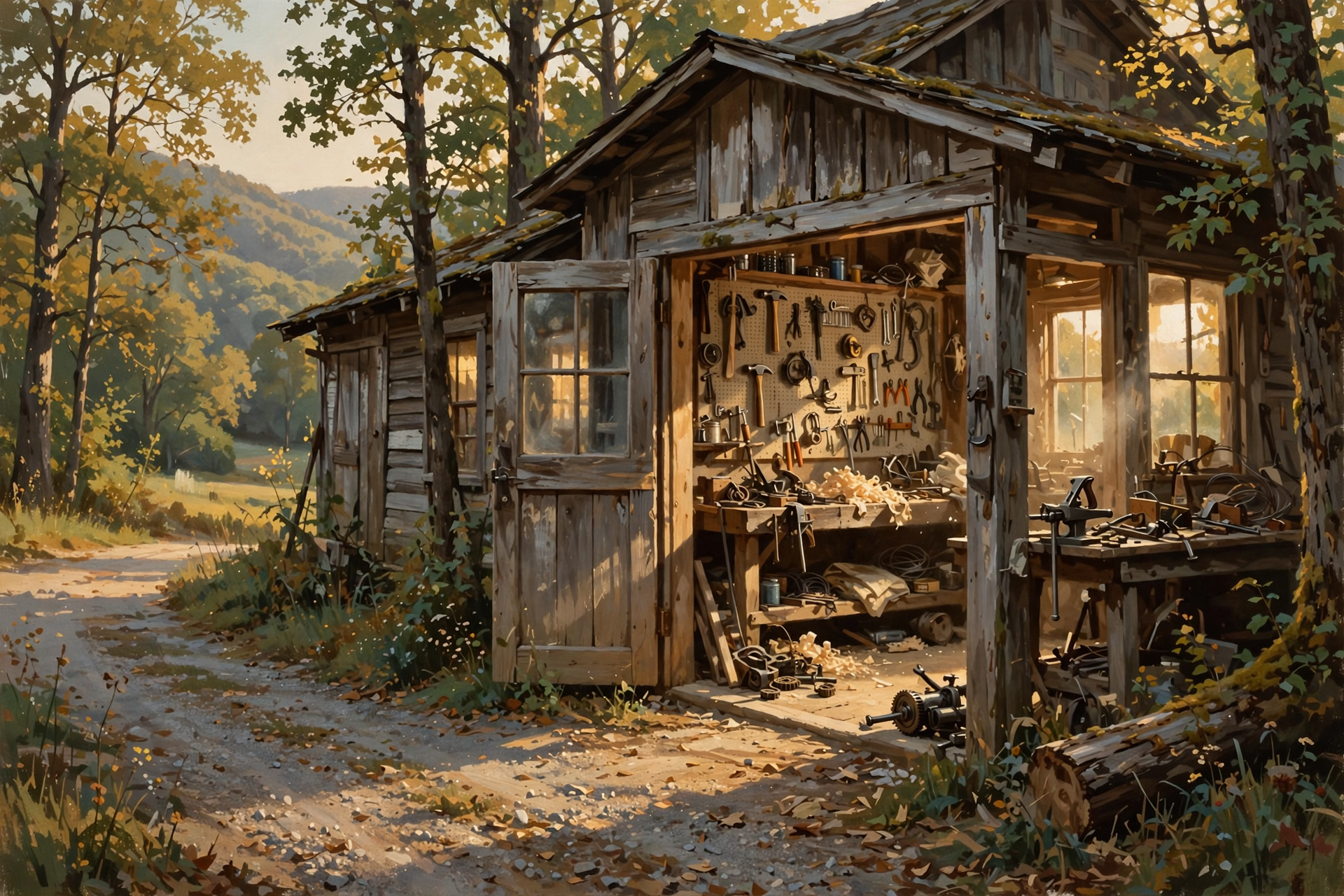
To understand why this matters so much here, you have to understand something about the way many businesses operate in the Sequatchie Valley.
We have businesses that have been serving customers for years, sometimes decades, with almost no meaningful online presence.
Some do not have websites.
Some have Facebook pages that appear to have been abandoned shortly after Facebook was invented.
Some use a telephone number that has been passed around through friends, relatives, and former customers.
Some operate from farms, workshops, home offices, sheds, or commercial buildings that are not particularly visible from the road.
Others deliberately keep their digital presence limited for reasons of privacy, personal preference, religious practice, or simply because their businesses have always operated successfully without it.
That includes some of our Amish and Mennonite neighbors, but it certainly is not limited to them.
Plenty of longtime residents are perfectly happy operating a business without maintaining a website, posting photographs of breakfast on Facebook, or learning what an SEO consultant does.
And there is nothing inherently wrong with that.
For generations, a business could develop a reputation by doing good work, charging a fair price, and treating its customers properly.
If you needed a mechanic, you asked somebody who knew a mechanic.
If you needed a carpenter, you asked somebody who had used a carpenter.
If you needed hay, firewood, welding, fencing, excavation, roofing, or a reliable person to repair something that had no intention of cooperating, you asked around.
Eventually somebody would say, “You need to talk to so-and-so.”
There might not be a website, a logo, or even a particularly memorable business name.
But there was a person.
There was a reputation.
There was a history.
And most importantly, there were people who could tell you whether the business deserved your trust.
That kind of reputation is extraordinarily valuable. The problem is that it does not automatically travel very far.
Two Businesses, Two Very Different Stories

Consider two imaginary businesses. They are illustrations of the problem, not descriptions of particular local companies.
Business Number One: The Real Craftsman
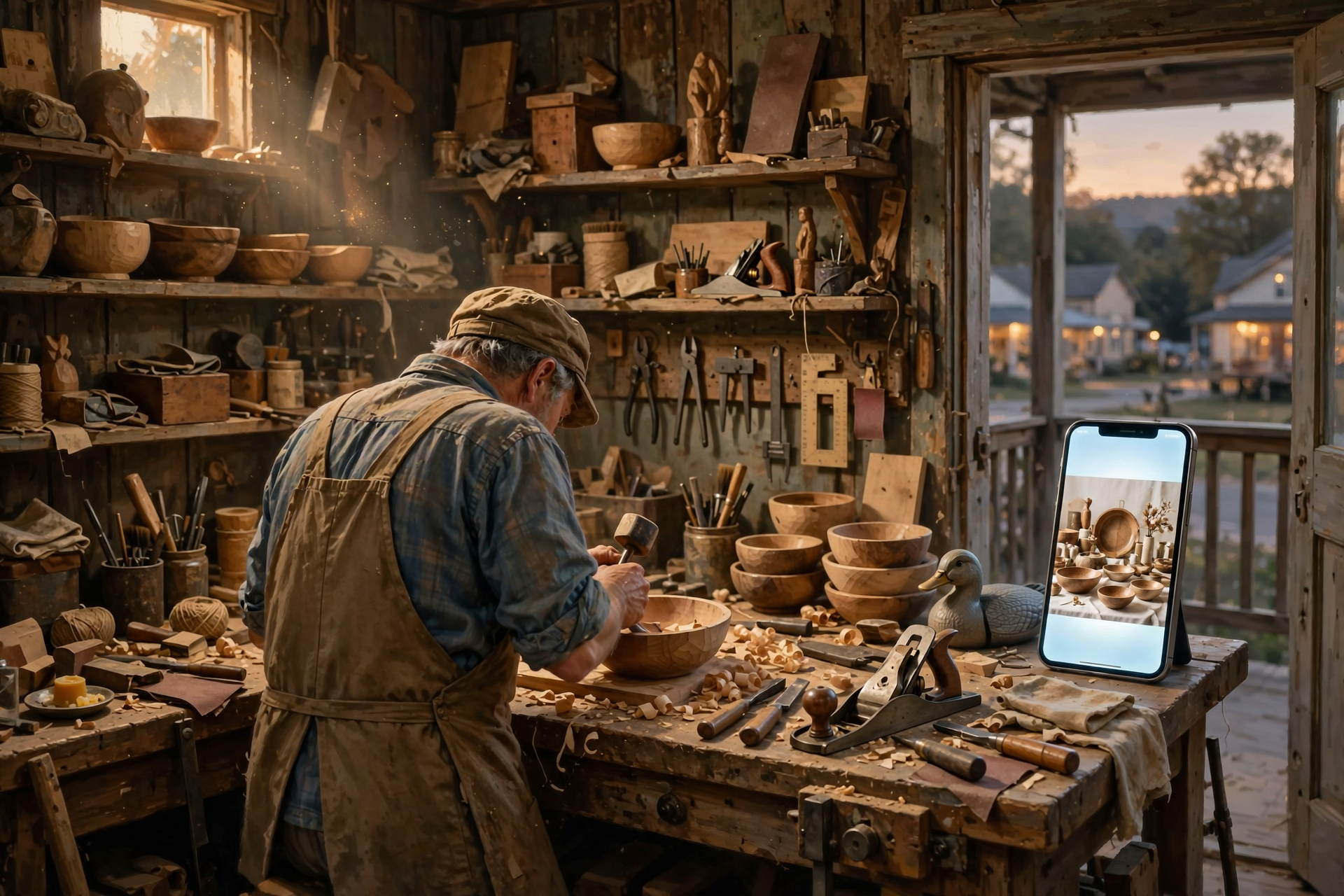
Imagine a man living outside Dunlap who has spent thirty years making exceptionally good furniture.
He knows his wood.
He knows his tools.
He knows the difference between a properly fitted joint and something held together by glue, wishful thinking, and a finishing nail.
His customers love his work.
Some have pieces he built twenty years ago.
People recommend him to relatives. Other craftsmen respect him. He stands behind what he makes.
He has a workshop, actual equipment, actual customers, and products you can touch.
What does he have online?
Nothing.
Perhaps a telephone number mentioned in a Facebook comment from 2019.
Maybe a photograph of a cabinet posted by someone’s aunt.
His reputation is excellent.
His digital identity is nearly nonexistent.
Business Number Two: The Professional-Looking Impostor
Now imagine another seller.
This seller has never built a cabinet.
He might not know the difference between walnut and plywood.
But he has a beautiful website.
He has professional-looking photographs of furniture that he did not necessarily make.
He has a convincing business description, enthusiastic testimonials, attractive social media posts, and a special holiday promotion.
His advertisements describe generations of craftsmanship, old-fashioned family values, and a deep commitment to customer satisfaction.
He has discovered that these phrases can be assembled much faster than an actual dining room table.
The seller may be legitimate, incompetent, dishonest, or operating a fraudulent storefront. The appearance alone cannot tell us which.
But if the seller is a scammer, he has a substantial advantage over our craftsman.
When a stranger searches online, the suspicious seller may be the one who gets discovered.
The honest craftsman remains invisible.
Not because his work is inferior.
Not because his reputation is poor.
Simply because the online world has little evidence that he exists.
And that is the problem.
We Have Entered the Age of Manufactured Credibility

There was a time when building a convincing online business presence required considerable effort.
You needed someone who could design a website.
You needed photographs, advertising copy, product descriptions, and perhaps a professional logo.
You needed to know how to manage online marketing.
Today, many of these things can be created quickly with artificial intelligence and inexpensive digital tools.
That is wonderful news for legitimate businesses.
A small business owner can now produce materials that previously required the services of an advertising agency.
But the same tools are available to dishonest people.
A scammer can generate dozens of convincing product descriptions, create synthetic product photographs, translate sales pitches into different languages, imitate customer-service conversations, and experiment with countless variations of the same advertisement.
Artificial intelligence can make the presentation look remarkably professional.
Unfortunately, it cannot make the underlying business honest.
A beautiful photograph might be a picture of something real, a picture borrowed without permission, or an entirely artificial creation.
A persuasive testimonial might describe a genuine customer experience, or it might be fiction.
A cheerful customer-service response might come from a helpful employee or from an automated system designed to keep someone engaged long enough to obtain payment.
None of these technologies is inherently fraudulent.
But they make it easier to manufacture the appearance of trustworthiness without earning the substance of it.
The cost of looking legitimate has fallen dramatically. The cost of actually being legitimate has not.
You still have to make the product, perform the service, honor the agreement, fix the mistakes, pay the employees, and answer to your customers.
And that is a much more demanding business model than creating a convincing website.
How Large Has the Scam Problem Become?
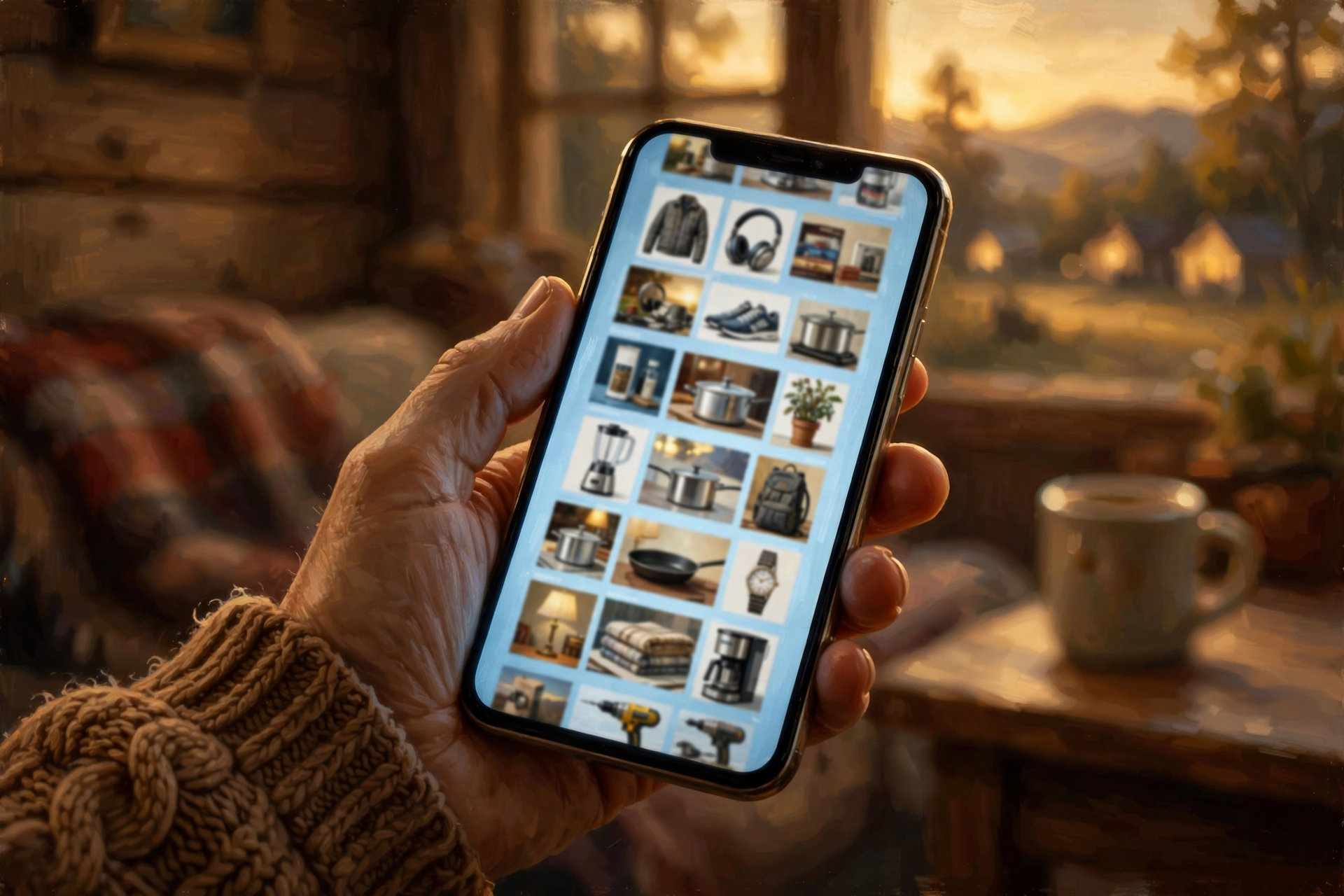
This is not merely a theoretical concern about technology.
According to the Federal Trade Commission, American consumers reported approximately $15.9 billion in total fraud losses during 2025.
Of particular concern, the FTC reported that people lost approximately $2.1 billion to scams that began on social media during that year.
That social media figure was roughly eight times the amount reported in 2020.
Nearly 30 percent of people who reported losing money to a scam in 2025 said the scam began on social media.
Shopping scams were the most frequently reported type of social media scam.
And among people who reported losing money to scams that began on social media, more than 40 percent said their experience involved ordering something advertised there.
Those are reported losses, not a complete measurement of every scam that occurred.
Many incidents are never reported.
Think about what these numbers mean.
Millions of people are navigating a marketplace where the presentation of an offer can be disconnected from the reality of the seller.
And the same social media platforms that help a legitimate Dunlap business find customers can also help a dishonest operator reach those customers.
Technology provides the delivery system.
The character of the person using it determines whether the opportunity is used honestly.
The Newcomer Problem: When Nobody Knows Who Anybody Is

Here is where this becomes particularly important to the Sequatchie Valley.
Our communities are changing.
People move here from Chattanooga, Nashville, other parts of Tennessee, and from states all across the country.
Some are coming for retirement.
Some want a different pace of life.
Some want land, space, or an opportunity to operate a business.
Some are arriving with families and looking for communities where they can build a future.
But newcomers have a problem that longtime residents often underestimate.
They do not know the local reputations.
They do not necessarily know who has been doing good work for thirty years.
They do not know which handyman has helped half the neighborhood.
They do not know who operates the dependable local machine shop, which contractor stands behind his work, or which small farm sells excellent products.
And when they need something, they often reach for the one thing they already understand.
Their phones.
They search Google.
They ask Facebook.
They ask an AI assistant.
They may get useful recommendations. They may get incomplete information. They may even get confident answers containing mistakes.
But an excellent local business with no meaningful digital footprint is difficult for those systems to discover and evaluate.
Meanwhile, a questionable business with an aggressive online marketing operation may appear more prominently.
For longtime residents, reputation travels through relationships.
For newcomers, reputation increasingly travels through information systems.
And those two systems do not always agree.
We are moving toward a world in which a business can be trusted by nearly everyone who knows it, yet remain unknown to nearly everyone who might need it.
And Then There Are the Data Centers

You have probably heard plenty of discussion about artificial intelligence, enormous data centers, new computing facilities, and the growing demand for electricity to operate them.
These developments are already influencing communities and utilities throughout Tennessee and the broader Tennessee Valley.
But it is important to understand what those data centers actually mean to a business in Pikeville, Dunlap, Whitwell, or one of our smaller mountain communities.
A data center is not automatically a scam factory.
It does not personally decide which local carpenter deserves to appear in a search result.
And opening another data center does not instantly erase an honest business from the internet.
The connection is broader.
More computing capacity can support the expansion of AI services, automated research, digital advertising, software tools, and the systems that increasingly mediate how people discover information.
That expansion can benefit legitimate businesses enormously.
It can also make it cheaper and easier to produce deceptive content at scale.
As more people begin asking AI assistants whom to hire, where to shop, and which businesses to trust, another challenge emerges.
These systems generally depend on information they can access.
They cannot reliably evaluate a reputation that exists only in private conversations between neighbors.
They cannot interview every former customer.
They cannot visit every welding shop, cabinetmaker, farm, or repair business.
They cannot determine the honesty of a business merely because its website looks polished.
And they cannot guarantee that an online review reflects an actual customer experience.
Sometimes they can identify warning signs.
Sometimes they can compare independent records.
Sometimes they can help a customer ask better questions.
But they are not substitutes for evidence.
Here is my concern for the future.
As more purchasing decisions begin with automated information systems, businesses without accessible information may lose opportunities before they even know a customer was looking.
That does not mean every business needs an elaborate website or a large marketing budget.
It means that being discoverable, identifiable, and reasonably verifiable will become increasingly valuable.
The honest business needs to leave enough evidence of its existence for a stranger to find it.
How Do You Tell a Real Rural Business From an Online Scam?

This is where I think some traditional online scam advice fails people in rural communities.
You will often see warnings suggesting that businesses without websites, public addresses, active social media accounts, or recognizable telephone numbers should be treated as suspicious.
That advice can be misleading here.
Consider a few examples.
No Website
An absent website might indicate a business that does not exist.
Or it might indicate a legitimate craftsperson who has been busy working since 1987 and has never needed one.
The absence of a website is a missing source of information, not proof of dishonesty.
No Public Street Address
Some legitimate businesses operate from homes, farms, or private workshops.
Others serve customers at their locations and have no reason to invite strangers to a residential property.
Google itself allows eligible service-area businesses to keep their street addresses hidden while displaying the areas they serve.
Privacy is not evidence of fraud.
Cash Payments
Plenty of perfectly legitimate businesses accept cash.
Some prefer checks.
Some do not accept credit cards.
And some small businesses use payment applications for perfectly ordinary transactions.
The question is not simply which payment method is used.
The more important questions are whether the seller can be identified, whether the terms are clear, whether payment can be documented, whether there is meaningful protection if something goes wrong, and whether someone is pressuring you to use an irreversible method.
An Unfamiliar Telephone Number
People move.
They keep old telephone numbers.
They use internet telephone services.
They use Google Voice, business phone systems, and call-forwarding services.
A Tennessee business with an out-of-state area code is not automatically suspicious.
Neither is a business that uses a virtual telephone number.
These systems are widely used for legitimate reasons, including protecting an owner’s personal number.
No Secretary of State Listing
Tennessee maintains records of registered business entities, including corporations and limited liability companies.
Those records can be useful during verification.
However, not every legitimate business is required to organize as a corporation or LLC, and some sole proprietors will not appear in that database under their operating names.
Finding a registration does not guarantee honesty.
Failing to find one does not automatically prove fraud.
No Active Facebook Page
I know local businesses whose social media activity could best be described as an annual event.
Some post twice a year.
Some appear to post only when somebody’s daughter remembers the password.
Some have never posted anything.
That may represent a missed marketing opportunity.
It does not make the business illegitimate.
The lesson is simple: The absence of digital polish should not be confused with the absence of integrity.
What Actually Makes Me Suspicious?
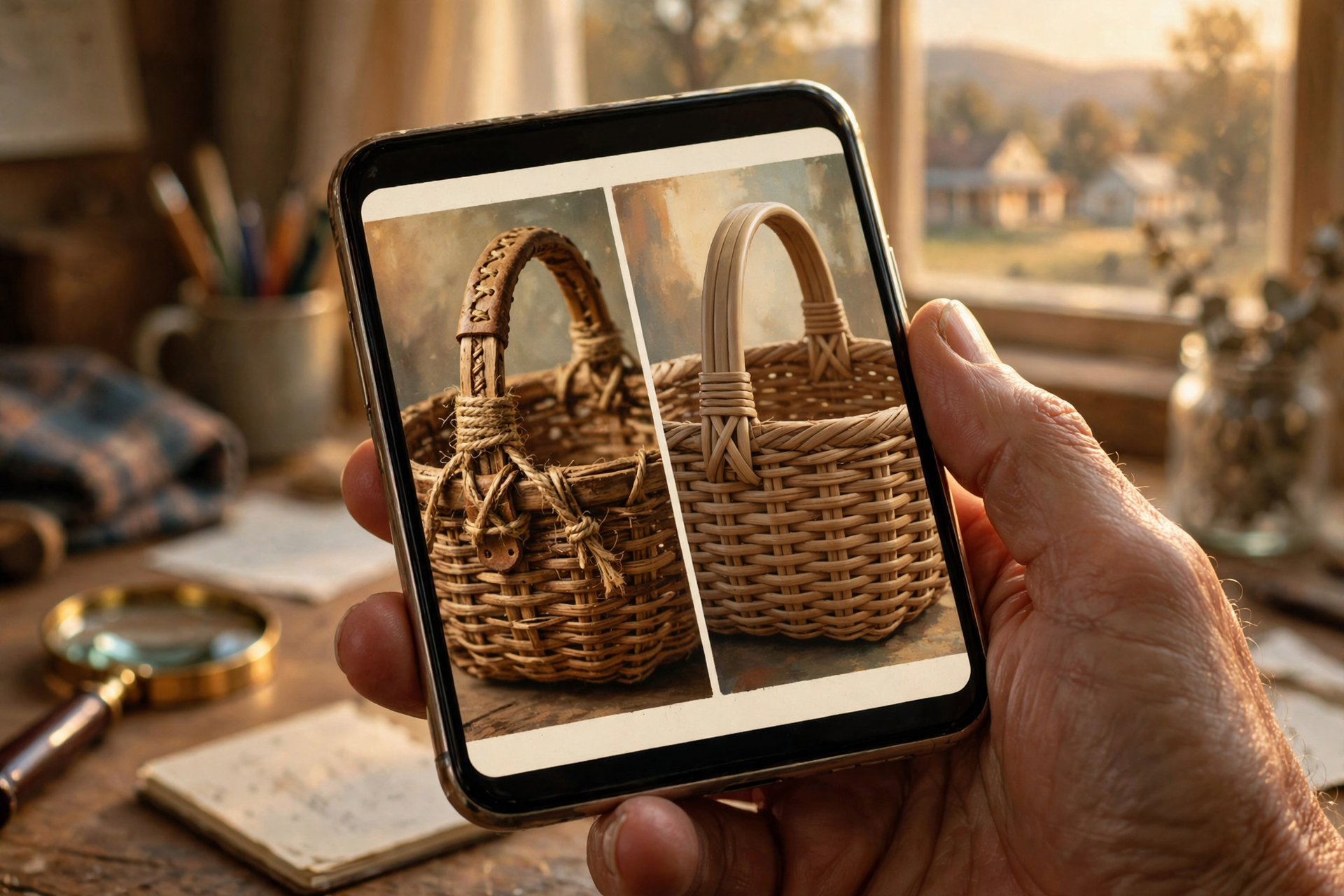
Rather than judging businesses by how sophisticated their websites appear, we should concentrate on conduct and evidence.
There are warning signs that deserve much closer attention.
1. Photographs That Do Not Belong to the Seller
If someone claims to produce handmade knives, furniture, artwork, or specialty products, but their photographs can be traced to another maker, that is a serious reason to investigate.
Sometimes manufacturers provide authorized product photographs to legitimate resellers. That is normal.
But claiming someone else’s work as your own is a very different matter.
When the origin of the product is central to the sales pitch, ask for evidence.
2. A Business Identity That Keeps Changing
A seller may advertise under one name, request payment under another, and provide a third name when questioned.
There can be innocent explanations involving legal entities or payment processors.
But unexplained inconsistencies deserve scrutiny, especially when the seller refuses to clarify them.
3. Pressure to Pay Immediately
Beware of sellers who manufacture emergencies.
“The discount expires in ten minutes.”
“You must send the deposit right now.”
“I cannot hold your order unless you pay before we hang up.”
Real businesses have legitimate deadlines, inventory constraints, and payment policies.
But pressure designed to prevent reasonable verification is a warning sign.
4. Payment Methods That Leave You With Little Protection
Be particularly cautious when an unfamiliar seller insists on gift cards, cryptocurrency, wire transfers, or personal payment transfers that are difficult to reverse.
For unfamiliar online purchases, credit cards generally provide stronger dispute protections.
With contractors, make sure deposits, materials, work stages, and payment terms are documented.
There is nothing automatically wrong with a contractor requesting a reasonable deposit.
The danger is sending substantial money to someone whose identity, work, and agreement you have not verified.
5. Refusal to Provide Reasonable Evidence
If somebody claims to make a specialized product, reasonable questions might include where it is manufactured, what materials are used, whether it is ready to ship, and what happens if it arrives damaged.
For a local contractor, ask about recent work, references, and applicable licensing or insurance.
Some legitimate operators have privacy or security reasons for limiting what they disclose publicly.
That is understandable.
But a seller asking for your money should generally be willing to provide enough appropriate evidence for you to make an informed decision.
6. Reviews That Look Like Advertising Instead of Experiences
Pay attention to what reviewers actually say.
“Amazing company! Best quality! Highly recommended!” may be a sincere review, but it does not tell you very much.
A useful review describes what someone purchased, what happened, and how the business handled the transaction.
Be cautious about large clusters of vague reviews, repeated language, contradictory details, or testimonials that cannot be meaningfully connected to a real experience.
Even photographs and videos should be evaluated in context.
And remember: fake reviews are not merely annoying marketing tactics. The Federal Trade Commission has established rules prohibiting several deceptive review practices, including certain AI-generated fake reviews and testimonials.
The Best Verification Question Is Often the Simplest

Here is a question that works remarkably well in small communities.
“Who has actually done business with these people?”
Not who has seen their advertisement.
Not who liked their Facebook post.
Not who has heard somebody mention the name.
Who has personally purchased a product, hired the contractor, visited the business, or received the service?
Then ask a follow-up question.
“What happened?”
Did the product arrive?
Was the work completed?
Was the price consistent with the agreement?
Did the owner respond when something went wrong?
Would the customer use the business again?
These questions are much more useful than asking whether someone thinks a business is legitimate.
A person’s actual experience provides a foundation for evaluating trust.
Of course, even personal recommendations require judgment. Friends can be mistaken, customers can have different expectations, and dishonest people can create convincing references.
But evidence from independent, firsthand experiences is generally more meaningful than an attractive advertisement.
Our Honest Businesses Are Facing a Quiet Competitive Disadvantage
This is the part of the story that concerns me most.
We sometimes talk about scams as if they are exclusively a problem for the people who lose money.
They are not.
Scams also create problems for honest businesses.
Every fraudulent advertisement competes for attention.
Every fake review can distort a comparison.
Every impersonated business name can confuse a customer.
Every disappointing transaction can make people less willing to trust unfamiliar sellers.
And every sophisticated digital storefront operated dishonestly can make an honest but technologically unsophisticated competitor appear less credible.
Imagine a local craftsman who has spent twenty years building a reputation.
He may have invested thousands of hours in learning his trade.
He may own substantial equipment.
He may have a waiting list of satisfied customers.
Yet someone with almost no investment in the actual craft can assemble a more impressive digital presence.
To a stranger looking at a telephone screen, the wrong business might appear to be the safer choice.
That is a terrible distortion of the marketplace.
And it becomes particularly damaging when local businesses do not recognize that the competition is taking place.
The craftsman may believe he is competing against other craftsmen.
But in the digital marketplace, he is also competing against whoever can produce the most persuasive representation of a craftsman.
Skill and visibility have become two different things. We need to make sure honest businesses do not lose simply because they are better at their work than at promoting it.
The Solution Is Not to Turn Every Farmer Into a Social Media Influencer

I can already imagine the reaction from some of our neighbors.
“So now you’re telling me I’ve got to be on Facebook?”
No.
“I’ve got to build a website?”
Not necessarily.
“I’ve got to start making videos and explaining what I had for breakfast?”
Absolutely not.
The world has enough breakfast photographs.
What I am suggesting is much simpler.
Every legitimate business that wants to be discovered by new customers should consider maintaining a small, accurate, trustworthy digital identity.
Think of it as a roadside sign for the information age.
The sign does not need to be elaborate.
It needs to help people identify the business and understand how to contact it.
For some businesses, that might mean a properly maintained directory listing.
For others, it could mean a simple website.
Some will benefit from a free Google Business Profile if their operations meet Google’s eligibility requirements.
Others may prefer to have a trusted person maintain their public information.
And some businesses will deliberately choose to remain private, serving customers only through established relationships.
That choice deserves respect.
But business owners should understand the tradeoff.
Remaining difficult to find may protect privacy or reduce unwanted inquiries.
It may also prevent new customers from discovering an otherwise excellent business.
Five Things a Local Business Can Do Without Becoming a Technology Company

1. Establish a Consistent Public Name
Choose the business name you want people to recognize and use it consistently.
When appropriate, make sure your directory listing, advertisements, invoices, and other public materials identify the same business.
If you use a trade name different from your legal business name, be prepared to explain the relationship when a customer needs to verify it.
2. Provide One Dependable Way to Reach You
This might be a business telephone number, business email address, contact form, or other method suitable for your operation.
It does not need to be your personal cell phone.
It does not need to reveal your home address.
It simply needs to give potential customers a legitimate way to make contact.
3. Explain What You Actually Do
Many businesses are remarkably difficult to understand online.
Some do several things but only mention one.
Others are listed under the wrong business categories.
Clearly describing your products, services, specialties, and service areas makes it easier for the right customers to find you.
4. Establish Evidence of Your Work
Where practical and appropriate, provide photographs of actual products, completed projects, equipment, or a business location.
Ask satisfied customers to share honest accounts of their experiences if they are comfortable doing so.
Do not manufacture testimonials or pressure people to leave favorable reviews.
One authentic example of completed work can be more valuable than a dozen photographs that tell customers nothing about what your business actually produces.
5. Keep the Information Current
When your telephone number changes, update it.
When your business moves, correct the address or service area where applicable.
When you stop offering a service, remove it from your descriptions.
When you close, let people know.
Outdated information does not automatically make a business suspicious.
But accurate information helps people establish confidence and prevents wasted trips, missed calls, and unnecessary frustration.
None of these steps requires becoming a digital marketing expert.
They simply make it easier for someone who does not already know you to discover that your business exists.
What About People Who Choose to Stay Offline?

Some of our neighbors have perfectly legitimate reasons for limiting their use of technology.
They may not want to operate a website.
They may not want a social media account.
They may not want to manage online reviews.
They may not want their private addresses or personal information scattered across the internet.
I understand those concerns.
In fact, I share many of them.
But there is an important distinction between personally using technology and allowing accurate, appropriate public information about a business to be available.
A business owner might authorize a directory to publish a business name, a general service area, a description of services, and a designated contact method.
That can be done without requiring the owner to operate a social media account or expose private personal information.
Another business might prefer that customers contact an authorized representative.
Some may choose to rely entirely on personal referrals.
There is room for different approaches.
The important principles are accuracy, appropriate permission, privacy, and a clear understanding of what information is being made public.
We should be able to help local businesses become easier to identify without requiring every business owner to surrender personal privacy or adopt technologies they do not want.
Why Local Directories Matter More Than Ever

This brings me back to Dunlap.Directory.
One reason I believe local directories matter is that they can help preserve and organize information that larger platforms may not have.
A national search engine might have thousands of signals about a large company.
It might have very little meaningful information about a skilled tradesperson working from a small shop in Bledsoe County.
That does not mean the small business has less value.
It means the information is harder to obtain.
A locally focused directory can help close that gap.
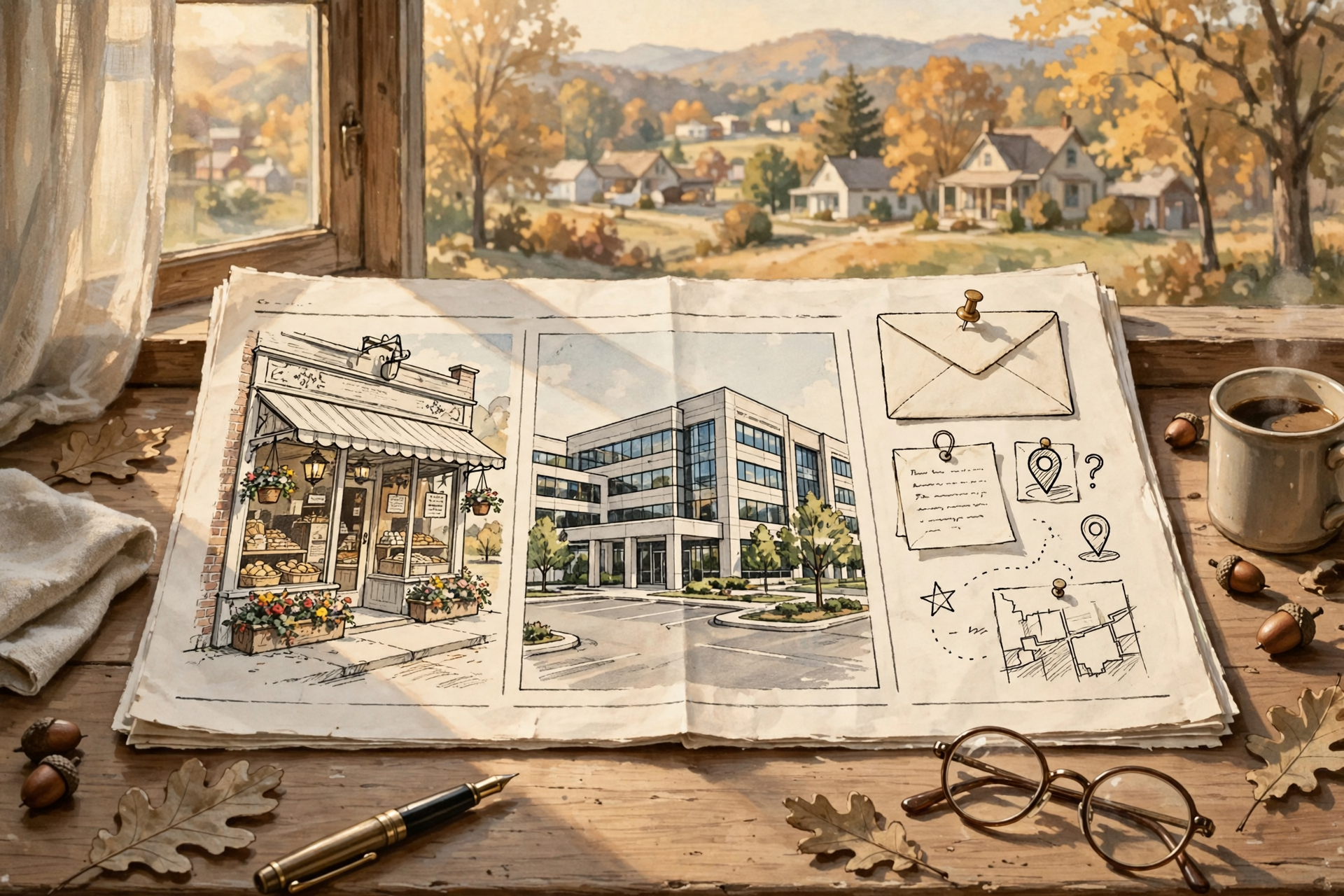
It can document the existence of businesses, describe their services, identify the communities they serve, and provide ways for customers to contact them.
It can also gather corrections and identify information that needs further review.
But directories have to recognize their limitations.
If a listing was assembled from publicly available information, that is different from having communicated directly with an owner.
Communicating with an owner is different from verifying actual work.
Verifying actual work is different from independently evaluating an entire business’s honesty, financial condition, or performance.
Those are different kinds of evidence.
I believe readers deserve to understand the differences.
For that reason, one of the ideas I want to emphasize going forward is a clearer distinction between information that has been submitted, information that has been reviewed, information confirmed directly with a business, and information supported by independent firsthand evidence.
None of those categories should imply a blanket guarantee.
But they can help readers understand what is known, what has been checked, and what remains uncertain.
That is a more useful goal than simply collecting as many business listings as possible.
We Also Need to Rethink How Local News Handles Business Stories
There is another responsibility here, and it belongs to publishers like Dunlap.Today.
When we share information about a business, readers may reasonably interpret that coverage as a sign that somebody has looked into it.
That is particularly true when a story appears alongside reporting about established community organizations, local events, and businesses that readers recognize.
Sometimes a story is based on information supplied by a business.
Sometimes it comes from publicly available announcements.
Sometimes it comes from an outside source or an online promotion.
And sometimes a reader provides information that deserves additional investigation.
These are not all the same thing.
A business announcement should not silently become an endorsement.
An advertisement should not be mistaken for independent verification.
And a concerning allegation should not be presented as a proven finding without sufficient evidence.
The reader who contacted me highlighted exactly why these distinctions matter.
I want our work to become better at identifying the original source of business claims, distinguishing publicity from verified reporting, reviewing credible complaints, and correcting information when evidence shows that we got something wrong.
That may sometimes mean withholding a promotional story while significant questions are investigated.
It may mean asking the business for clarification.
It may mean publishing a correction.
It may also mean concluding that an accusation was unsupported and giving readers that information.
Our responsibility is not to declare everyone suspicious.
It is to investigate responsibly, be candid about uncertainty, and avoid confusing a professional-looking presentation with established fact.
Trust is not created by pretending mistakes never happen. It is strengthened by taking concerns seriously and correcting the record when necessary.
A Simple Checklist for Anyone About to Spend Money

Before buying from an unfamiliar online seller or hiring a business you have never used, consider a few basic questions.
- Who am I dealing with? Can I identify the actual business or individual responsible for the transaction?
- What independent evidence exists? Are there credible references, public records, genuine customer experiences, or examples of completed work?
- Does the story make sense? Do the business name, contact information, products, prices, and payment instructions fit together?
- What am I actually buying? Is the product or service clearly described, including delivery expectations, warranties, and refund terms where applicable?
- How am I paying? Will I have a receipt, a written agreement, and meaningful options if the transaction goes wrong?
- Am I being rushed? Is someone trying to prevent me from asking questions or independently checking the business?
- Can someone with firsthand experience confirm the business performs as promised? Not merely that they have heard the name, but that they have completed a transaction.
You do not need to spend three days investigating a purchase of ordinary household supplies.
But the larger the transaction, the less familiar the seller, and the harder the payment is to reverse, the more verification makes sense.
And if a seller becomes hostile because you want to ask reasonable questions before sending money, that tells you something worth considering.
What If You Discover Something Suspicious?

First, avoid making an accusation based entirely on appearances.
A strange telephone number, a missing website, an unfamiliar accent, an inactive Facebook page, or a private address is not enough to establish fraud.
Instead, document the concern.
Save the advertisement, relevant screenshots, the business name, the website address, and any transaction information you can lawfully retain.
If you believe an image was stolen, record where the original appeared and why you believe the material was reused without authorization.
If you paid for something that never arrived, preserve your receipt, correspondence, and delivery promises.
If you suspect fraud, you can report the matter to the Federal Trade Commission at ReportFraud.ftc.gov.
If you have already made a payment, contact your bank, card issuer, or payment provider promptly to discuss available protections.
And when you warn other people, distinguish between what you personally experienced, what you can document, and what you suspect.
There is nothing wrong with saying, “I ordered a product on this date, paid this amount, and have not received what was promised.”
That is a factual account that other people can evaluate.
It is much more useful than forwarding an unsupported accusation with a dozen exclamation marks.
The Worst Outcome Would Be Losing Trust in Everyone

There is another danger that receives too little attention.
When people encounter enough deception, they can begin treating every unfamiliar business as suspicious.
That may sound like caution, but it can become a serious disadvantage for honest newcomers and small businesses.
A young person starting a repair service may have no reviews because the business is new.
A family opening a farm stand may not have a website.
An experienced craftsman may have no digital portfolio.
A business operated by someone who values privacy may have little public information.
None of those facts establishes dishonesty.
In fact, one of the best things a community can do is help good businesses become known without expecting them to spend years accumulating followers or purchasing advertising.
We should be skeptical of claims, not prejudiced against unfamiliar people.
We should verify transactions, not judge trustworthiness by someone’s technology preferences.
And we should recognize that an impressive online presence can be purchased or manufactured, while a genuine local reputation usually requires something much harder to obtain.
Time.
Service.
Accountability.
And customers who are willing to recommend you because you earned it.
What I Would Like Our Community to Do

I would like to turn this experience into something constructive.
If you know a legitimate business in the Sequatchie Valley that does good work but is difficult to find online, tell us about it.
Perhaps it is a repair shop.
Perhaps it is a small farm.
Perhaps it is a cabinetmaker, welder, electrician, landscaper, equipment operator, or specialty manufacturer.
Perhaps it is a family business that has operated for decades without ever needing a website.
Or perhaps it is a relatively new business that simply has not figured out how to establish a dependable public presence.
Help us identify those businesses and, where appropriate, connect with the owners to confirm what information they want shared.
We do not need their personal information.
We do not need to publish their private addresses.
We do not need to force them onto social media.
We need accurate information, appropriate permission, and a practical way for interested customers to learn about their products or services.
At the same time, if you encounter an online business promotion that raises serious concerns, share the evidence with us privately so it can be evaluated.
Tell us what you know firsthand.
Explain what appears inconsistent.
Provide supporting information where possible.
And allow the difference between suspicion and proof to remain clear.
I would much rather investigate a concern carefully than accidentally harm an honest business through an unsupported public accusation.
We owe that consideration to both our readers and our neighbors.
A Final Thought About the Future of the Valley

There is something rather remarkable about the situation we find ourselves in.
We are living in an age when computers can generate realistic photographs of products that do not exist, write persuasive advertisements for businesses they have never visited, and answer questions about companies they have never independently investigated.
Meanwhile, somewhere in the Sequatchie Valley, there is probably a man standing in a workshop who knows exactly how to repair something the rest of us would throw away.
He may have forty years of experience.
He may have served hundreds of satisfied customers.
He may possess more practical knowledge about his trade than a thousand online advertisements could describe.
And he may be almost impossible to find with a smartphone.
That is not a failure of his craftsmanship.
But it is increasingly a problem for his business and for the customers who could benefit from his work.
We have spent generations building a local culture in which reputation matters.
Now we must figure out how to carry the useful parts of that culture into an information environment where people often encounter the advertisement before they encounter the person.
We do not need to abandon word-of-mouth recommendations.
We need to make trustworthy local knowledge easier to discover.
We do not need to force every business to become a technology company.
We need to make sure technology does not automatically favor whoever is best at pretending to be a business.
And we do not need to believe everything an artificial intelligence system tells us.
We need to ask what evidence supports the answer.
I appreciate the reader who called our attention to the suspicious online promotion.
That reader did exactly what I hope more people will do: notice something questionable, raise the concern, and give us an opportunity to investigate.
It is a useful reminder that the best information system still needs people who care whether the information is true.
Because the long-term risk is not simply that scammers will become more convincing.
It is that honest businesses may become harder to recognize than the scammers pretending to be them.
And if we let that happen, the Sequatchie Valley will lose something much more valuable than a few search-engine positions.
We will lose opportunities to support the people who actually live here, work here, serve our communities, and stand behind what they do.
That is worth protecting.
One business, one customer, and one verified fact at a time.
Help Us Find the Businesses Worth Knowing

Do you know a trustworthy local business that is almost impossible to find online?
We would like to hear about it.
Visit Dunlap.Directory and help us identify the small businesses, craftspeople, service providers, and family enterprises that deserve to be easier for customers to discover.
If you are a business owner, take a few minutes to look at how your business appears online. Is the information correct? Can new customers understand what you do? Can they find an appropriate way to contact you?
And if you know somebody starting a business, share this article with them. Establishing a trustworthy public identity is becoming just as important as making a good first impression in person.
If you have credible information about a potentially fraudulent promotion, please contact Dunlap.Today with the supporting details rather than publicly accusing someone without evidence.
Our communities benefit when honest businesses can be found, questionable claims can be examined, and customers can make decisions based on facts instead of appearances.
And to the reader who brought this issue to my attention: thank you. Your willingness to question what we published may help protect others.
Sources and Further Reading
The national fraud statistics and consumer guidance discussed in this article come from the Federal Trade Commission. Business registration and online listing information are supported by official Tennessee and Google resources. The local business examples are illustrative, and no specific seller has been independently established as fraudulent by this article.
- Federal Trade Commission: Reported Losses to Social Media Scams Eight Times Higher Than in 2020
- Federal Trade Commission: Imposter Scam Losses and 2025 Fraud Data
- Federal Trade Commission: How to Avoid Online Shopping Scams
- Federal Trade Commission: Consumer Reviews and Testimonials Rule
- Tennessee Secretary of State: Business Services and Entity Records
- Google Business Profile: Free Business Listings
- Google Business Profile: Address and Privacy Guidance
Editor’s Note: This article addresses the difference between legitimate businesses with limited online visibility and deceptive online business practices. The concerns that prompted the article remain distinct from any formal finding of fraud. Dunlap.Today welcomes documented corrections, relevant firsthand experiences, and responses from businesses about information published concerning their operations.
Know about an upcoming event or story in the Sequatchie Valley? Submit it here.



0 Comments