

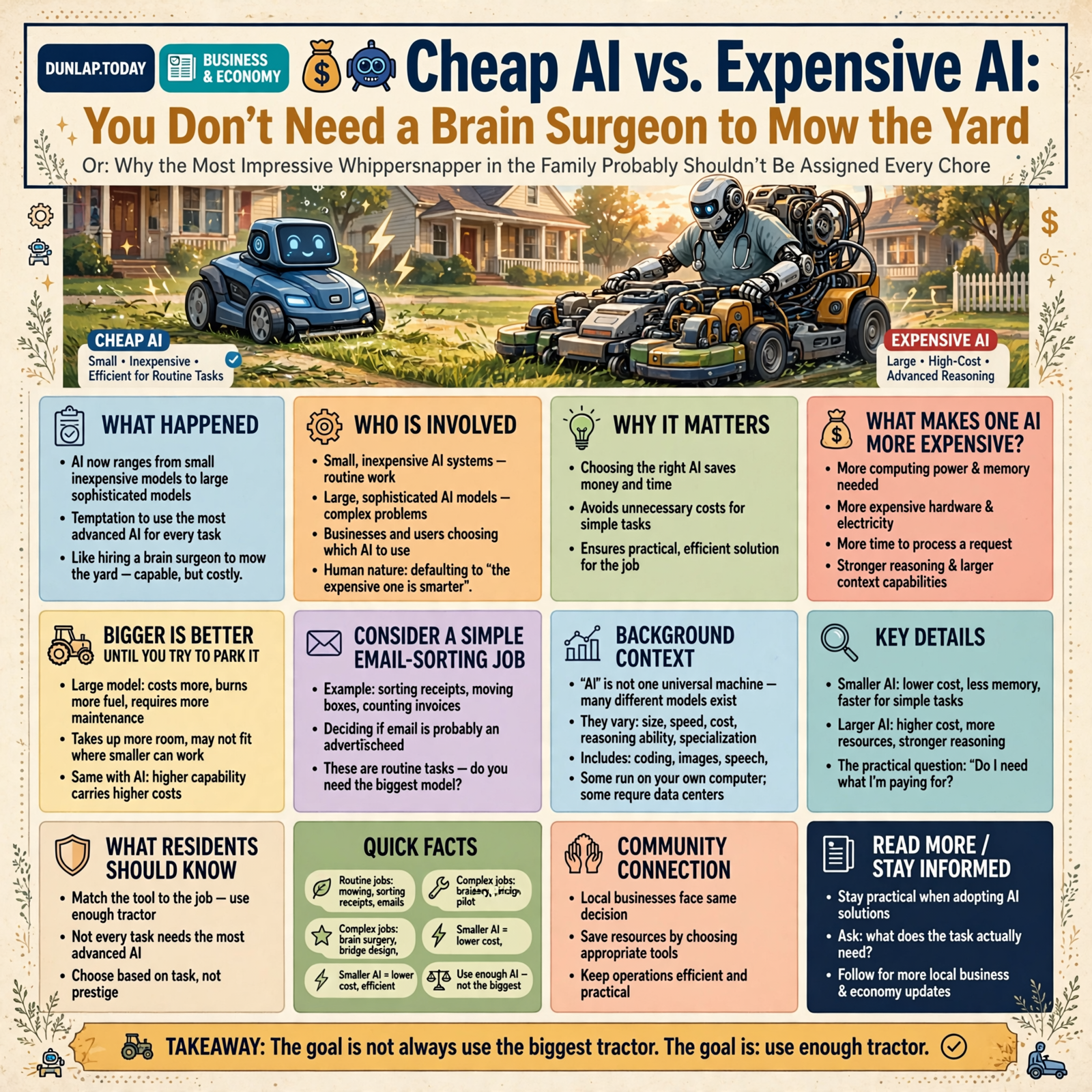
💰🤖 Cheap AI vs. Expensive AI: You Don’t Need a Brain Surgeon to Mow the Yard

Or: Why the Most Impressive Whippersnapper in the Family Probably Shouldn’t Be Assigned Every Chore
There are certain jobs for which extraordinary qualifications are useful.
Brain surgery comes to mind.
Designing a suspension bridge.
Landing an airplane in a thunderstorm.
Rebuilding an automatic transmission when three mysterious springs have already rolled under the workbench.
For jobs like these, experience matters.
Capability matters.
You want the best person you can reasonably get.
Then there are other jobs.
Mowing the yard.
Sorting receipts.
Moving boxes.
Counting how many invoices arrived.
Deciding whether an email is probably an advertisement.
You could theoretically hire a neurosurgeon to perform these tasks.
The neurosurgeon might do an excellent job.
But after receiving the bill, you may begin wondering whether somebody else could have pushed the mower.
Artificial intelligence is developing the same problem.
We now have AI models ranging from small, inexpensive systems capable of routine work to enormous, sophisticated models capable of handling much more difficult problems.
And human nature being what it is, we are tempted to assume:
“If the expensive one is smarter, let’s use it for everything.”
That is approximately how you end up with a brain surgeon mowing the yard.
🧠 Not All AI Is the Same Size

When people say “AI,” it can sound as though there is one universal machine somewhere answering everybody’s questions.
There is not.
There are many different models.
They vary in:
- size,
- speed,
- cost,
- reasoning ability,
- specialization,
- memory requirements,
- hardware requirements,
- and the kinds of work they perform well.
Some are enormous general-purpose models.
Some are smaller.
Some are designed for coding.
Some for images.
Some for speech.
Some for classification.
Some can run on your own computer.
Some require enormous data centers.
Calling all of these simply “AI” is a little like calling everything in the equipment shed:
“a machine.”
Technically true.
Not especially useful when you’re trying to choose between a weed eater and a bulldozer.
💵 What Makes One AI More Expensive Than Another?

There are several reasons one AI system may cost more to use.
A larger model may require:
- more computing power,
- more memory,
- more expensive hardware,
- more electricity,
- and more time to process a request.
A provider may also charge more because the model offers stronger reasoning, larger context, specialized capabilities, or access to more advanced tools.
The customer usually sees this as:
“This model costs more.”
Behind that simple price difference may be an astonishing amount of machinery.
The important question, however, is not:
“Why is this one expensive?”
The practical question is:
“Do I need what I’m paying for?”
🚜 Bigger Is Better Until You Try to Park It

Farm equipment provides a useful lesson.
A giant tractor may pull more than a small tractor.
That does not make it better at everything.
The giant tractor:
- costs more,
- burns more fuel,
- requires more maintenance,
- takes up more room,
- and may not fit where the smaller machine can work easily.
The same thing happens with AI.
A large model may have more capability.
But capability carries costs.
If the job is simple, the extra capability may provide little practical benefit.
The goal is not:
always use the biggest tractor.
The goal is:
use enough tractor.
📨 Consider a Simple Email-Sorting Job

Suppose your business receives 1,000 emails each day.
You want AI to classify each one as:
- customer inquiry,
- invoice,
- order,
- spam,
- or something needing human attention.
This is not necessarily advanced reasoning.
A smaller model may perform the job very reliably.
If so, paying for the most powerful available AI 1,000 times a day accomplishes little except making the bill feel important.
You are not asking the system to interpret quantum mechanics.
You are asking:
“Is this an invoice?”
There is a point at which additional intelligence stops improving the answer.
A thirteen-year-old who knows how to identify a chicken does not become more useful at chicken identification merely because you replace him with a veterinarian.
🧮 Some Jobs Barely Need AI at All

Here is another useful correction.
Sometimes the cheapest AI is:
no AI.
Suppose the problem is:
“Add these numbers.”
Use a calculator.
Suppose the problem is:
“Find all invoices older than 30 days.”
A database query may be better.
Suppose the problem is:
“If the value is greater than 100, mark it red.”
Ordinary software can handle that perfectly well.
Artificial intelligence is useful partly because it handles messy problems involving language, ambiguity, patterns, and judgment.
It is not automatically the best answer to every computational problem.
You do not call a philosopher to count fence posts.
🧰 The Cheapest Reliable Tool Is Often the Best Tool

Suppose you need to tighten one bolt.
You have:
- a $12 wrench,
- a $300 torque wrench,
- and a $40,000 robotic assembly system.
If the $12 wrench reliably does the job, there is no prize for choosing the robot.
AI economics works similarly.
The correct question is not:
“What is the cheapest model?”
Nor is it:
“What is the smartest model?”
The useful question is:
“What is the least expensive system that reliably meets the requirements of this job?”
That word matters:
reliably.
Cheap AI that produces bad work is not cheap.
It is merely an invoice you have not fully calculated yet.
📉 Cheap Mistakes Can Become Expensive

Suppose a small inexpensive model saves you $50 per month.
Wonderful.
Then it incorrectly handles one $5,000 customer order.
Your cost savings have experienced a setback.
The real cost of AI includes more than the model fee.
It can include:
- mistakes,
- human correction time,
- customer dissatisfaction,
- missed opportunities,
- rework,
- and operational risk.
This is why “cheapest” and “lowest cost” are not necessarily the same thing.
A $3 hammer that breaks every Tuesday is not cheaper than the $20 hammer you keep for ten years.
🎯 This Is Why Task Difficulty Matters

Some AI jobs are easy.
Some are difficult.
Easy tasks might include:
- classification,
- simple extraction,
- formatting,
- basic summarization,
- rewriting standard text,
- or identifying obvious patterns.
Harder tasks might involve:
- complex reasoning,
- ambiguous evidence,
- large strategic decisions,
- difficult computer programming,
- multi-step research,
- or unfamiliar situations requiring careful judgment.
The model should match the difficulty.
You do not send the youngest farmhand to diagnose a hydraulic failure.
You do not call the equipment dealer because somebody forgot to put fuel in the mower.
Correct assignment matters.
🚦 This Is Exactly Why We Need AI Routing

In the previous article, we discussed AI routing.
Routing is simply deciding which model, agent, tool, or human receives a particular job.
Cost is one of the most important reasons routing exists.
A router might say:
“This is easy. Use the inexpensive model.”
Then:
“This appears complicated. Use the stronger model.”
Then:
“This is sensitive. Keep it local.”
Then:
“This involves substantial risk. Send it to a human.”
The result can be much more economical than sending every request to the most expensive AI available.
Good routing is basically intelligent thrift.
🪜 Start Cheap, Then Escalate

One useful pattern is escalation.
Let the smaller model try first.
If it completes the job confidently and correctly, stop.
If it struggles, send the task upward.
For example:
- Small inexpensive model attempts the task.
- A check determines whether the result appears acceptable.
- A stronger model handles failures.
- A human receives the truly difficult or consequential cases.
This resembles a repair shop.
The apprentice looks first.
If the problem is:
“The battery cable is loose,”
there is no need to wake the master mechanic.
If the apprentice says:
“There’s metal in the transmission fluid,”
perhaps we escalate.
🧑⚖️ Judge Models Can Help Decide Whether Cheap AI Was Good Enough

Our recent article introduced AI judge models—systems that evaluate the work of other AI.
This creates an interesting cost-saving pattern.
A smaller model performs the job.
A reviewer checks:
“Did this meet the standard?”
If yes, done.
If no, send it to something stronger.
That sounds efficient.
But notice something important:
the judge costs money too.
You must consider the whole workflow.
If the cheap model costs one cent and the judge costs nine cents, the system may not be as inexpensive as the first price suggests.
Never calculate the cost of one whippersnapper while ignoring the three standing behind him.
🏠 Local AI Can Change the Economics Again

Earlier in the series, we discussed local AI.
Local models run on hardware you control.
That creates a different cost structure.
Instead of paying each time the AI works, you may pay for:
- hardware,
- electricity,
- maintenance,
- and the time required to operate the system.
If you have a repetitive workload, local AI can become attractive.
Imagine processing 100,000 small documents every month.
Paying a cloud provider for every request may become expensive.
Running a smaller local model may be economical.
But if you only process fifty documents per month, buying a powerful AI workstation may resemble purchasing a combine to tend a window box.
☁️ Cloud AI Lets You Rent Extraordinary Intelligence

Cloud AI has an important economic advantage.
You can access very powerful systems without owning the machines required to run them.
This is one of the remarkable features of modern computing.
A tiny business can temporarily use resources that would once have required enormous capital investment.
That is similar to renting specialized heavy equipment.
You might never afford to own a giant crane.
But if you need one for Tuesday afternoon, renting one can be perfectly sensible.
The key is not turning the rented crane into your permanent mailbox-opening solution.
🧠 Small Models Are Becoming Surprisingly Capable

One reason this discussion matters is that smaller AI models can be remarkably useful.
They may not match the largest systems on every difficult benchmark or reasoning problem.
But that may not matter for the work you actually have.
A smaller model might be excellent at:
- categorizing documents,
- extracting names and numbers,
- summarizing standard reports,
- routing messages,
- identifying topics,
- rewriting text,
- or answering questions from a well-organized knowledge base.
This is where specialization can outperform extravagance.
A good border collie may manage sheep better than a very intelligent college professor.
That does not make the professor stupid.
It means the dog has the correct job.
📚 RAG Can Let a Smaller Model Punch Above Its Weight

We have also discussed RAG—Retrieval-Augmented Generation.
That is the system where we send the whippersnapper to the filing cabinet before letting him answer.
RAG can make smaller models much more useful.
Why?
Because the model does not have to know everything.
It needs to:
- understand the question,
- read the relevant records,
- and produce a useful answer from the evidence.
A smaller AI with excellent information may outperform a larger AI guessing from general knowledge.
A smart stranger may know more about tractors than your teenage grandson.
But your grandson knows exactly which drawer contains the maintenance records for your tractor.
Context matters.
🔧 Specialized Models Can Beat General Models at Specific Jobs

Imagine two workers.
One is broadly talented.
He can:
- write,
- research,
- calculate,
- program,
- and discuss nearly anything.
The other performs one particular task all day.
For that narrow task, the specialist may be faster and cheaper.
AI works similarly.
A specialized system may be ideal for:
- speech recognition,
- image generation,
- OCR,
- translation,
- coding,
- classification,
- or search.
The giant general-purpose model may be able to help.
That does not mean it should get every job.
⏱️ Expensive AI Can Also Cost You Time

Cost is not only dollars.
A larger, more complicated model may take longer to respond.
For a difficult research problem, that extra time may be worthwhile.
For a customer waiting for a simple answer, it may not be.
Suppose your system needs to decide:
“Is this message an invoice or not?”
If a small model answers in a fraction of a second, wonderful.
If the premium reasoning model spends thirty seconds thoughtfully considering the philosophical nature of invoices, somebody has overengineered the chore.
Speed is part of value.
📏 Quality Has a Point of Diminishing Returns

Suppose a small model performs a task correctly 97 times out of 100.
A more expensive model performs it correctly 98 times.
The larger model costs ten times as much.
Is the additional one percent worth the additional cost?
Maybe.
Maybe not.
It depends on what happens when the model is wrong.
If the task is:
“Categorize newsletter topics,”
perhaps 97 percent is excellent.
If the task involves:
“Identify whether this industrial machine should be shut down immediately,”
the equation changes considerably.
The value of extra accuracy depends on the consequences.
⚠️ Risk Determines How Much Intelligence You Can Afford to Save

A cheap model can be perfectly appropriate for low-risk work.
Examples:
- drafting internal notes,
- tagging documents,
- summarizing routine material,
- classifying public content.
Higher-risk work deserves more caution.
Examples:
- large financial decisions,
- safety-related actions,
- legal commitments,
- sensitive customer situations,
- major system changes,
- or decisions difficult to reverse.
You may use a stronger model.
You may use additional verification.
You may require human approval.
The question becomes:
“What is the cost of getting this wrong?”
That number often matters more than the model price.
🔄 Cheap First, Expensive Only When Needed

This can become a general operating principle.
Imagine 1,000 tasks.
Perhaps:
- 800 are easy,
- 150 are moderate,
- 40 are difficult,
- and 10 require a human.
If all 1,000 go directly to the premium AI, you pay premium prices for 800 easy jobs.
A better system may route:
- the easy 800 to inexpensive AI,
- the moderate 150 to something stronger,
- the difficult 40 to the premium system,
- and the final 10 to people.
This is a digital version of a well-run business.
Not every question reaches the owner.
If every question does reach the owner, the business has a management problem.
📊 You Need Measurements, Not Impressions

There is a danger in model selection.
People can become impressed by expensive systems.
A larger model may:
- write more elegantly,
- sound more confident,
- produce longer explanations,
- or generally feel more sophisticated.
That does not necessarily mean it performs your specific task better.
Test it.
Measure:
- accuracy,
- cost,
- response time,
- failure rate,
- human correction rate,
- and overall business outcome.
You may discover the fancy whippersnapper is worth every penny.
You may discover his younger brother does the chore just as well for lunch money.
Either result is useful.
🧪 Build a Test Set Before You Pick a Winner

A practical business can create a representative collection of real tasks.
Perhaps 100 examples.
Run the same work through:
- the inexpensive model,
- the middle model,
- the premium model,
- and whatever existing human process you already use.
Then compare results.
Do not test only easy cases.
Include:
- routine cases,
- messy cases,
- ambiguous cases,
- unusual cases,
- and known failures.
You are trying to discover where each model begins to struggle.
That boundary is often more useful than a general ranking.
💰 Calculate Cost Per Successful Job

Here is a better number than raw model price:
cost per successful job.
Suppose:
Model A costs one cent per task.
Model B costs ten cents.
Model A frequently produces errors requiring employee correction.
Model B rarely does.
The true cost includes that employee time.
Now perhaps Model A costs:
one cent plus three minutes of Sharon.
Three minutes of Sharon may be substantially more expensive than nine additional cents.
Business arithmetic should include the whole workflow.
Sharon is not free because her salary appears somewhere else in the accounting system.
👷 Cheap AI Can Be an Excellent Apprentice

A useful way to think about smaller models is not:
“inferior AI.”
Think:
“apprentice.”
An apprentice can handle:
- routine work,
- first drafts,
- sorting,
- basic checks,
- and straightforward assignments.
Then difficult situations move to the experienced worker.
A well-run shop does not demand master-level craftsmanship from every task.
It creates a progression.
This can be a useful design pattern for AI too.
🧑🏫 Expensive AI Can Be the Senior Whippersnapper

The larger model may act more like:
- the senior technician,
- the manager,
- the researcher,
- or the problem solver you call when the ordinary process breaks.
That is valuable.
But it becomes more valuable when reserved for work deserving that capability.
Imagine paying your most experienced mechanic $125 an hour.
You want him diagnosing the difficult electrical problem.
You probably do not want him spending Tuesday afternoon washing hubcaps.
Using expensive intelligence wisely respects the intelligence.
👥 Multi-Agent Systems Can Accidentally Multiply the Bill

Our multi-agent article introduced teams of AI systems.
Those teams create additional cost considerations.
You may have:
- a researcher,
- an analyst,
- a writer,
- a judge,
- a supervisor,
- and a router.
If every member of this digital department uses a premium model for every action, costs can multiply quickly.
Perhaps the researcher needs strong reasoning.
Perhaps the formatting agent does not.
Perhaps the router can use a tiny model.
Perhaps the final judge deserves something stronger.
Even inside one workflow, different roles may justify different levels of intelligence.
You do not pay everybody in the company the CEO’s salary merely because they are working on the same project.
🔐 Privacy Can Change What “Cheap” Means

Suppose a cloud model appears cheaper than local AI.
But using it would require sending sensitive records outside your environment.
Perhaps your business decides that is inappropriate.
Then the cheaper price is irrelevant.
Likewise, perhaps maintaining local AI requires expensive staff and hardware while the cloud provider already meets your requirements.
Then local control may cost more than it is worth.
Price exists inside constraints.
You cannot evaluate model cost separately from:
- privacy,
- security,
- compliance,
- availability,
- and operational requirements.
The cheapest hammer is not useful if you are not allowed to bring it onto the job site.
🏪 Small Businesses Should Care About This More Than Big Companies

A large company may be able to waste thousands of dollars on inefficient AI experiments without noticing immediately.
A small business feels inefficiency faster.
That makes model selection especially important.
A small company can ask:
“Which tasks actually create value?”
“Which tasks can a small model handle?”
“Where do we really need premium AI?”
“Can repetitive work run locally?”
“Can humans review only the exceptions?”
This can turn AI from another subscription bill into an actual productivity system.
That distinction matters.
💳 Beware the Five-Dollar Task With Fifty Cents of Value

AI makes it possible to automate many things.
That does not mean every automation makes economic sense.
Suppose an AI workflow costs $5 each time it runs.
It saves an employee one minute.
That may not be a triumph.
Automation should create value greater than its full cost.
The calculation may include:
- labor saved,
- errors prevented,
- faster response,
- new revenue,
- better customer service,
- or information that improves decisions.
Sometimes AI is worthwhile even when it does not reduce labor.
But somebody should know why it is worthwhile.
Otherwise the whippersnapper may be very busy doing work nobody needed.
🧾 Track AI Spending Like Any Other Business Expense

If AI becomes part of regular operations, its cost should be measurable.
A business should eventually be able to answer questions such as:
“What did AI cost us this month?”
“Which workflows consumed the most?”
“Which model generated those costs?”
“What business value did we receive?”
“Are there jobs we should move to cheaper models?”
“Are there jobs where cheap models create too much rework?”
This is not anti-AI.
This is accounting.
Grandpa tracked diesel because tractors were useful, not because he hated tractors.
📈 Cheap Today Does Not Mean Cheap Forever

Artificial intelligence pricing changes.
Models improve.
Hardware improves.
Competition changes.
A task that is expensive today may become inexpensive later.
A local model that seemed weak last year may become good enough this year.
A premium cloud model may become cheaper.
Or a provider may change prices in the other direction.
This means routing and model selection should not be treated as permanent decisions.
Reevaluate occasionally.
Farmers compare seed, fertilizer, fuel, and equipment costs every season.
AI deserves the same lack of sentimentality.
🛑 Do Not Optimize Cost Until the System Actually Works

This is another useful principle.
First make the workflow reliable.
Then optimize it.
If the process does not work, making it cheaper merely allows you to fail economically.
Start with something that reliably performs the task.
Measure it.
Then ask:
“Can a cheaper model do the same thing?”
This is much safer than beginning with:
“What’s the cheapest AI available?”
and hoping it happens to understand your business.
🎯 Premium AI Should Earn Its Premium

A more expensive model should provide something valuable in exchange.
Perhaps:
- better reasoning,
- fewer errors,
- better instruction following,
- stronger coding,
- better use of tools,
- more reliable analysis,
- or the ability to solve problems smaller models cannot.
If the premium system produces meaningfully better outcomes, wonderful.
Pay for it.
If it performs no better on your actual workload, paying more is not sophistication.
It is decoration.
👴 Older Folks Already Understand This Entire Subject

Artificial intelligence companies may discuss:
inference cost.
model tiers.
parameter counts.
latency.
throughput.
routing optimization.
Those concepts matter.
But the business question is old.
Do I hire the apprentice?
Do I hire the master?
Do I buy the tool?
Do I rent the tool?
Can I do this in-house?
What happens if somebody gets it wrong?
What does the whole job actually cost?
Every sensible shop owner has asked those questions.
AI has simply provided new equipment for the shop.
🐓 Wisdom From the Front Porch

There is something deeply tempting about always choosing the most powerful artificial intelligence available.
It feels safe.
It feels sophisticated.
It feels like buying quality.
Sometimes it is exactly the right decision.
But good management is not about buying the most expensive thing.
It is about matching resources to needs.
The smartest AI model may deserve the hardest problem.
The smaller AI may deserve the routine work.
A calculator may deserve the arithmetic.
A database may deserve the filtering.
A human may deserve the important judgment call.
And nobody deserves a committee meeting to determine whether the office printer is out of paper.
As AI becomes more common, successful businesses may discover that the real advantage does not come from owning access to the fanciest model.
Everybody may eventually have access to impressive models.
The advantage may come from knowing:
when expensive intelligence matters
and
when it does not.
So when somebody proudly announces:
“We’re using the most advanced AI available for every workflow,”
you might ask:
“Every workflow?”
Then look toward the fellow pushing the mower.
If he has twelve years of medical school, a surgical fellowship, and a pair of grass-stained New Balances…
there may be room for optimization.
Because a brain surgeon can probably mow the yard.
That does not mean the yard requires a brain surgeon.
— Dunlap.Today
📚 Plain-English AI Glossary

💰 AI Inference Cost: The computing or service cost involved when an AI model processes a request and produces an output.
🧠 Large Model: A comparatively powerful AI model requiring more computing resources and often capable of handling more difficult tasks.
🪶 Small Model: A lighter AI model that may run faster and more cheaply while still performing many routine or specialized tasks effectively.
🎯 Specialized Model: An AI model designed or selected for a narrower category of work rather than general-purpose use.
🚦 AI Routing: Choosing which model, agent, tool, or human should receive a particular task.
🪜 Escalation: Moving a task to a more capable model or person when the first level cannot handle it reliably.
📊 Cost Per Successful Job: The total cost required to produce an acceptable result, including model usage, retries, human correction, and related workflow costs.
⚡ Latency: The amount of time between submitting a request and receiving a result.
📈 Diminishing Returns: The point at which spending more produces progressively smaller improvements.
🏠 Local AI: Artificial intelligence running on hardware controlled by the user or organization.
☁️ Cloud AI: Artificial intelligence running on remote infrastructure and accessed through a network or Internet connection.
❓ Frequently Asked Questions

Is expensive AI always better?
No. More expensive models may provide stronger capability, but simpler tasks may receive little or no meaningful benefit from that extra intelligence.
Can small AI models be useful for business?
Yes. Smaller models can be effective for tasks such as classification, extraction, summarization, routing, document processing, and other routine work.
Why not always use the cheapest model?
A model that creates frequent errors, rework, customer problems, or human correction can cost more overall even if its per-request price is lower.
How should a business choose an AI model?
Test representative real-world tasks and compare quality, cost, speed, failure rate, human correction needs, privacy requirements, and the consequences of mistakes.
What does “cost per successful job” mean?
It means calculating the total amount required to obtain an acceptable result rather than looking only at the listed model price. Retries, human review, errors, and other workflow expenses matter too.
Can businesses start with a cheap model and escalate difficult tasks?
Yes. A common pattern is to let a smaller or less expensive model handle routine work and escalate uncertain or difficult cases to stronger models or humans.
Can RAG make smaller models more useful?
Yes. Giving a smaller model relevant source material can allow it to answer specific questions effectively without requiring the model to contain all knowledge internally.
Does local AI eliminate model costs?
It can eliminate or reduce per-request provider fees, but local AI still carries costs for hardware, electricity, maintenance, storage, security, and administration.
Should high-risk work use stronger models?
Often yes, but model strength is only part of the solution. High-risk work may also require better evidence, objective verification, guardrails, and human approval.
How often should businesses reevaluate which AI models they use?
Periodically, because model quality, hardware, pricing, and available alternatives change. A routing decision that made sense previously may become unnecessarily expensive or insufficient later.
✅ The Front-Porch AI Cost Checklist

Before sending every chore to the most expensive whippersnapper in town, ask:
- ✅ How difficult is this task really?
- ✅ Could ordinary software solve it without AI?
- ✅ Could a smaller AI model handle it reliably?
- ✅ Does a specialized model fit the job better?
- ✅ How often will this task run?
- ✅ What is the cost per request?
- ✅ What is the cost per successful job?
- ✅ How much employee correction does the cheaper model require?
- ✅ What happens financially if the model is wrong?
- ✅ Does the premium model produce meaningfully better results?
- ✅ Could RAG make a smaller model sufficient?
- ✅ Could the work run locally at lower long-term cost?
- ✅ Should easy cases start cheap and escalate only when necessary?
- ✅ Are judge models or extra agents quietly multiplying the workflow cost?
- ✅ Are we measuring response time as well as dollar cost?
- ✅ Are privacy or security requirements limiting our choices?
- ✅ Are we tracking total AI spending by workflow?
- ✅ Have model prices or capabilities changed enough to justify reevaluation?
The practical rule is simple:
Use all the intelligence the job requires.
Just don’t hire a brain surgeon because the grass got tall.




0 Comments