
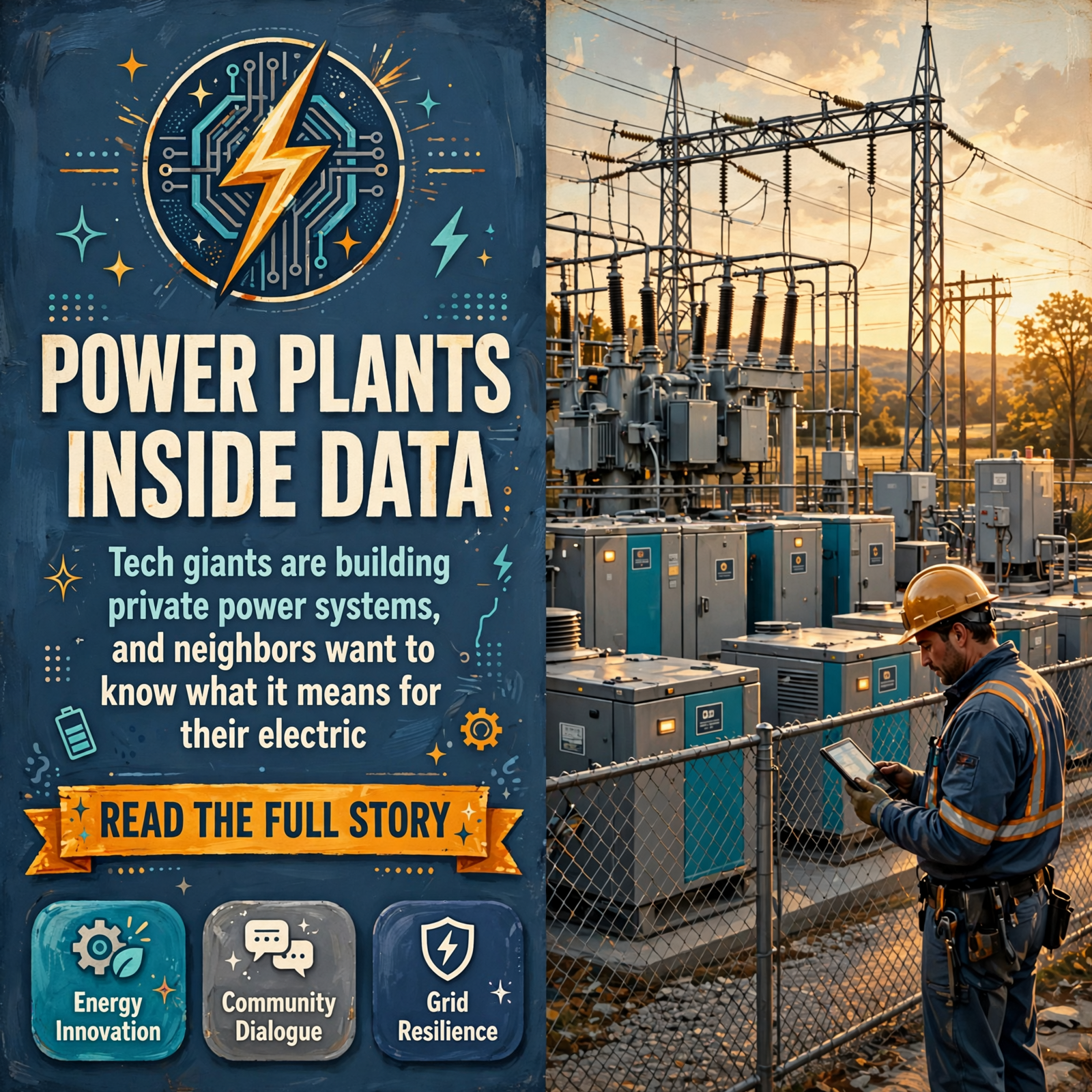
⚡ How AI Data Centers Are Building Their Own Power Plants – and Why Communities Are Watching
As artificial intelligence infrastructure expands across the country, a fundamental shift is reshaping how data centers operate. Major tech companies are no longer waiting for utility grids to catch up; they’re building private power systems on their own campuses-a trend that raises important questions about energy supply, community impact, and the future of local electricity costs.
📍 The Grid Bottleneck: Why Companies Are Going Solo
The traditional power grid simply cannot keep pace with AI demand. In the tightest markets worldwide, new grid connections can take 7 to 10 years-London faces an 8-year wait, Amsterdam up to 10 years, and Northern Virginia, the world’s largest data center market, averages around 7 years. Meanwhile, data center buildings themselves are completed in just 18 to 24 months. The mismatch has forced hyperscalers to take matters into their own hands. 🏗️
In 2025 alone, approximately 50 gigawatts of behind-the-meter data center power was announced-power that companies are generating and controlling themselves, independent of the public utility system.
⚙️ Six Parts of a Private Utility: How It Works
Modern AI data centers now function as complete private power systems. Here’s what that infrastructure looks like:
Grid Link: The campus still connects to the high-voltage transmission network, but that connection often becomes a backup rather than the main supply-think of it as a private slip road onto the motorway. 🛣️
Switchyard: A full high-voltage substation sits inside the fence, complete with breakers, transformers, and protection relays. Companies now own and test equipment that utilities traditionally managed.
On-Site Generation: Gas turbines and engines power the campus today. Small nuclear reactors (SMRs) are planned for the future-companies are essentially drilling their own wells instead of waiting for the water main. 🔋
Battery Storage: Rows of grid-scale batteries smooth out the intense, unpredictable power swings of AI workloads, cover gaps, and can restart the entire site from cold. It’s like a water tower keeping pressure steady.
Microgrid Control: Sophisticated software acts as air traffic control for electricity, balancing grid power, generators, and batteries second by second. The system can even run the campus as a completely independent island. 🎛️
Compute Campus: Medium voltage now runs directly into data halls and converts beside the racks, cutting losses and heat-the town the power station was built for.
💭 What Communities Are Worried About
Public concern about data center expansion is significant. According to Gallup, 71% of Americans oppose a data center being built in their area. The worry isn’t just about the facility itself-it’s about what it means for local power supply and utility bills. 📊
A Reuters/Ipsos survey found that 77% of Americans fear higher electricity bills as a result of data center development. These concerns reflect real questions: Will massive new power demands strain local grids? Will residents pay more to subsidize private corporate infrastructure? Will communities have a say in how their energy future unfolds?
🔄 The Commissioning Challenge: A New Skill Set
Building a private power plant requires expertise that traditional data center teams don’t always have. Commissioning now means testing grid equipment, not just UPS systems and cooling-a fundamental shift in how projects are managed and staffed. Energization is no longer a routine milestone; it’s a critical schedule risk. Nothing runs until the power flows. ⚡
🌍 What This Means Going Forward
The industry’s own words capture the scale of change: “We’re no longer building data centers. We’re building power plants that contain compute.” This shift reflects a broader reality-AI infrastructure is becoming as much about energy as it is about computing. For communities considering or already hosting data centers, understanding these six components of private utility infrastructure is essential to informed conversations about development, environmental impact, and long-term community benefit.
🤔Source
K & A Electric LLC – K&A Electric promotes their residential and commercial electrical services for outdoor outlets, dedicated circuits, and exterior lighting.




0 Comments