
When Your Stuff Needs Permission to Work: The Hidden Cost of Cloud-Dependent Hardware

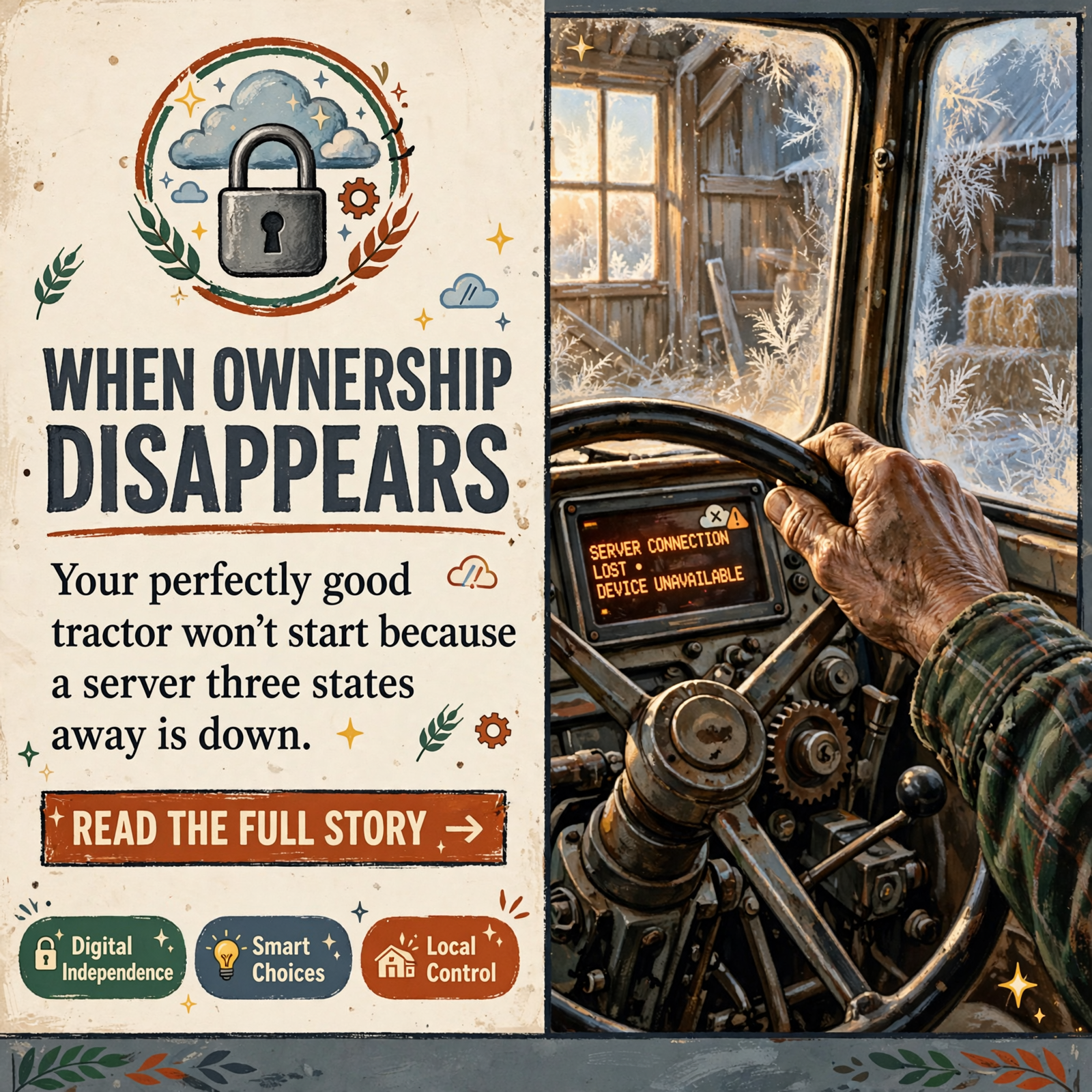
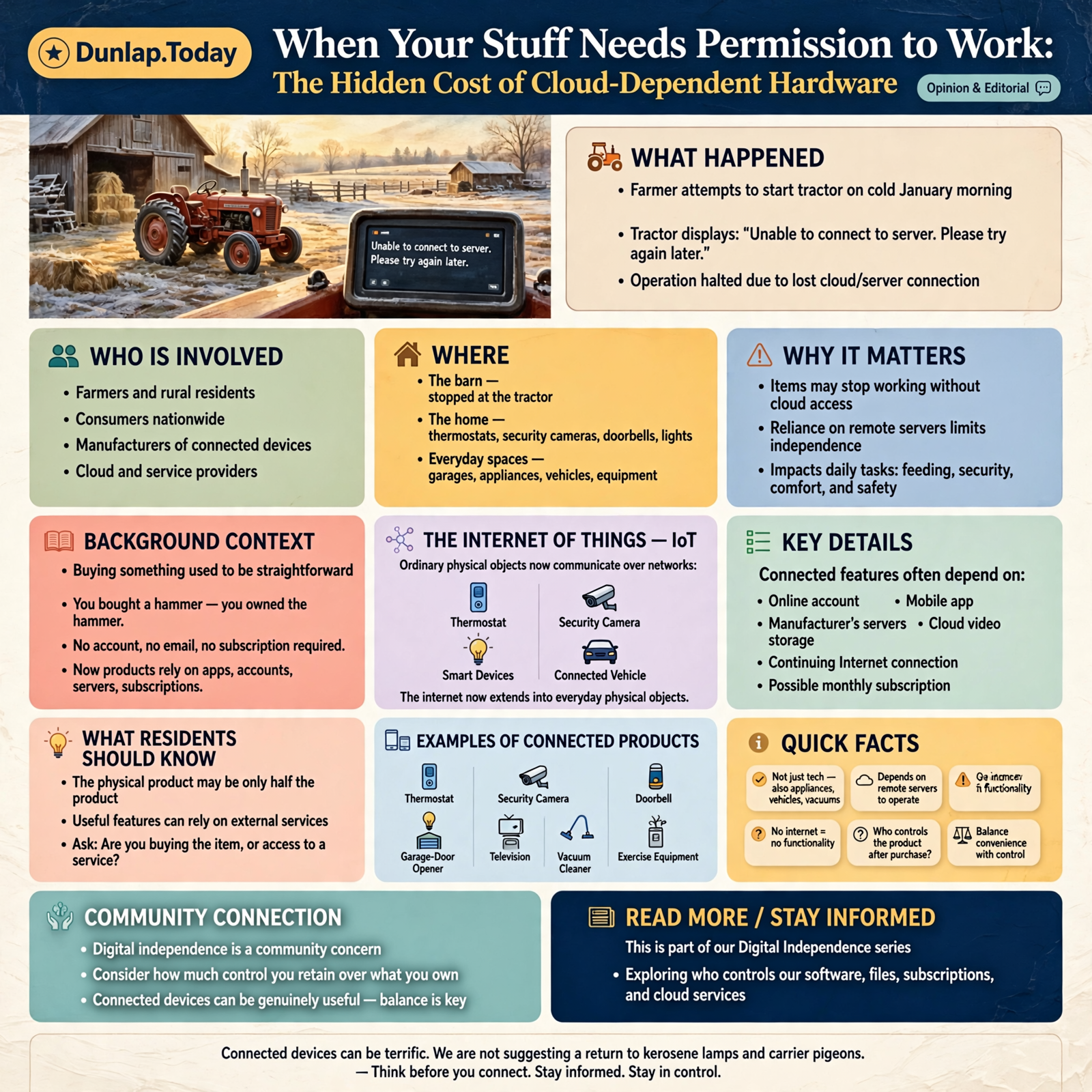
Imagine walking out to the barn on a cold January morning, climbing onto a perfectly good tractor, turning the key, and seeing this:
Unable to connect to server. Please try again later.
You turn the key again.
Same message.
The battery is good.
There’s fuel in the tank.
The engine is mechanically fine.
But apparently a computer three states away is having a rough morning, so you’re not feeding cattle until further notice.
I suspect most farmers would have some observations about that arrangement.
Several of those observations probably wouldn’t survive editing for a family newspaper.
Yet we’ve gradually accepted something surprisingly similar with a growing number of products in our homes.
Thermostats.
Security cameras.
Doorbells.
Light bulbs.
Televisions.
Garage-door openers.
Vacuum cleaners.
Appliances.
Vehicles.
Exercise equipment.
And assorted gadgets that apparently became unhappy being merely useful and decided they needed Wi-Fi.
Connected devices can be terrific.
I am not suggesting we return to kerosene lamps and carrier pigeons.
But our Digital Independence series has spent a lot of time asking who controls our software, files, subscriptions, and cloud services.
There is another question worth asking:
Who controls the physical thing after we buy it?
Buying Something Used to Be Pretty Straightforward

For most of history, ownership was easy to understand.
You bought a hammer.
You owned a hammer.
The hammer company did not create an account for you.
The hammer did not need your email address.
There was no Hammer Premium subscription.
You did not receive a notice six months later explaining that:
Basic striking functionality will remain free, but Nail Detection Plus is moving to our Premium Hammer Plan.
You bought the hammer.
You hit things with it.
End of relationship.
Modern connected products can create a very different bargain.
The Physical Product May Be Only Half the Product

Suppose you buy a smart security camera.
The camera is physically attached to your house.
You paid for it.
But many of its useful features may depend upon:
- An online account
- A mobile app
- The manufacturer’s servers
- Cloud video storage
- A continuing Internet connection
- Possibly a monthly subscription
So what did you actually buy?
A camera?
Or a camera-shaped doorway into somebody else’s service?
Sometimes the answer is:
both.
And that’s where consumers need to understand the arrangement.
Welcome to the Internet of Things

Computer people use the phrase Internet of Things, commonly shortened to IoT.
That sounds much more mysterious than it is.
It basically means ordinary physical objects that can communicate over networks.
A thermostat connected to the Internet is part of the Internet of Things.
So is a camera.
A smart plug.
A connected washing machine.
A vehicle sending information to an online service.
The Internet escaped from the computer and started climbing into everything else.
Why Would I Want My Thermostat on the Internet?
Because connected devices can be genuinely useful.
A smart thermostat might let you:
- Adjust the temperature while you’re away
- Create schedules
- Monitor energy use
- Receive alerts
- Integrate with other home systems
A security camera might let you see your house while you’re traveling.
A doorbell camera might tell you somebody left a package.
A water sensor might warn you about a leak before your basement becomes an indoor swimming pool.
A connected appliance might alert you to a problem.
These are real benefits.
The question isn’t whether connectivity has value.
It obviously can.
The question is:
What happens when the connection goes away?
The Internet-Outage Test

This is the simplest test you can apply to almost any connected device.
Ask:
If the Internet goes down for twelve hours, what still works?
A good answer might be:
Everything important still works locally. I just lose remote access until the Internet returns.
That’s a fairly resilient design.
A less comforting answer is:
Well, the device becomes decorative.
Some features naturally require the Internet.
You obviously cannot view your home camera from Florida if your Tennessee house has no Internet connection.
That’s physics, not bad design.
But perhaps the camera should still record locally.
Perhaps the thermostat should still control the furnace.
Perhaps the light switch should still turn on the light.
Those distinctions matter.
The Company-Disappears Test

Here’s another question:
What happens if the company stops supporting this device?
Not tomorrow necessarily.
Five years from now.
Ten years from now.
The hardware may still be perfectly good.
But what if:
- The app disappears?
- The online account system closes?
- The company is sold?
- The servers shut down?
- The manufacturer decides the product is too old to support?
Does the device retain useful local functions?
Or does your perfectly good piece of hardware become an electronic paperweight?
The Light Bulb Should Probably Still Be a Light Bulb
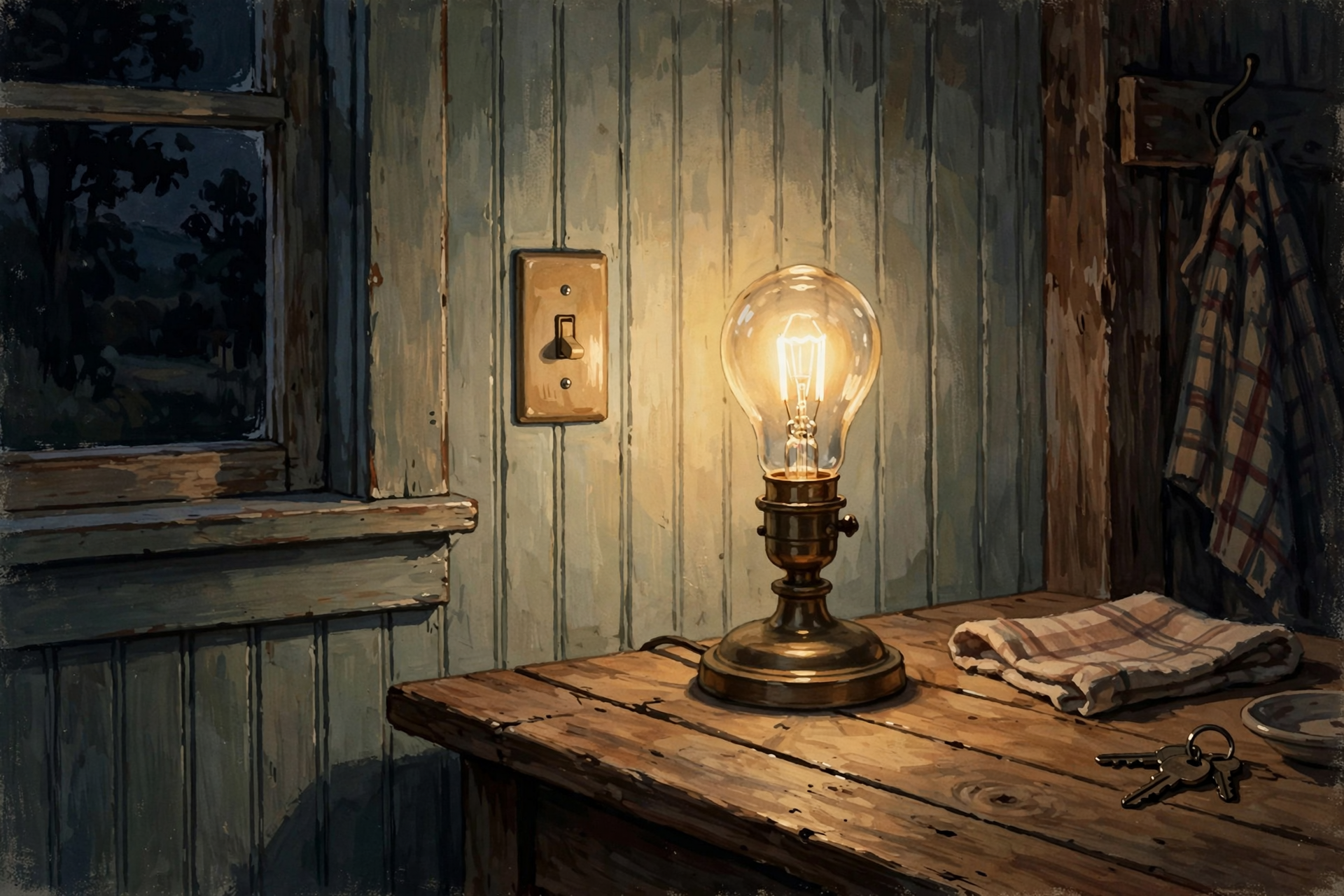
This is my personal threshold for sanity.
Smart features can enhance a basic product.
They should not unnecessarily eliminate the basic product.
A smart bulb may have:
- Dimming
- Schedules
- Color control
- Voice commands
Wonderful.
But if the Internet fails, I would still like:
LIGHT ON.
LIGHT OFF.
I don’t think that’s asking too much from civilization.
Local Control Is the Hardware Version of Local-First Computing
Earlier in this series, we talked about local-first computing.
The basic idea was:
Your important digital tools should remain useful locally, while the Internet adds synchronization, sharing, backup, or other capabilities.
Connected hardware can follow the same philosophy.
Local control means important functions can occur inside your home, business, or device without every command traveling through a distant manufacturer’s server.
For example:
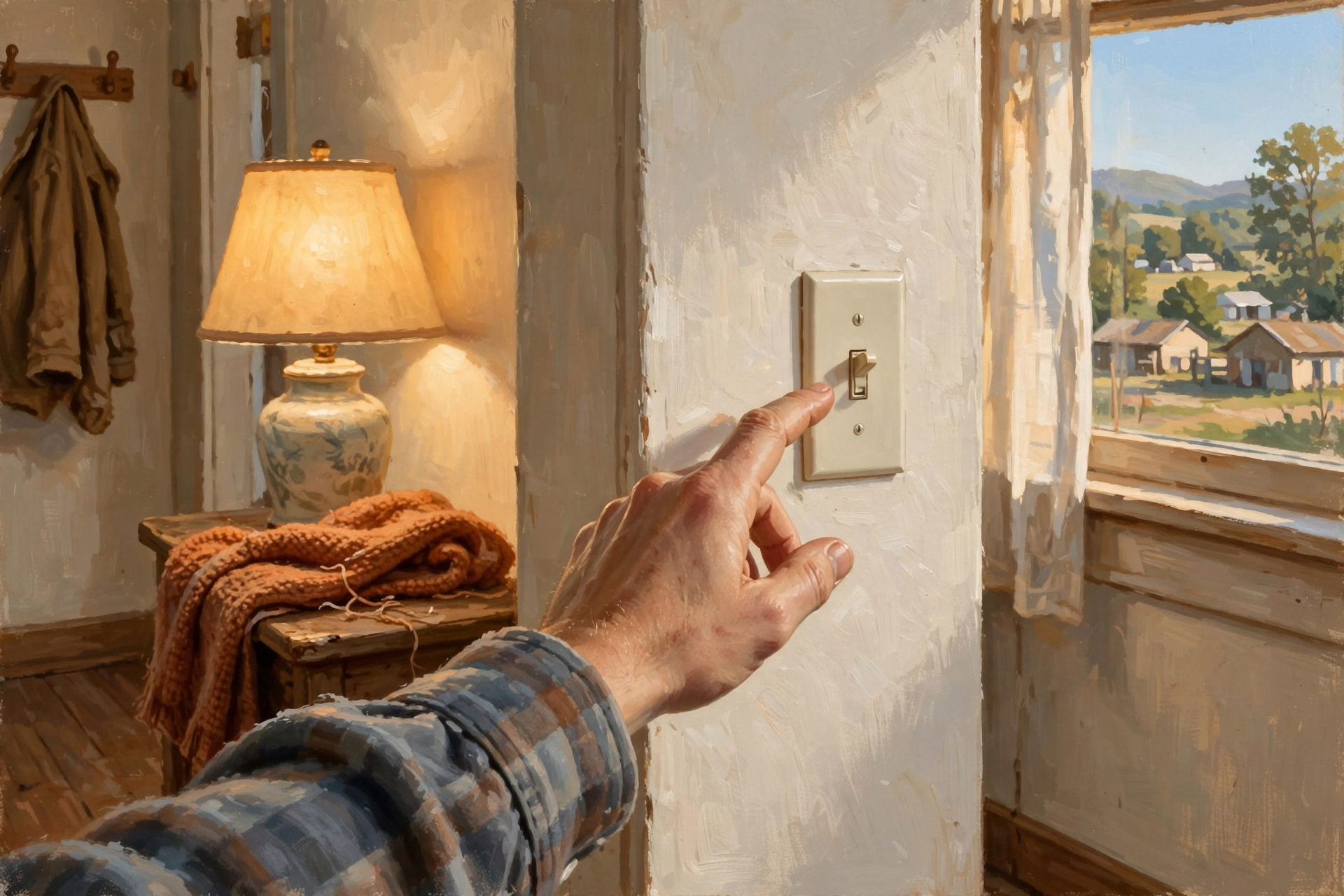
You press a wall switch.
The light responds directly.
Your local home system can still automate it.
The Internet may add remote access.
But the basic job doesn’t depend entirely on a trip through the cloud.
Imagine Sending the Light Switch Through Nashville

You walk into the kitchen in Dunlap.
You flip the switch.
The command travels across the Internet to a server in Nashville.
The server says:
Yes, Tom would indeed like the kitchen light on.
The command returns to Dunlap.
The light turns on.
That may happen fast enough that you never notice.
But philosophically, that’s an awfully long trip to accomplish what a piece of copper wire has been doing rather reliably for generations.
There may be good reasons for cloud involvement.
There may also be good reasons not to require it for every basic action.
The Subscription Test
Article 12 looked at the $9.99 economy.
Connected hardware gives us another version of that problem.
You buy the physical object.
Then discover certain capabilities require continuing payments.
Perhaps:
- Video history requires a subscription
- Advanced alerts require a subscription
- Cloud storage requires a subscription
- Analytics require a subscription
- Premium automation requires a subscription
Again, this is not automatically unreasonable.
Cloud storage costs money to operate.
Servers cost money.
Ongoing services cost money.
The important question is:
What did I think I was buying?
The Price Tag May Not Be the Whole Price

A $99 camera with a $10 monthly subscription isn’t really a $99 purchase if you expect to use the paid features for five years.
That’s roughly:
$99 for the hardware
plus:
$600 in subscription payments.
Now you’re comparing a roughly $700 relationship with other alternatives.
That might still be an excellent value.
But now you’re making the comparison with the right number.
Ask What Happens If You Stop Paying

This is one of the most useful questions before purchasing any subscription-connected device.
If you cancel the monthly service:
- Does the device still function?
- Can you still view live video?
- Does it still record anything?
- Do basic controls remain?
- Can you access local storage?
- Do alerts still work?
The answer tells you whether the subscription is an enhancement or a dependency.
There Is a Difference Between Paying for Service and Paying to Unlock Hardware

This distinction will matter more in the future.
Paying monthly for ongoing cloud storage makes intuitive sense.
Somebody has to operate the servers.
Paying indefinitely to activate a component already physically installed in something you bought may feel different.
Neither arrangement is automatically illegitimate.
But consumers should understand which kind of bargain they’re entering.
Cars Are Becoming Computers With Wheels

Vehicles demonstrate how complicated this subject can become.
Modern cars increasingly include:
- Software-controlled features
- Connected navigation
- Remote services
- Mobile applications
- Telematics
- Driver-assistance systems
- Over-the-air updates
Many of these features can improve safety, convenience, and maintenance.
Software updates can sometimes improve a vehicle after you buy it.
That’s remarkable.
But it also changes the traditional meaning of automobile ownership.
You may physically possess the machine while some capabilities continue depending on software, accounts, servers, or ongoing services.
The Mechanic Needs a Computer Now

There was a time when fixing a vehicle mostly required:
- Tools
- Parts
- Mechanical knowledge
- A vocabulary unsuitable for Sunday school
Modern repairs may also require:
- Diagnostic software
- Electronic calibration
- Computer access
- Manufacturer information
That’s not necessarily bad.
Modern vehicles are dramatically more sophisticated.
But sophistication can increase dependence.
This is why repairability belongs in the Digital Independence conversation too.
Can Somebody Other Than the Manufacturer Fix It?

This is a good ownership question.
Suppose the product breaks five years from now.
Can:
- You repair it?
- A local repair shop fix it?
- Parts be obtained?
- Another technician diagnose it?
Or is the manufacturer the only practical path?
The fewer repair choices you have, the more dependent your ownership becomes.
Repairability Has a Price
A cheaper device that becomes trash when one small component fails may ultimately cost more than a more expensive product designed to be repaired.
This is another example of something we’ve seen throughout this series:
purchase price and total cost are not the same thing.
Smart Appliances Deserve a Dumb Question

Before purchasing a connected refrigerator, washing machine, oven, or other appliance, ask:
What useful job does the Internet connection actually perform?
Maybe there’s a good answer.
The washing machine alerts you when the cycle finishes.
The freezer warns you when temperature rises.
The oven can be monitored remotely.
Fine.
But you don’t have to assume that adding Wi-Fi automatically improves every household object.
Not Everything Needs an App

I remain unconvinced that civilization was suffering terribly because lamps lacked user accounts.
Every app adds:
- Another account
- Another password
- Another company
- Another privacy policy
- Another thing that needs updating
- Another possible failure point
Sometimes the convenience is absolutely worth it.
Sometimes a switch is pretty dang efficient.
Convenience Versus Complexity

Connected products often trade physical simplicity for digital convenience.
You can operate something remotely.
Excellent.
But now the system may involve:
- The device
- Your home network
- Your Internet provider
- The company’s server
- Your account
- Your phone
- The mobile app
If something doesn’t work, which piece failed?
That matters particularly for people who don’t want their refrigerator becoming a networking project.
Older Adults May Bear More of the Complexity Cost

Our recent article on Digital Independence for Seniors discussed the burden of accumulating accounts and technology dependencies.
Connected devices can make this better or worse.
A smart device that automatically handles something useful may help an older person remain independent.
That’s tremendous.
A smart device requiring three accounts and weekly troubleshooting may do the opposite.
The right measure is not:
How advanced is this?
It’s:
Does this make the person’s life easier?
Accessibility Can Be a Strong Argument for Connected Devices

Voice control and automation can be enormously useful for people with limited mobility, vision problems, or other accessibility needs.
Turning lights on by voice may sound like a novelty to one person and be life-changing to another.
Remote monitoring may let family members help an older relative live independently longer.
Again, the technology is neither good nor bad in isolation.
The important thing is understanding the tradeoff.
Security Cameras Raise Another Question: Where Does the Video Go?
A connected camera produces information about your home, property, employees, visitors, or family.
Ask:
- Is video stored locally?
- Is it stored in the cloud?
- How long is it retained?
- Who can access it?
- What happens if the subscription ends?
You don’t need to become a cybersecurity specialist.
But you should have a basic understanding of where the recordings live.
Privacy Is Part of Ownership Too

A traditional doorbell knew very little about you.
It knew somebody pushed the button.
That’s about it.
A connected doorbell may potentially involve:
- Video
- Audio
- Motion events
- Account information
- Network information
That capability can provide tremendous value.
It also produces more information.
More information deserves more thought.
The Local Storage Question
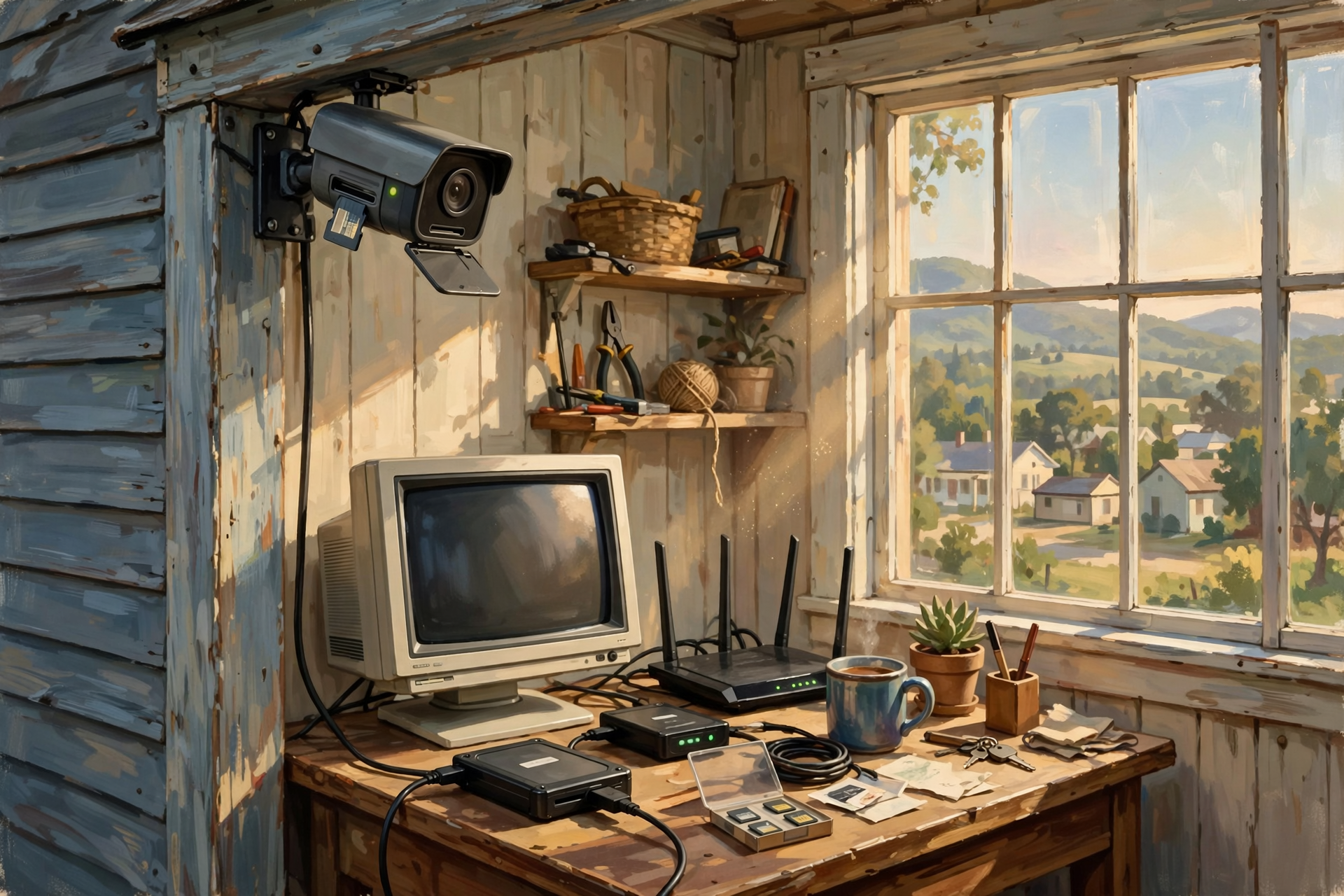
For cameras and similar devices, local storage can provide another option.
Some products can record to:
- A memory card
- A local hub
- A computer
- Network storage
This may reduce cloud dependence.
But it creates responsibility.
If the device gets stolen and the only recording was inside the device, that’s not ideal either.
Once again, a hybrid arrangement may be strongest.
Local recording plus appropriate remote backup can provide benefits from both approaches.
The Smart Home Doesn’t Need to Be One Big System

Technology companies love ecosystems.
Buy the thermostat.
Then the cameras.
Then the lights.
Then the speakers.
Then the locks.
Everything works beautifully together.
That can be convenient.
But it also concentrates dependence.
Before building an entire house around one platform, ask what happens if you eventually want to leave it.
Interoperability Is a Useful Word

Interoperability simply means different products or systems can work together.
In ordinary English:
My stuff doesn’t all have to come from the same company.
Products using broadly supported standards may give consumers more flexibility.
It isn’t always possible.
But it’s worth asking.
The Extension-Cord Test
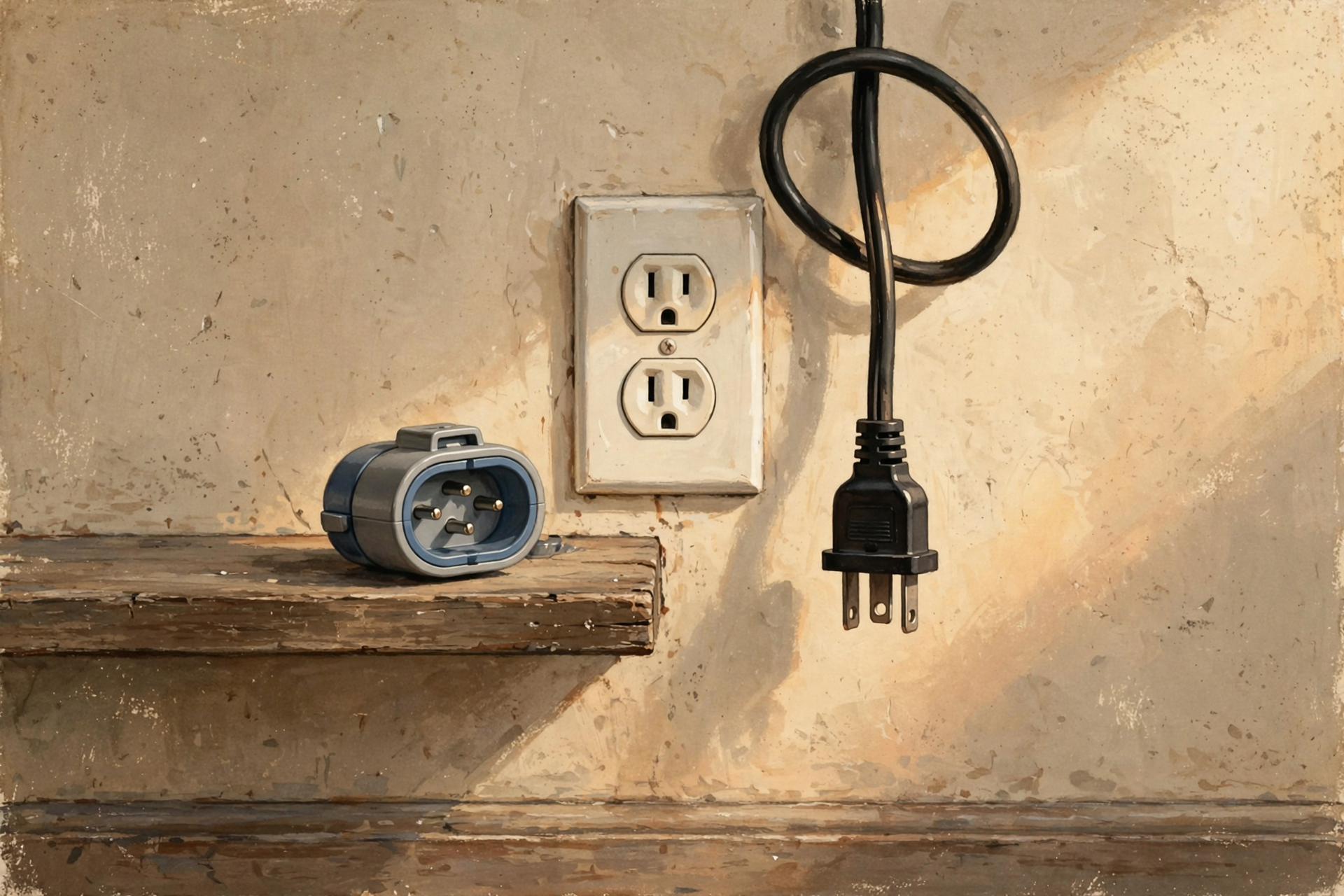
Imagine buying a power tool with a plug that fits only one company’s electrical outlets.
You’d probably ask:
“Why?”
We accept digital versions of that arrangement surprisingly often.
One special app.
One special cloud.
One special hub.
One special account.
Sometimes proprietary integration creates an excellent experience.
Sometimes it creates a very comfortable cage.
Small Businesses Need to Think About Connected Equipment Too

This isn’t merely a household issue.
Businesses increasingly use connected:
- Cameras
- Printers
- Scanners
- Point-of-sale equipment
- Machinery
- Access-control systems
- Sensors
- Vehicles
- Inventory equipment
Before making a connected device operationally important, ask:
What happens if its cloud service is unavailable?
A temporary inconvenience may be acceptable.
A complete shutdown of production may deserve a backup plan.
The Copier Should Not Close the Business
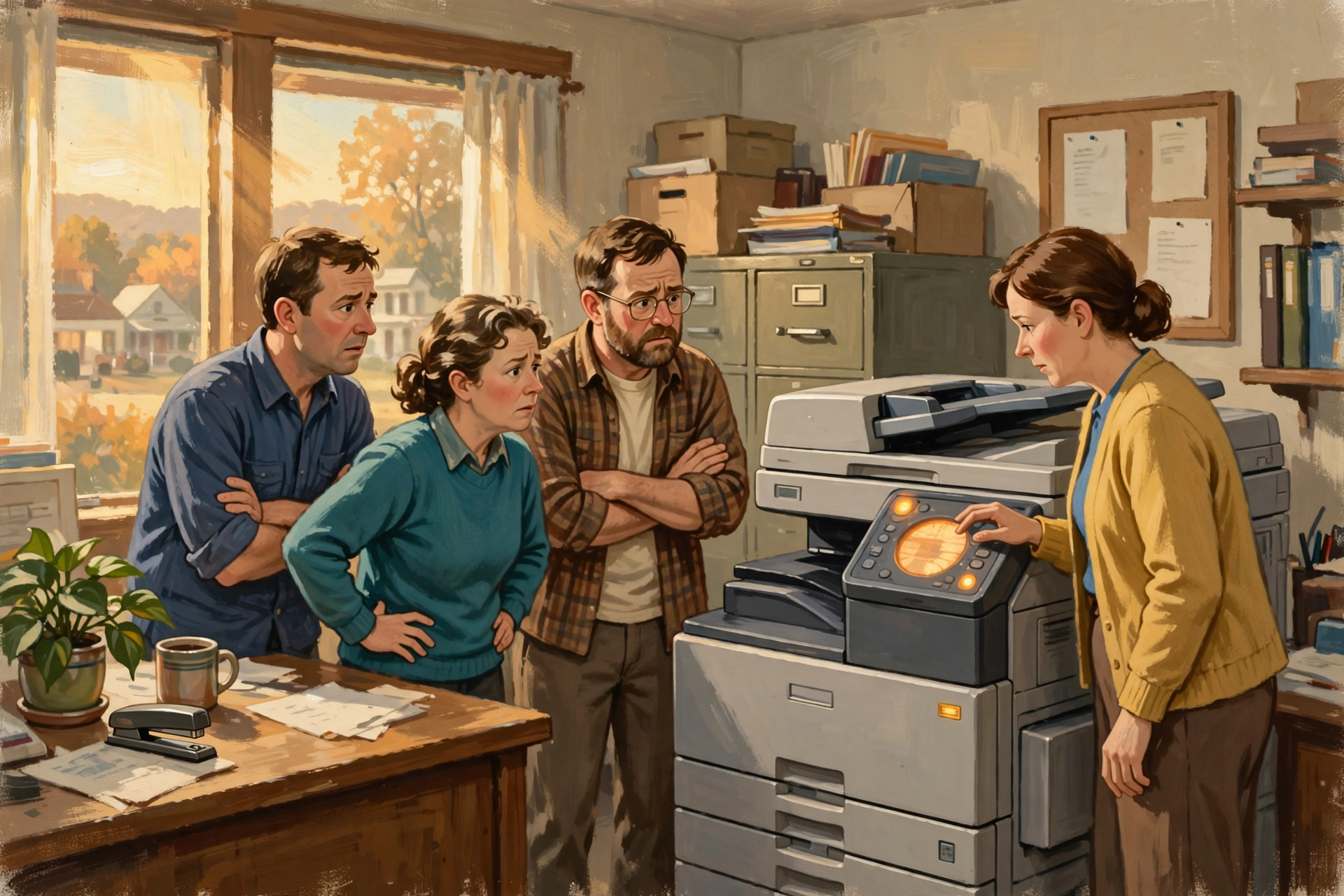
Every company has some device that becomes absurdly important.
The label printer.
The scanner.
The shipping station.
The credit-card terminal.
It works so reliably that nobody thinks about it.
Then it stops.
Suddenly twelve employees are standing around watching one blinking red light.
Technology planning means identifying these quiet dependencies before the light turns red.
Cloud Failure Is Only One Failure

A connected device can fail because of:
- The device itself
- Your Wi-Fi
- Your Internet connection
- The manufacturer’s server
- The app
- Your account
- A subscription problem
- A software update
More capability usually means more moving parts.
Again, that doesn’t make the product bad.
It means reliability should be evaluated as a system.
Updates Are Both a Benefit and a Risk
Connected products can receive updates after purchase.
That’s wonderful when updates:
- Fix security problems
- Improve reliability
- Add useful features
- Correct defects
But software updates can also change behavior.
This is another difference from traditional hardware.
Your physical product can become meaningfully different after you buy it.
Sometimes better.
Sometimes not.
Long-Term Support Matters More for Hardware
If an app disappears, you download another app.
If a $1,500 appliance loses software support, replacement is considerably more annoying.
For expensive connected hardware, ask:
- How long does the manufacturer generally support products?
- Does basic functionality survive after support ends?
- Are replacement parts available?
- Can the device be reset and used independently?
The more expensive and permanent the physical object, the more important those questions become.
The Right to Repair Is Really About Options

You don’t have to repair your own equipment to benefit from repairability.
I don’t rebuild automatic transmissions either.
What matters is having choices.
Can you choose:
- The manufacturer?
- An independent shop?
- A knowledgeable local technician?
- Yourself?
More repair options generally provide more resilience.
Digital independence keeps returning to the same idea:
options.
Sometimes the Cloud Is the Best Answer

Let’s not swing the pendulum too far.
A professionally operated cloud service may provide:
- Better remote access
- Better off-site storage
- Easier setup
- Automatic updates
- Strong integration
- Less maintenance
You may gladly trade some control for that convenience.
That’s perfectly rational.
Digital independence isn’t maximum local control.
It’s informed choice.
The Dumb Product Can Sometimes Be the Smart Purchase

Suppose you’re choosing between:
A perfectly good traditional appliance.
And a connected appliance with an app, account, cloud service, software updates, and features you’ll use twice.
The simpler product may have:
- Fewer failure points
- Less privacy exposure
- No account dependency
- No subscription
- Easier repairs
That’s not being anti-technology.
That’s selecting the technology appropriate to the job.
And Sometimes the Smart Product Is Clearly Better

A water-leak sensor that texts you while you’re traveling could save thousands of dollars.
A remotely adjustable thermostat might improve comfort and reduce energy use.
A connected medical or accessibility device might help somebody live independently.
A security system might provide tremendous peace of mind.
Usefulness wins.
Not ideology.
Wisdom From the Front Porch

If the Internet makes the tool better, that’s useful.
If the Internet is the only reason the tool works at all, you ought to understand the arrangement before buying it.
That’s the heart of this article.
You don’t have to reject connected products.
You simply need to know where the connection fits into ownership.
The Five Questions to Ask Before Buying a Smart Device

- What still works if the Internet is down?
- What still works if I cancel the subscription?
- What happens if the manufacturer stops supporting the product?
- Can the device work locally?
- Can somebody besides the manufacturer repair or replace important parts?
Those five questions will tell you more about long-term ownership than most glossy packaging ever will.
For Expensive Products, Add Five More

- Where is my data stored?
- Can I export important information?
- Are ongoing fees required?
- Does the product use broadly supported standards?
- What is the realistic total cost over five or ten years?
Now you’re shopping for the relationship rather than merely the box.
Plain-English Glossary
Internet of Things
Physical devices that connect to networks or the Internet to exchange information or provide connected features.
IoT
An abbreviation for Internet of Things.
Smart Device
A physical product containing computing and communications technology that adds functions such as remote control, automation, monitoring, or Internet connectivity.
Cloud-Dependent Device
A device whose important functions rely partly or entirely on remote servers operated by a provider.
Local Control
The ability to operate a device directly within your home, business, or local network without requiring every command to travel through an outside Internet service.
Interoperability
The ability of products from different systems or manufacturers to communicate or work together.
Firmware
Software built into a physical device that controls how the device operates.
Remote Access
The ability to monitor or control a device from another location, usually through the Internet.
Repairability
How practical it is to diagnose, obtain parts for, and repair a product rather than replacing the entire device.
Total Cost of Ownership
The complete cost of using something over time, including the purchase price, subscriptions, maintenance, repairs, energy, and other ongoing costs.
The Dunlap.Today Smart Device Checklist

- ☐ I know which functions require an Internet connection.
- ☐ I know which functions continue working offline.
- ☐ I know whether a subscription is required.
- ☐ I know what disappears if I cancel the subscription.
- ☐ I have calculated the likely multi-year subscription cost.
- ☐ I know where important device data or recordings are stored.
- ☐ I know whether useful local storage is available.
- ☐ I understand what happens if the manufacturer stops supporting the product.
- ☐ I have considered whether local control matters for this particular device.
- ☐ I know whether replacement parts are reasonably available.
- ☐ I know whether an independent technician can repair the product.
- ☐ I have considered whether I am becoming dependent on one manufacturer’s entire ecosystem.
- ☐ The smart features solve a real problem rather than merely creating another app.
- ☐ For critical business equipment, I know what happens during an Internet or provider outage.
Frequently Asked Questions

What is a cloud-dependent device?
It is a physical device whose important features rely on remote Internet services operated by another company. The device may still have some local functionality, or it may become substantially less useful when the cloud service is unavailable.
Are smart devices bad for digital independence?
No. Connected devices can provide valuable remote control, accessibility, automation, monitoring, security, and convenience. Digital independence means understanding the dependencies and deciding whether the benefits justify them.
Should a smart thermostat still work without Internet access?
For most households, retaining basic local temperature control during an Internet outage is highly desirable. Remote access and other online features naturally require connectivity, but essential local functions are worth examining before purchase.
Why do smart devices have subscriptions?
Some connected services involve continuing costs such as cloud storage, remote servers, analytics, support, and software development. A recurring charge may therefore be reasonable when it pays for a genuine continuing service.
How do I compare the true cost of two smart devices?
Include the purchase price plus expected subscription charges, accessories, storage, replacement parts, and likely maintenance over the period you expect to own the product.
What is local control?
Local control means commands and basic functions can operate within your own device, home, or local network instead of depending entirely on a remote Internet service.
Is local control always better than cloud control?
No. Cloud services can make remote access, storage, updates, collaboration, and maintenance much easier. A hybrid approach combining reliable local functions with useful cloud features can often provide the best balance.
What happens if a smart-device company goes out of business?
That depends on the product. Devices with substantial local functionality may continue providing useful service, while products heavily dependent on the manufacturer’s servers can lose features or potentially stop functioning. This is worth researching before buying expensive connected hardware.
Should I avoid buying devices that require apps?
Not necessarily. An app may provide excellent functionality. Consider whether the app adds enough value to justify the extra account, software dependency, and potential long-term support requirement.
What’s the simplest question to ask before buying a connected product?
Ask: “If the Internet and the manufacturer’s app both disappeared tomorrow, what would this thing still do?” The answer gives you a surprisingly good picture of how much of the product you truly control.
The Smartest House Isn’t Necessarily the House With the Most Apps

A truly smart home should make life easier.
It should:
- Reduce work
- Improve comfort
- Improve safety
- Save time
- Improve accessibility
- Provide useful information
If it instead creates:
- More passwords
- More subscriptions
- More troubleshooting
- More dependence
perhaps we’ve confused intelligence with complexity.
The same principle applies to businesses.
Technology should support the work.
The work should not become supporting the technology.
The Bottom Line

Buying a physical object used to answer the ownership question pretty clearly.
Now the answer can be more complicated.
You may own the camera.
But rent the storage.
You may own the thermostat.
But depend on the app.
You may own the appliance.
But depend on software updates.
You may own the vehicle.
But some capabilities may depend on continuing digital services.
None of that is automatically bad.
In many cases, the connected version is genuinely better.
Just understand what you’re buying.
Ask what works offline.
Ask what happens when you stop paying.
Ask how long the device is likely to be supported.
Ask whether somebody else can repair it.
Ask whether the smart feature solves a problem you actually have.
And perhaps most importantly:
Make sure the thing you bought can still do its basic job without asking a server in another state for permission.
Because sometimes the smartest feature a product can have is simply:
It still works.




0 Comments